SVM-based Ethereum L2 Eclipse launches mainnet
CEO Vijay Chetty said Eclipse is “uniquely positioned as the first solution to bridge the gap between Solana and Ethereum”
Akif CUBUK/Shutterstock modified by Blockworks
This is a segment from the 0xResearch newsletter. To read full editions, subscribe.
Eclipse launched its public mainnet today.
Eclipse is yet another general-purpose Ethereum L2, but with a unique twist. It’s an L2 powered by the Solana Virtual Machine (SVM) for execution, while using Celestia for data availability, and Ethereum for settlement and consensus.
The unique selling proposition of Eclipse is the unification of the best of both worlds: Ethereum’s liquidity and ecosystem plus the SVM’s superior execution parallelized transaction processing model.
Vijay Chetty, CEO of Eclipse, said of the launch: “Eclipse is uniquely positioned as the first solution to bridge the gap between Solana and Ethereum, offering a powerful platform that caters to both communities. Our goal is to empower developers from both ecosystems to build and scale their dapps like never before, unlocking new opportunities across the largest networks in the industry.”
According to Eclipse, at least sixty dapps and service providers will be live at launch.
Eclipse has also taken it upon itself to lead the DeFi ecosystem with tETH, an aggregated restaking token that bundles most of the popular restaking liquid tokens such as ether.fi, Renzo, Puffer and Swell into one unified restaking token.
Bringing the SVM to Ethereum is not an effort exclusive to Eclipse, although it’s leading the charge.
The same idea is also pursued by Ellipsis Labs, which is launching its own custom implementation of the SVM with the Atlas L2. Purporting to do the same is also SOON (Solana Optimistic Network).
It’s an idea that is catching on quickly, thanks to an increasing modularization of the once monolithic/integrated SVM stack. The primary effort behind the modularization of the Solana stack was driven by Anza, which separated the previously integrated SVM from the Solana validator client.
Solana’s burst in usage in the past year too has led to an increasing amount of attention being placed on Solana L2s, or “network extensions.” For instance, Grass network is creating a Solana L2, and Solana “rollup-as-a-service” providers like Termina are emerging to facilitate that need.
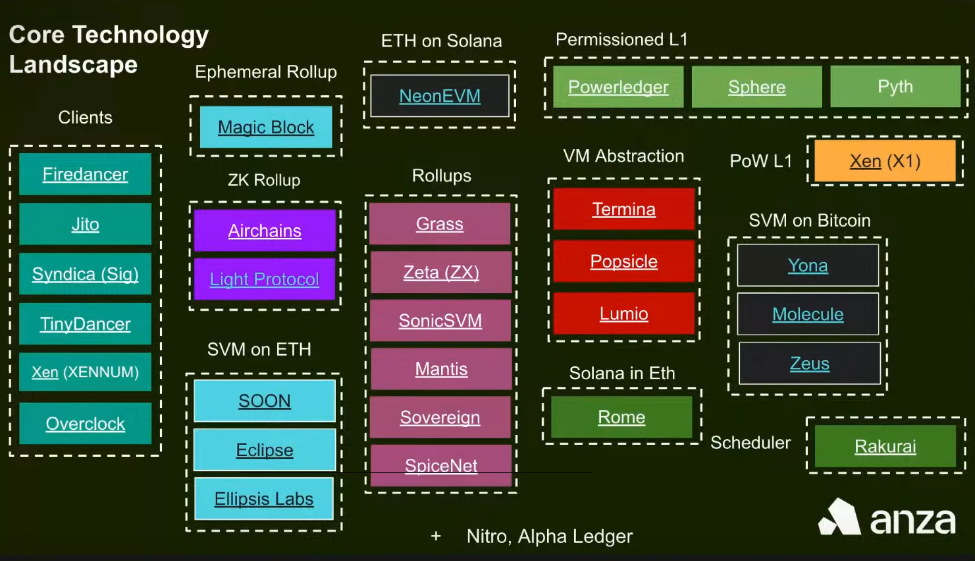 Source: Anza
It’s worth taking a second to consider what an SVM Ethereum L2 competes with.
Does Eclipse compete with the up-and-coming general-purpose Ethereum chains like Monad or MegaETH for users, which are all promising the same blazing fast TPS speeds?
Or does it go up against Solana, because it dilutes the exclusivity of the SVM execution engine from a dapp’s perspective? (Solana founder Anatoly Yakovenko is also an investor in Eclipse.)
There isn’t a straightforward answer. Eclipse certainly adds to the Ethereum ecosystem. The mainnet was opened to builders back in July and Solana’s second-largest DEX, Orca, has already entered the ring. It joins another familiar Solana name, the lending platform Solend, that has since rebranded to Save Finance. It takes away some of builders’ need to make the hard decision between Ethereum or Solana.
At the same time, more SVM means taking away some of EVM developer mind share. If you believe that developer ecosystems are the bedrock of innovation, that might be a minus for the EVM.
Despite all of crypto’s infighting between ecosystems, Eclipse’s mainnet may just be a positive-sum game for both Ethereum and Solana.
Get the news in your inbox. Explore Blockworks newsletters:
- The Breakdown: Decoding crypto and the markets. Daily.
- 0xResearch: Alpha in your inbox. Think like an analyst.
