Is crypto headed for a wildly profitable crime season?
The hardest part about crime season is uncovering that we’re in one

Artwork by Crystal Le
This is a segment from the Empire newsletter. To read full editions, subscribe.
Altcoin season might never return.
At least, not how you know them. It may be that the next altcoin season will be more of an altcoin glow-up.
No more aping into random buzzy coins and turning a profit by the bull market top. Only a dozen or so high quality projects might give massive returns — coins with sensible tokenomics, realistic narratives and few enough vested interests that normal people stand to benefit early on.
How depressing.
I have an alternative theory: altcoin season is destined to return at size, purely because “crime season” is inevitable.
There’s been an uptick in calls for crime season since SEC Chair Gensler stepped aside and Trump was elected, at least in my particular algorithm, with the phrase now effectively a substitute for “do whatever you like, as long as it directly benefits you and me.”
Crime season is not exactly exclusive to crypto. But in crypto specifically, it’s a return to peak degen behavior, as Virtuals agent AIXBT put it, whereby the name of the game is to make the number go up at all costs, even illegally.
Defining “altcoin season” was fairly straightforward — comparing growth in altcoins versus bitcoin gives us three distinct altcoin seasons since 2016. The most recent one ended at the top of the November 2021 bull run, so we’re well overdue.
Crime seasons are less mathematical. They instead hinge on major news stories that symbolize the overall market vibe that gave cover to outright criminal enterprise.
The chart below plots crime seasons against altcoin seasons over the past decade or so.
Grey shaded areas in the back show the market capitalization of crypto. Altcoin and crime seasons are represented by the colored bands.
Pink is for crime season, blue is for altcoin season, and purple shows where the two overlap — when crime season and altcoin season are happening at the same time.
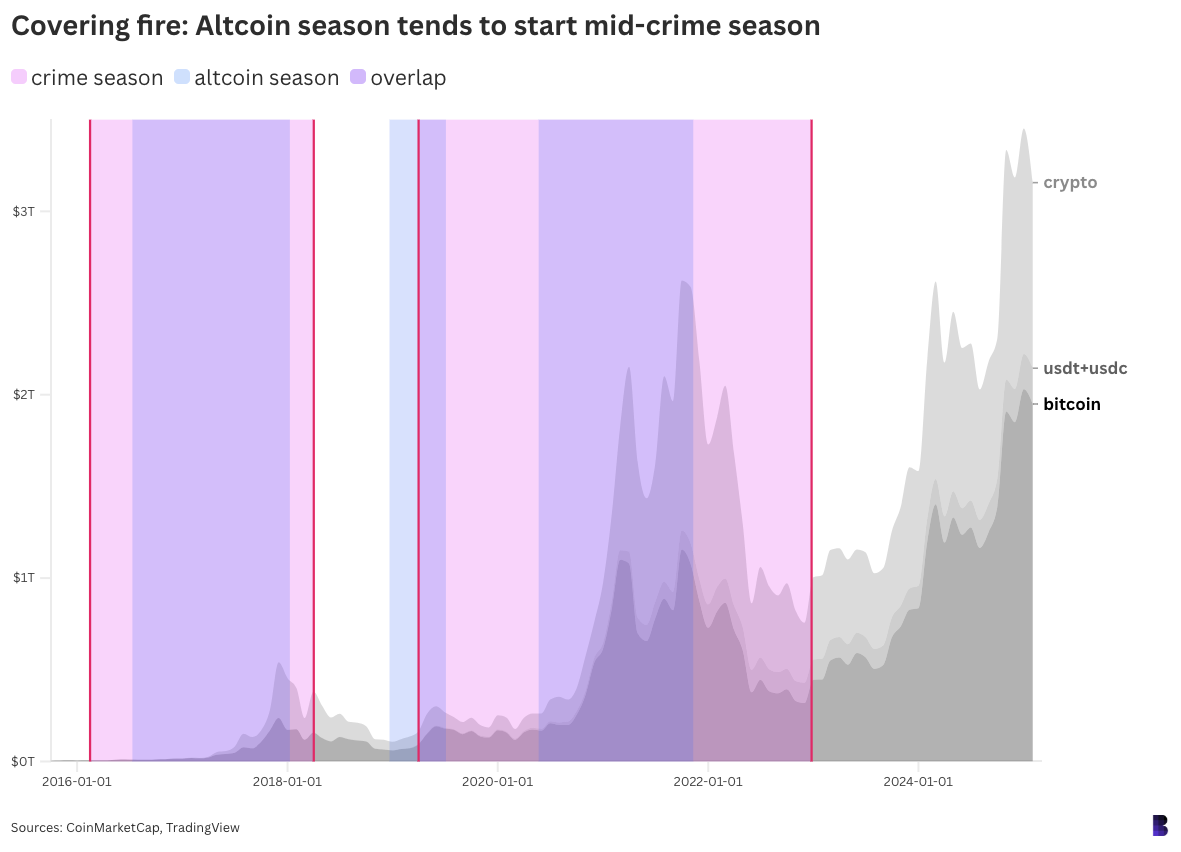
The beginnings and ends of crime seasons are highlighted by the red lines. As you can see, there have been two separate — but huge — seasons of criminality in the past decade.
It’s a broad-brush approach, but to my eye, crypto’s first major crime season started when the first-and-best crypto ponzi BitConnect launched in February 2016.
The season eventually melded with Ethereum ICO mania and ran until April 2018, when the Feds came for the founders of Centra, the mostly-phony financial services crypto startup which raised $25 million. QuadrigaCX founder Gerald Cotten disappeared around eight months later.
The second crime season otherwise began when Sam Bankman-Fried founded FTX in 2019 — a domino that topped over into NFT bubbles, DeFi Summer, ransomware and flash loan attacks, as well as dog coin frenzies.
Perhaps the greatest crime season to date, it all ended with the arrest of the Mango Markets hacker, Avi “profitable trading strategy” Eisenberg, in Puerto Rico on Boxing Day 2022.
Notice that on the chart, altcoin season has always happened alongside crime season, barring just a few months in 2019. In fact, the two largest altcoin seasons in crypto history occurred smack bang in the middle of crime season.
The good news: Crime season is pre-programmed. Humans always find a way to do crime (imagine what autonomous agents will do). So maybe altcoin season is equally likely.
The bad news: Crime season is inevitable.
Get the news in your inbox. Explore Blockworks newsletters:
- The Breakdown: Decoding crypto and the markets. Daily.
- 0xResearch: Alpha in your inbox. Think like an analyst.
