ETP: Exchange-traded patience
Canary CEO Steven McClurg has “a high level of confidence” there’ll be more spot crypto ETFs in the US market this year

Wit Olszewski/Shutterstock modified by Blockworks
This is a segment from the Forward Guidance newsletter. To read full editions, subscribe.
After the 2024 launches of US bitcoin and ether ETFs, proposals for funds holding solana, XRP and even HBAR surfaced. Others would, if greenlit, diversify across multiple coins.
There was also a litecoin ETF plan from Canary Capital Group that the firm amended this week. Nasdaq submitted a 19b-4 form on Canary’s behalf — with some considering this step a positive sign for the product’s fate.
Canary CEO Steven McClurg told me he has “a high level of confidence” there’ll be more spot crypto ETFs in the US market this year, declining to get too specific.
We’ve heard industry watchers offer their “when, not if” optimism. But as the proposal stack grows bigger on the proverbial SEC desk (we’re in the digital filing age, didn’t you know?), the key question is what exactly it will take for these to get the go-ahead.
And with a new SEC administration, are we talking weeks, months or years?
Bloomberg Intelligence’s James Seyffart (who spoke with me and Felix recently) noted on X that a litecoin ETF could see the light of day before SOL and XRP offerings.
One of the reasons would be that the SEC — in lawsuits against Coinbase and Binance, for example — has not labeled litecoin as a security.
It did however put SOL in that securities category. And you know about the agency’s legal battle with Ripple. If you need a refresher, Casey yesterday detailed the SEC moving forward with an appeal in that case.
ETF.com analyst Sumit Roy agreed an LTC ETF may have better odds due to “its simpler use case and history,” avoiding some regulatory scrutiny tied to XRP and SOL. He added that approval in 2025 is possible.
“That said, the SEC remains cautious about market manipulation and custody risks, which apply to all crypto ETFs,” Roy told me.
Beyond the young US spot crypto products, today is the seven-year anniversary of the Amplify Transformational Data Sharing ETF (BLOK) coming to market.
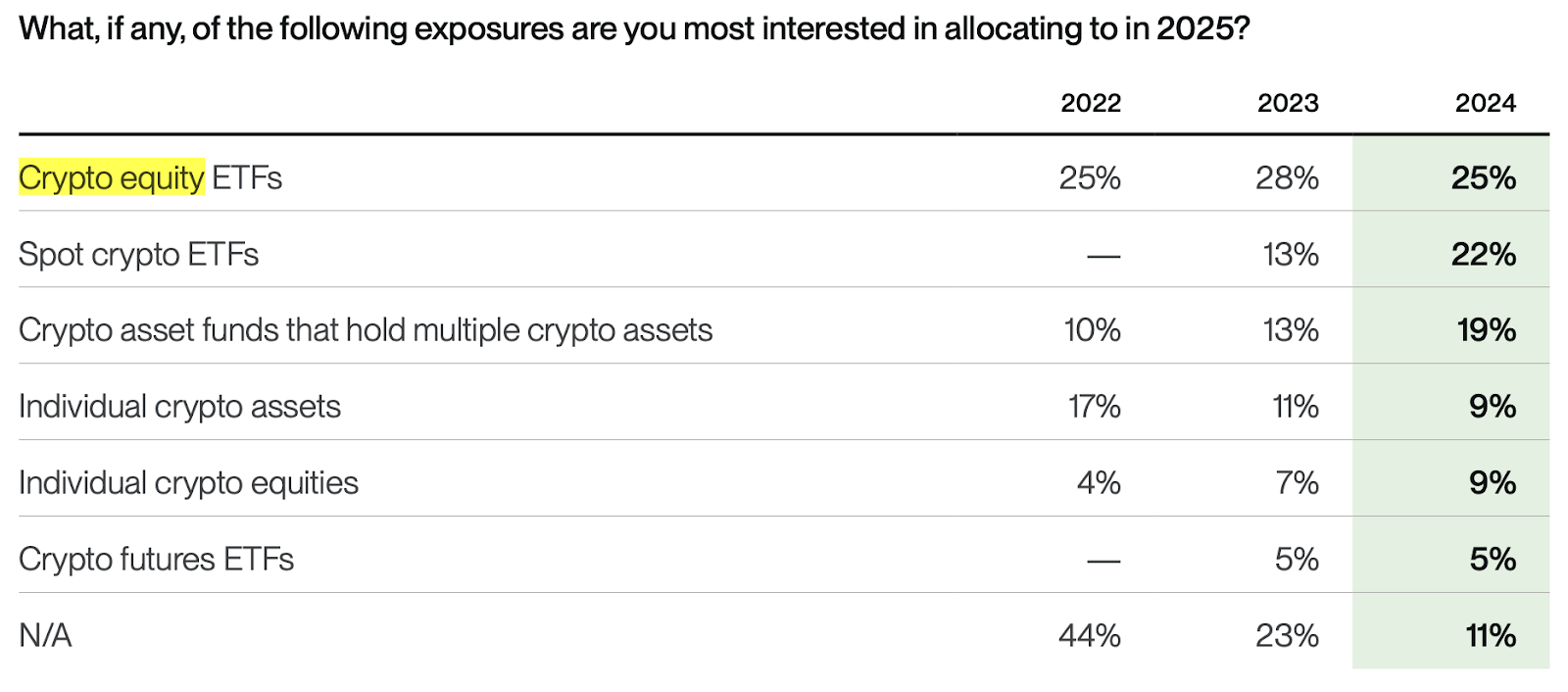
Crypto equity ETFs remain a key way advisers plan to get exposure to the space (see Bitwise/VettaFi survey results below), so I’ll be interested to see what sort of flows this fund notches in 2025. Its assets under management stand just shy of $1 billion.
We could see new holdings for BLOK when more crypto- and blockchain-related companies go public. But for now, BLOK co-portfolio manager Dan Weiskopf told us he’s watching miners delving deeper into the AI segment and companies buying/holding BTC.
BLOK’s top five holdings are currently Galaxy, Robinhood, Core Scientific, Coinbase and MicroStrategy.
The six-spot goes to Metaplanet, a Japan-based MicroStrategy Jr. of sorts that has said it intends to up its bitcoin holdings to 10,000 BTC this year.
Get the news in your inbox. Explore Blockworks newsletters:
- The Breakdown: Decoding crypto and the markets. Daily.
- 0xResearch: Alpha in your inbox. Think like an analyst.
