The Fed committed to pausing rate cuts. Why?
Looking at data points that hint at a labor market that continues to remain in balance

rarrarorro/Shutterstock modified by Blockworks
This is a segment from the Forward Guidance newsletter. To read full editions, subscribe.
The FOMC meeting was yesterday, and not a whole lot happened.
The Fed committed to pausing rate cuts for this meeting, as has been priced into the SOFR curve for many months now.
As is always the case for FOMC meetings, the statement comes out first before Fed watchers comb through it to sort out what new changes have been made.
Interestingly, a shift in language was made around how they’re viewing inflation:

Initially, this sent risk assets lower on the interpretation of a more hawkish Fed. Shortly after however, during the press conference, Chair Powell mentioned that this was simply them cleaning up language and shouldn’t be taken as a change in policy stance. This then sent risk assets in the opposite direction — higher. What a whipsaw!
This whipsaw showcases just how important it is to discern which side of the dual mandate the Fed is prioritizing at any given time. So with that in mind and no meeting until March, let’s take a look at where the economic data stands:
Labor market
Today we received the weekly initial jobless claims data, some of the most up-to-date and high frequency labor market data that we can get our hands on. Notably, we saw a major down-move in claims:

Further, we saw continuing claims continue to flatten out:

Overall, these data points hint at a labor market that continues to remain in balance and has no cause for concern from the Fed.
Growth
Achieving solid economic growth without inflation being its driver is the golden goose of central banking. When it happens, it’s magic.
Today, we received preliminary GDP growth data that shines a light on an economy that remains solid.
Although the print came in at 2.3%, below the consensus of 2.6%, the underlying drivers remain solid.
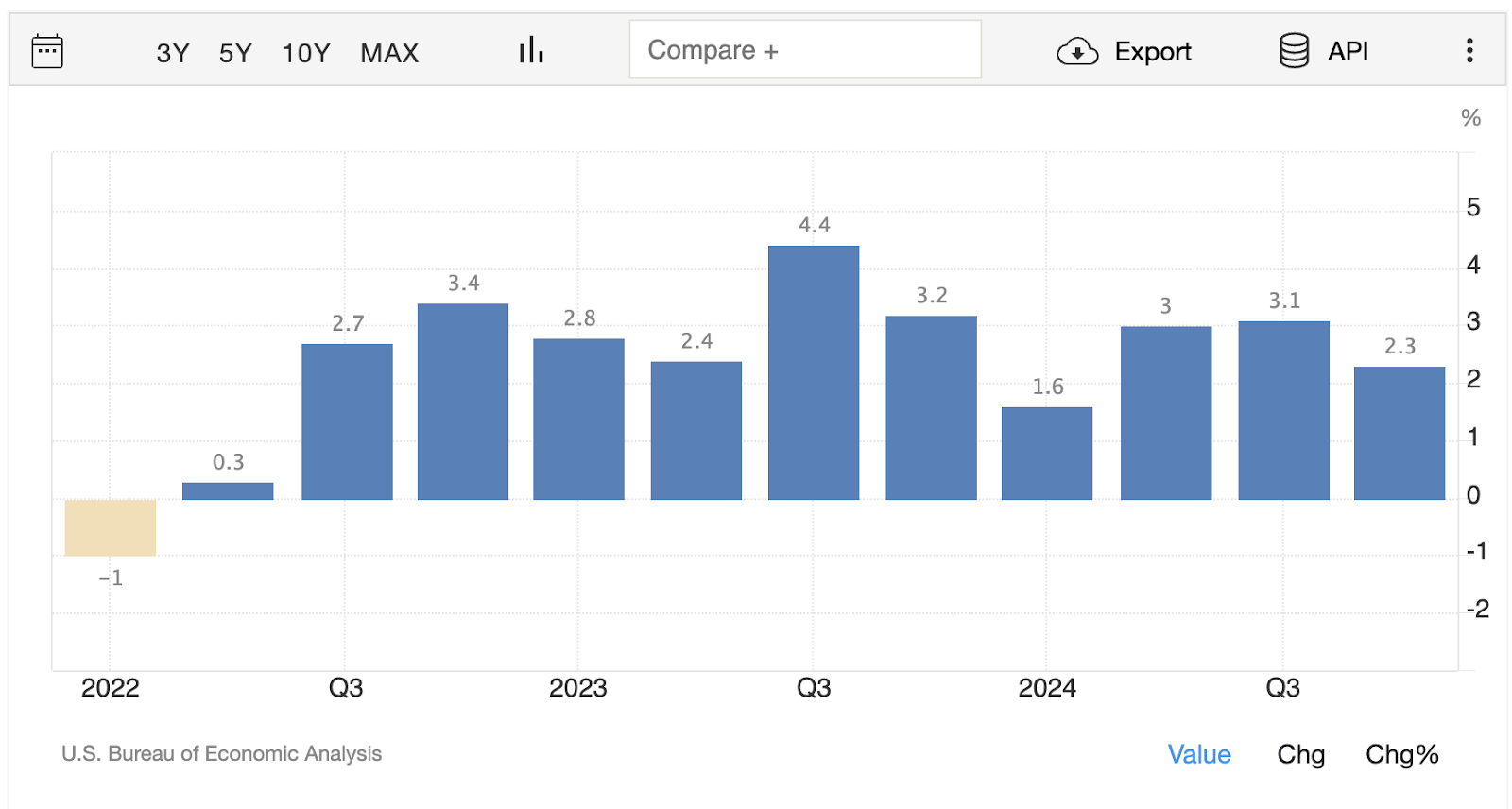
Consumption remained the primary driver of the growth, at 4.2%. The consumer is the engine of the US economy; so as long as this remains strong, there’s little to worry about in terms of the growth outlook.
Notably, however, fixed investment saw its first contraction since 2023 — of -0.6%. It’ll be interesting to see how the Fed digests this dispersion in growth between the investment sector and the consumption sector. Overall, however, there’s nothing of major concern yet.
Piecing it all together and contrasting it with the Fed’s dual mandate, we have a labor market that is in solid balance and no major concern of deterioration. Further, we have a consumer that remains strong and spending that doesn’t hint at major worries of a growth slowdown at the moment.
This all sets the stage to validate the Fed opting to pause cutting rates here as it takes time assessing how its 100-basis point cuts during this cycle so far impact the economy.
Get the news in your inbox. Explore Blockworks newsletters:
- The Breakdown: Decoding crypto and the markets. Daily.
- 0xResearch: Alpha in your inbox. Think like an analyst.
