Why the bull run so far has been standard
Bitcoin bull markets have historically been cyclical and, therefore, predictable

Sem_Sem/Shutterstock modified by Blockworks
This is a segment from the Empire newsletter. To read full editions, subscribe.
Happy Friday!
The bitcoin blues are real today, though We’ve been told by many a bull that there’s still a few weeks left in December to hit another new all-time high. We’ll just have to see if that pans out.
Keep calm and carry on, as the UK government once advised. We think it’s pretty relevant right now.
Anyway, this morning, we’re diving into this cycle and why it’s really not that different from past cycles (sorry, y’all) and a lot of people have thoughts on AI agents and where they go from here.
See you bright and early Monday.
This time is no different
It’s always tempting to go against the grain. To believe this time is different.
The problem with that is, at least in crypto, everything that is happening today has already played out in the past.
Bitcoin bull markets have so far been cyclical and, therefore, even predictable.
With the exception of BTC’s all-time high before the halving this time around — rather than around six months after the fact — the current bitcoin bull market is totally par for the course.
Those who’ve been reading our emails are familiar with the chart below. It plots our current run (purple) against previous cycles (the others) as if they all started at once.
As you can see, this bitcoin bull run to date is entirely standard. Not especially fast, slow or explosive, and more or less in line with the previous bull run.
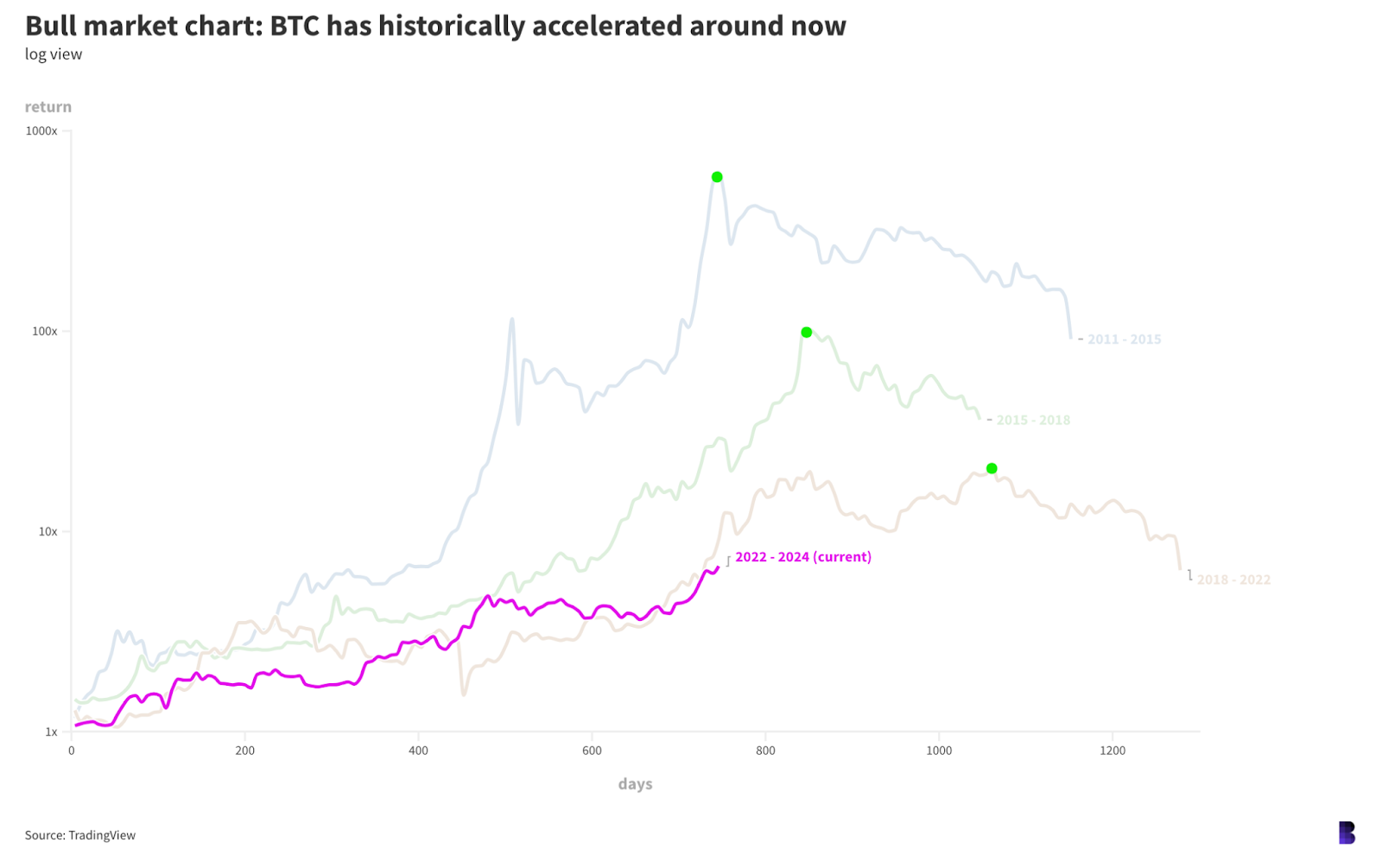 Not shown: bitcoin’s first major run between late 2009 and the second half of 2011
Bull market trajectories have indeed been similar over the years. But there are still emerging trends:
1. BTC is taking longer to reach cycle peaks each time
Bitcoin topped about 750 days into its first major bull market cycle between 2011 and 2015.
It took 845 days to peak in the following bull market between 2015 and 2018, and more than 1,060 days in the one after, which spanned 2018 and 2022.
Today is day 746 of the bull market. If the trend holds, we could see another 10 months to a year before a real peak.
2. Returns are shrinking.
Bitcoin went almost 621x in the first run, over 100x in the second and nearly 22x in the third.
Extrapolating that downward trend implies BTC would go about 6x from the bottom of the bear to the cycle top.
Good news: We’ve already smashed those returns — BTC at $100,000 is 6.7x.
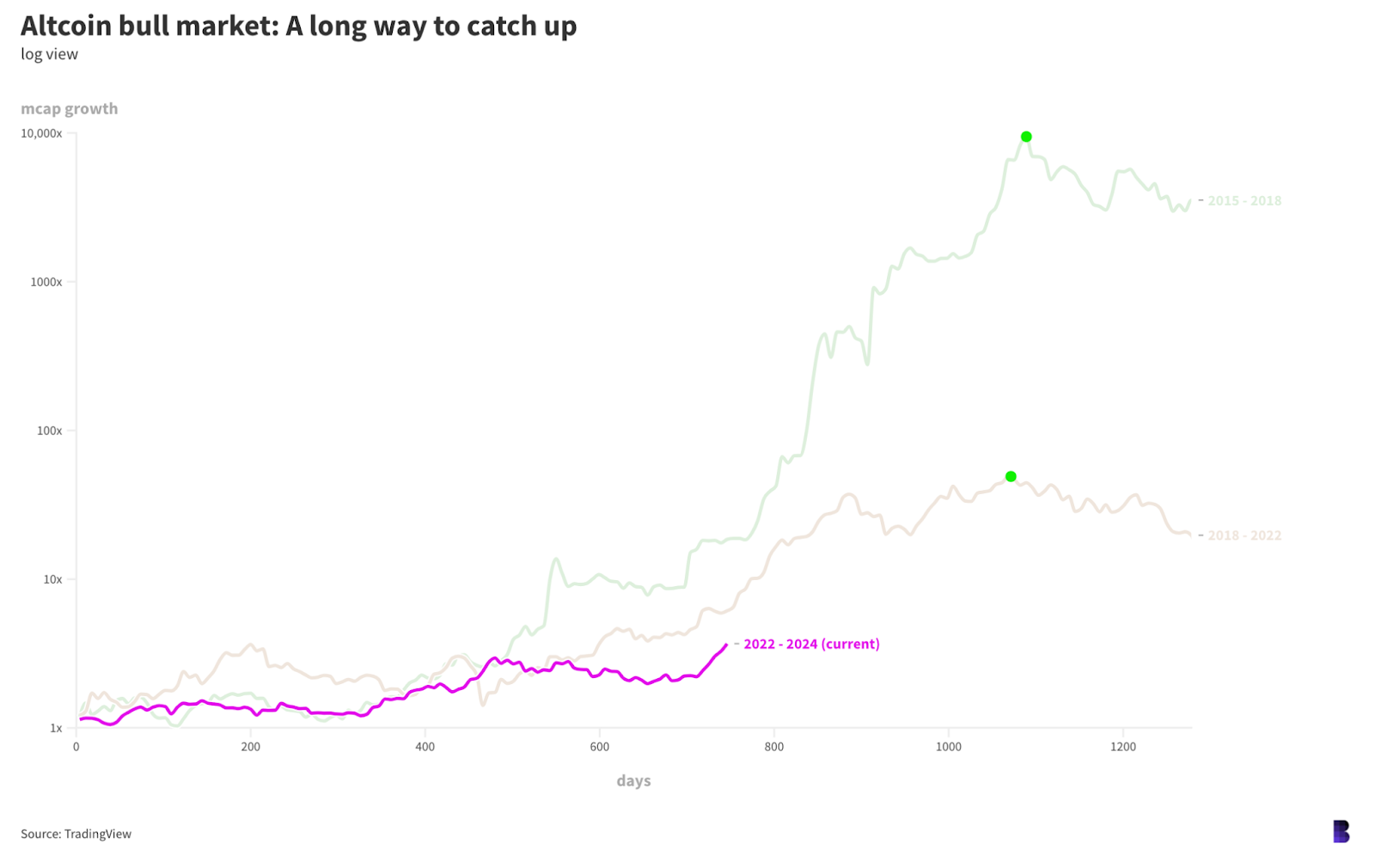
Above is the same chart but for altcoins (everything that isn’t bitcoin).
We already know that we’re getting closer to a potential fully-fledged altcoin season. What’s interesting is just how far altcoins will need to run to match their growth from the last cycle.
The market cap of crypto (excluding bitcoin) had gone 49x by the time it peaked in November 2021. To date, altcoins have done 3.7x at most.
It’s reassuring, at least, that it took altcoins more than 1,000 days to peak on the past two occasions.
So, if this time truly isn’t different, there’s still plenty of time for alts.
Nothing quite like hopium on a Friday morning.
Get the news in your inbox. Explore Blockworks newsletters:
- The Breakdown: Decoding crypto and the markets. Daily.
- 0xResearch: Alpha in your inbox. Think like an analyst.