Do DAO grants really work to stimulate growth?
Grant money can create a cycle of fleeting capital that rapidly shifts between projects in search of quick gains

CryptoFX/Shutterstock modified by Blockworks
This is a segment from the 0xResearch newsletter. To read full editions, subscribe.
One of crypto’s biggest go-to market strengths are tokens.
The ability to spin up billions of dollars worth of digital tokens with a click, then use them as lucrative grants to attract users and developers has very much become part of the standard Web3 growth playbook.
It works, but the tangible benefits of this spending is hard to measure.
Grant money invites extractive rent-seekers, creating a cycle of fleeting capital that rapidly shifts between projects in search of quick gains.
As such, DAO grant spending has largely been bogged with inefficiencies.
Since November 2023, Arbitrum has distributed 71 million ARB ($81 million) to ecosystem projects through the Short-Term Incentive Program (STIP) grant program. This was a significant expenditure at about 3-4% of Arbitrum’s entire treasury.
Treasure DAO co-founder Karel Vuong, who eventually did not participate in STIP due to the grant’s misalignment with gaming applications, called the grant a “double-edged sword.”
“While it led to some degree of ecosystem growth and usage as well as learnings to inform a longer-term DAO-led program for incentives, this also came at the cost of increased sell pressure of ARB, poor mitigation of sybilling and decreased value capture resulting from the lower sequencer margin post-ArbOS Atlas upgrade,” Vuong told Blockworks.
As part of the Arbitrum Research & Development Committee (ARDC), Blockworks Research conducted a study of STIP’s impact on 17 Arbitrum projects across the verticals of perpetual exchanges, AMM exchanges and yield aggregators.
An econometric method known as a “synthetic control” was used to compare real-world Arbitrum to a simulated version that received no grants. In terms of ROI, STIP generated $15.2 million in sequencer revenue for Arbitrum against a $85.2 million marketing spend between November 2023 to March 2024.
In sum, Arbitrum’s sequencer revenues would have generated 43% less without STIP.
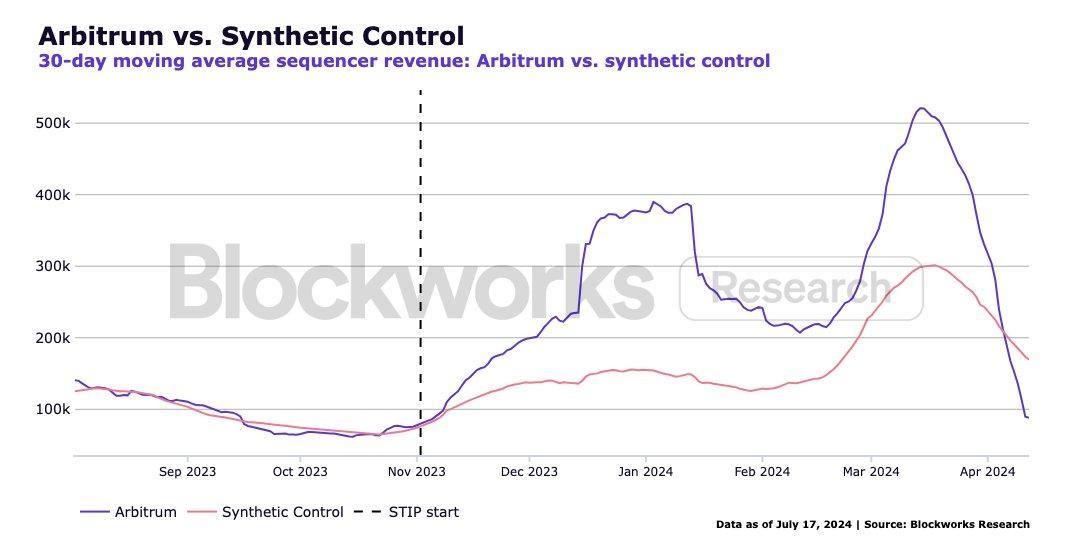 Source: Blockworks Research
A subsequent second grant program, the Long-Term Incentive Pilot Program (LTIPP), has to date distributed another 22.87 million ARB ($26 million) to users over 12 weeks.
To better track its impact, the metric of “volume-adjusted TVL” was used to better reflect growing TVL numbers that were actually translating into real activity. Simply put, volume-adjusted TVL gives more weight to protocols only when trading volumes are growing faster than TVL.
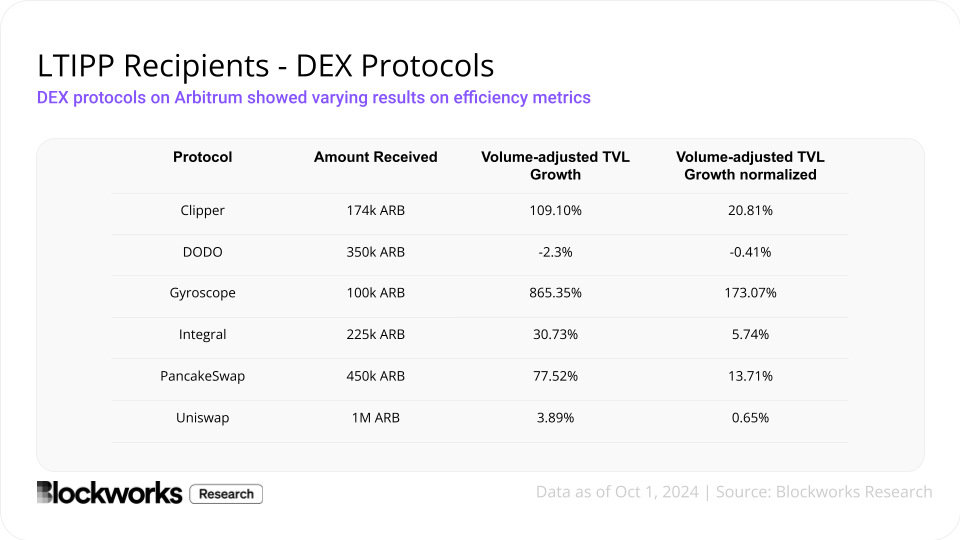 Source: Blockworks Research
Based on Blockworks Research studies, LTIPP had a positive impact on sequencer revenues and Arbitrum’s DEX and lending markets, but not its perps markets:
We find that, for lending, DEXs, and perps, TVL market share grew by 25%, 17%, and -5% respectively. We find that volume market share grew by 7%, 21%, and -11.38%, respectively. And finally, sequencer revenue market share grew by 6.54%. As one can see, while incentives have a positive impact on DEX, lending and sequencer revenues, they do not have a positive impact on perps.
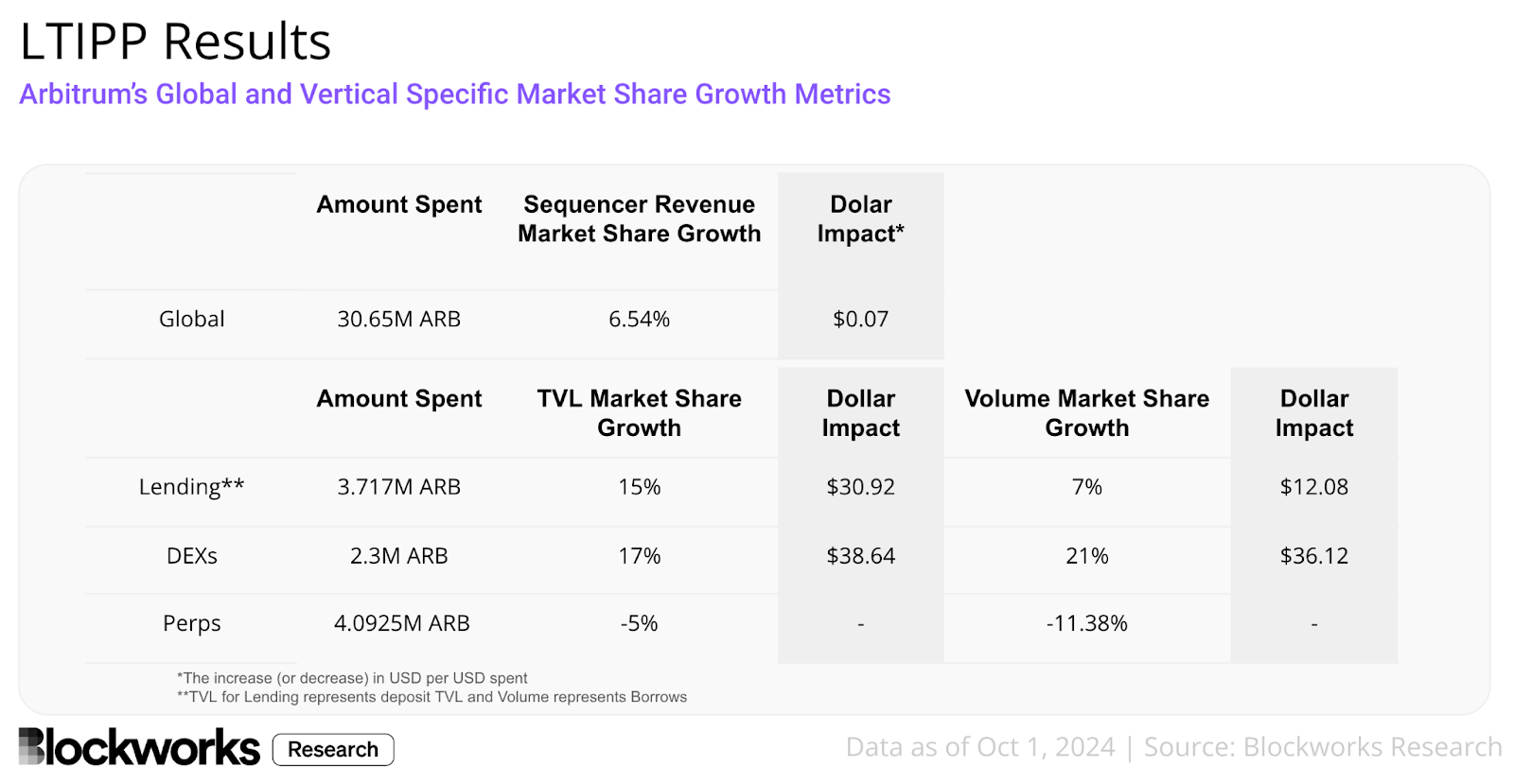
For more, see Blockworks Research’s latest report, Meta-Analysis on Incentive Programs.
Get the news in your inbox. Explore Blockworks newsletters:
- The Breakdown: Decoding crypto and the markets. Daily.
- 0xResearch: Alpha in your inbox. Think like an analyst.