FTX Native Token FTT Plunges Following Takeover News
Traders question what the utility of the FTT token will be with Binance in charge

Source: Shutterstock
The FTX.com international exchange has long offered traders a variety of perks for holding and staking FTT, the exchange’s native token. Following the news of some sort of buyout deal tentatively reached between FTX and Binance, the future of FTT is in doubt.
For trades on FTX, holding various amounts of FTT in an account offered up to a 60% fee discount, among other benefits.
But Binance has its own BNB token, which likewise provides diminished fees — leading to industry chatter that an FTT token could well become redundant.
After an initial bounce, FTT has fallen sharply Tuesday, down over 70% on the day through 3 pm ET.
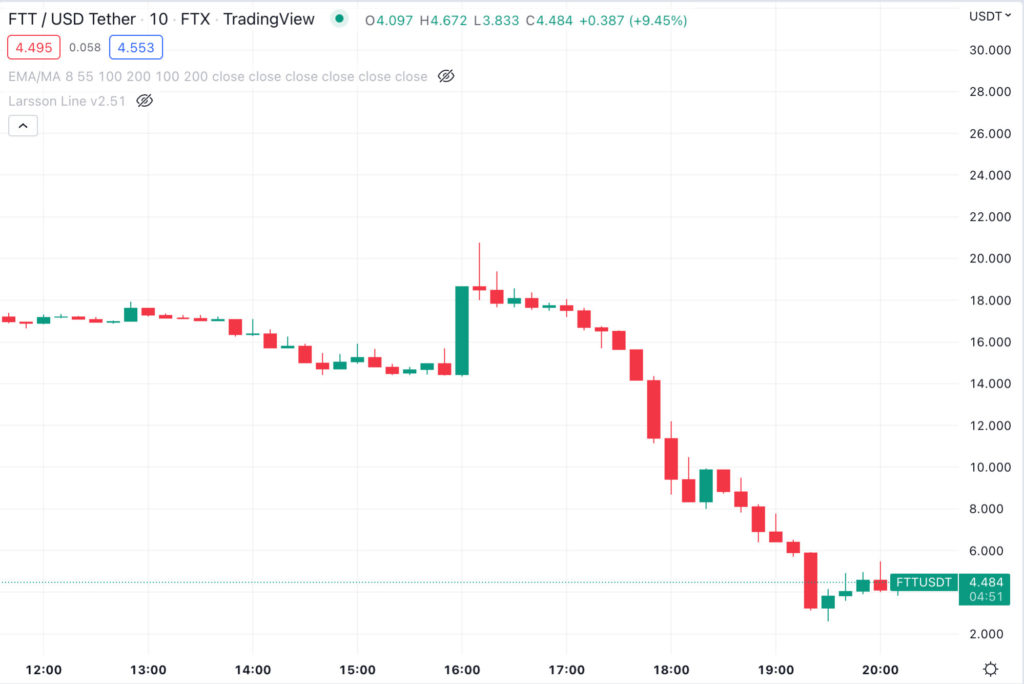 Source: TradingView
Spot trading of FTT — which is ostensibly off limits to US traders — is only available on a handful of crypto exchanges, principally FTX itself and Binance.
In a recent market-rattling move, Binance’s CEO Changpeng ‘CZ’ Zhao said his firm would divest from the FTT token, before changing course entirely and making public his preliminary intention to acquire the firm. The deal, which is contingent on due diligence and finalizing terms, does not include FTX’s US arm.
On Nov. 5, FTX transferred 23 million FTT tokens, then worth $584 million, from Binance cold wallets to the exchange. CZ confirmed on Monday that the transfer was “part of” the Binance investment. That represented a significant fraction of the total volume of FTT trading, considering sellers ran rampant and liquidity hit a wall.
A liquidity crunch of epic proportions
The relative illiquidity of the token meant that Binance could not sell en masse on the open market. That reality, no doubt, prompted the now-infamous tweeted offer to snap up of all Binance’s stake at $22 per FTT from Alameda CEO Caroline Ellison.
The move placed a temporary floor under the FTT price. But it didn’t last.
As of early Tuesday — around 2:30 am ET — FTT broke down and never recovered. By 3:00 pm in New York, the token was in the midst of a bounce from a low of roughly $2.60 and trading for between $4 and $5 in a very volatile market environment.
The FTX exchange suffered from a crisis of confidence, according to Peter Eberle, chief investment officer and president of the digital-asset focused investment manager Castle Funds.
“FTX had massive outflows from their exchange as everyone feared losing online assets,” he told Blockworks via email. “This means that market makers also removed assets and that removed liquidity. Many traders seem to have backed away or reduced their trading size.”
When fear takes hold, a lack of liquidity in already sparsely traded markets can be particularly deadly.
A spokesperson for FTX was not available for comment.
Ornella Hernandez contributed reporting.
Get the news in your inbox. Explore Blockworks newsletters:
- The Breakdown: Decoding crypto and the markets. Daily.
- 0xResearch: Alpha in your inbox. Think like an analyst.
