Ethereum cope to counter worries that ETH is doomed
A theory on why the overperformance of rivals has little to do with Ethereum itself

Akif CUBUK/Shutterstock modified by Blockworks
This is a segment from the Empire newsletter. To read full editions, subscribe.
You’ve probably heard by now that ETH is a cursed asset. Doomed.
Maybe you’ve read tweets that say Ethereum is destined to go the way of Intel — a stock that has collapsed in value by two-thirds over the past five years while competitors (Nvidia and AMD) have thrived by comparison.
It’s a take that only works if you focus solely on price and ignore how much activity persists on Ethereum and its surrounding web of layer-2s and layer-3s.
Ether has only gained 30% in the past year while its direct rival, SOL, has about doubled.
Even XRP has easily beaten ETH over the bull market to date. XRP is now up more than 600% since the bottom of the last bear market in November 2022.
BTC has otherwise gained about 500% and SOL almost 1,500%. ETH does appear spookily dull by comparison.
 At least ETH has beaten BNB
Here’s an alternative theory: The relative overperformance of coins like SOL and XRP has nothing to do with ETH.
Let’s start with XRP. Ripple Labs’ ongoing clash with the SEC (which started in December 2020) had sidelined XRP for practically this entire market cycle, not to mention its underperformance through the 2021 bull run.
So, whatever gains XRP made in light of Trump’s win in November has more to do with catching up with the market than anything particularly special about the asset itself.
As for SOL, it pays to look back at how the top end of crypto really looked over the years.
Generally, the top three coins have stayed more-or-less the same since 2016: BTC, ETH and then XRP.
In 2017, the next most valuable were litecoin (LTC) and monero (XMR). It was those, plus bitcoin cash (BCH) and cardano (ADA) in 2018; EOS in 2019; BNB in 2020.
LTC is now in 27th place — much further down in the market — while monero in 37th and bitcoin cash 23rd.
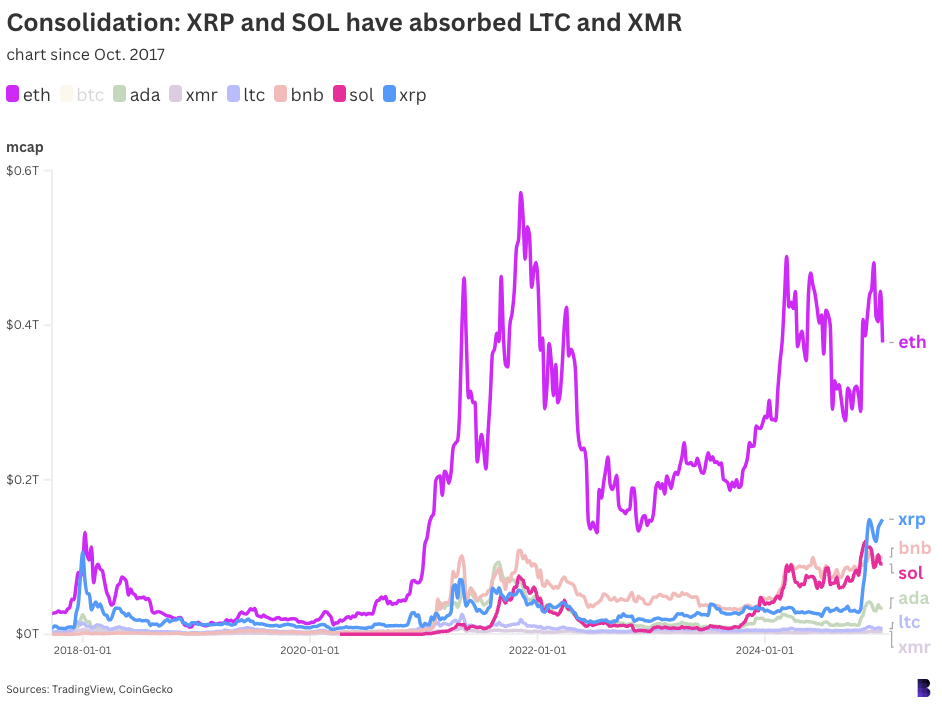
Compare the chart above to the first one, which only mapped price performance. It tracks the market caps of the top end of the market — and it makes clear just how much smaller all those coins are to ETH.
It’s only natural that they’d outperform ETH at certain parts of the cycle. While liquidity doesn’t necessarily map to market capitalization, smaller assets generally need much less fresh capital to move the needle that far.
It’s also not a coincidence that LTC, XMR and BCH, all bitcoin alternatives, have fallen off so dramatically between cycles.
Bitcoin has won the race as a store of value and stablecoins emerged to better fulfil the digital payments use case than litecoin.
Whatever mind and market share the major coins from yesteryear — the ones that never found product-market-fit at scale — may have simply been transferred to Solana.
So, the Solana renaissance has little do with the anticipated demise of Ethereum, and more to do with the shrinking significance of much older coins.
As for whether Ethereum will also become one of those “much older coins” sometime down the line — handwaiving that concern requires entirely different cope. Let me get back to you.
Get the news in your inbox. Explore Blockworks newsletters:
- The Breakdown: Decoding crypto and the markets. Daily.
- 0xResearch: Alpha in your inbox. Think like an analyst.
