BTC’s evolving correlation to more traditional asset classes
Quantifying such relationships is becoming more prevalent as investors seek diversification and hedging opportunities
NewFabrika/Shutterstock modified by Blockworks
This is a segment from the Forward Guidance newsletter. To read full editions, subscribe.
Digital assets are not quite like any others. That’s part of what makes them appealing to many — but it can also spur confusion.
Trying to quantify the relationship between BTC, for example, and other asset classes is becoming more prevalent as more investors seek diversification and hedging opportunities.
A clear finding in a recent FTSE Russell report: The rolling correlations of bitcoin and ether returns sharply increased with risk-on assets since 2020.
If we look at BTC in particular, the Russell 1000 index — comprising US large-cap stocks — has a 0.58 correlation to the asset. That relationship is nearly as strong for BTC and US financial stocks and US tech stocks — at 0.53 and 0.52, respectively.
The correlation, since Covid, between BTC and US high-yield credit (the most “risk-on” fixed income asset class) stands at 0.49.
Prior to the Covid-19 outbreak (spurring inflation and monetary tightening), all these correlations were much closer to zero.
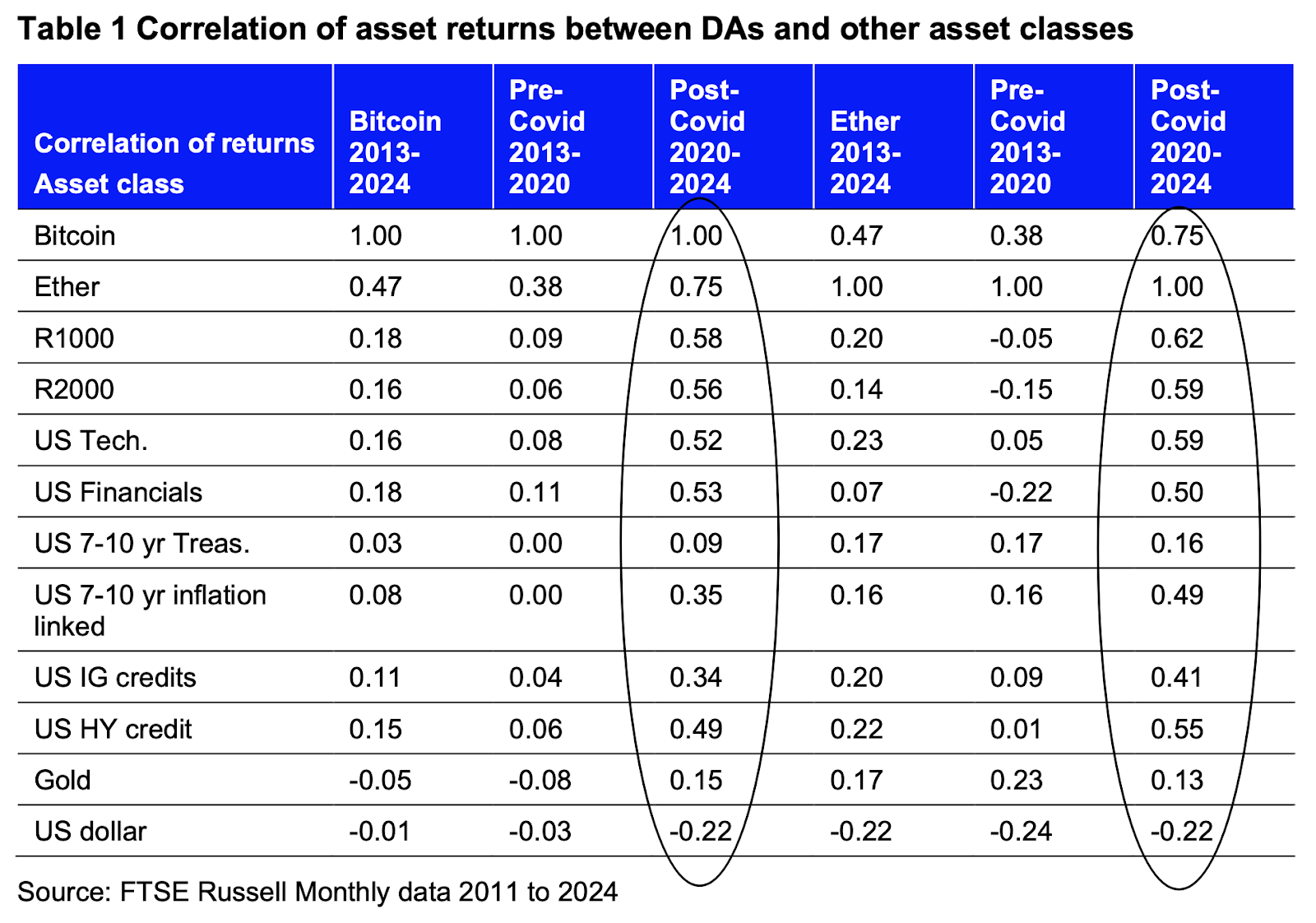
7–10 year US Treasurys were rather unique in not seeing a meaningfully higher correlation to BTC after Covid. And the US dollar is the only asset showing negative correlation to BTC and ETH over those years.
Despite bitcoin often being compared to gold, the BTC-gold correlation in the post-Covid era is only 0.15.
BTC’s high volatility (and the varying importance of safe haven and store-of-value characteristics in financial markets) may obscure the “true correlation” between these assets’ returns, the report notes.
It adds: “But the true correlation may simply be low, reflecting the fact that bitcoin and ETH are predominantly risk-on assets, whereas gold has a long-established trading history as a ‘safe haven’ asset, even if they do share some store of value characteristics.”
Get the news in your inbox. Explore Blockworks newsletters:
- The Breakdown: Decoding crypto and the markets. Daily.
- 0xResearch: Alpha in your inbox. Think like an analyst.