Does the blockchain industry have too many blockchains?
VCs are chasing the fabled layer-1 premium
SkillUp/Shutterstock and Outlier Ventures chart modified by Blockworks
This is a segment from the 0xResearch newsletter. To read full editions, subscribe.
We call this industry the “blockchain” industry. But people are fed up with too many chains.
If you’re launching a new chain in 2025, expect plenty of skepticism on Twitter. It’s what all the L1 blockchain raises in the last week had to confront.
- Camp Network, an intellectual property-focused L1, raised $30 million at a valuation of $400 million.
- Unto, an SVM-based L1, raised $14.4 million at a valuation of $140 million.
- Miden, a zk rollup, raised $25 million (undisclosed valuation).
“Another chain, why?”
The easiest explanation is “greed.” It’s the fabled L1 premium!
Look at SUI’s price performance lately — what explains a $6.8 billion-market-cap token almost doubling in half a month?
We can all agree that it’s not based on fundamentals. Fees generated on Sui are at paltry lows compared to its highs last December.

Maybe I’m cherry-picking, and SUI is an anomaly. Maybe the L1 premium is dying, but it’s not quite dead yet.
Until then, the incentives to launch new L1s still exist.
The second (and charitable) explanation is simply that founders launching chains have competing visions of how a chain should be optimized.
How should the execution environment be designed? How is MEV captured? What data availability layer to use? Should there be a standardized oracle or gas token?
These things aren’t trivial. They determine where application developers go to build, and make or break the long-term success of a chain.
Expecting protocol builders to agree is like getting a hundred people to agree on a buffet’s menu.
It’s not all technical, either — there are social layer considerations. Take for example Rogue, @fede_intern’s upcoming zk rollup that wants to have zero VCs, insider allocation, and a completely fair launch like Bitcoin did.
Builders have different opinions. They launch their own chains. It’s as simple as that. That’s economic freedom. We should celebrate it.
A solution?
Yet, there may be some consolation in the fact that L1 valuations are already compressing.
One of the highest profile L1 raises last year was Monad. Valuations were undisclosed, but it was rumored to be at unicorn status according to Pitchbook, so that puts Monad in the range of a billion.
Or consider the Initia L1, which was valued at $350 million last year.
These raises are nothing like what was seen in the last cycle.
Contrast this to when Avalanche reportedly raised at a valuation of $5.25 billion in 2022. Or Flow, which raised at a valuation of $7.6 billion.
These numbers are dramatically down for L1s.
Public markets have responded to the distaste for more chains, and private markets are correcting overtime. The free market is working.
The data checks out when we zoom out. The below chart shows a downward trajectory for total funding raised for blockchains.

For those frustrated with “too many chains” who would like to see none at all, it’s probably not a satisfying answer.
Tied to that frustration is also an underlying desire to see more applications.
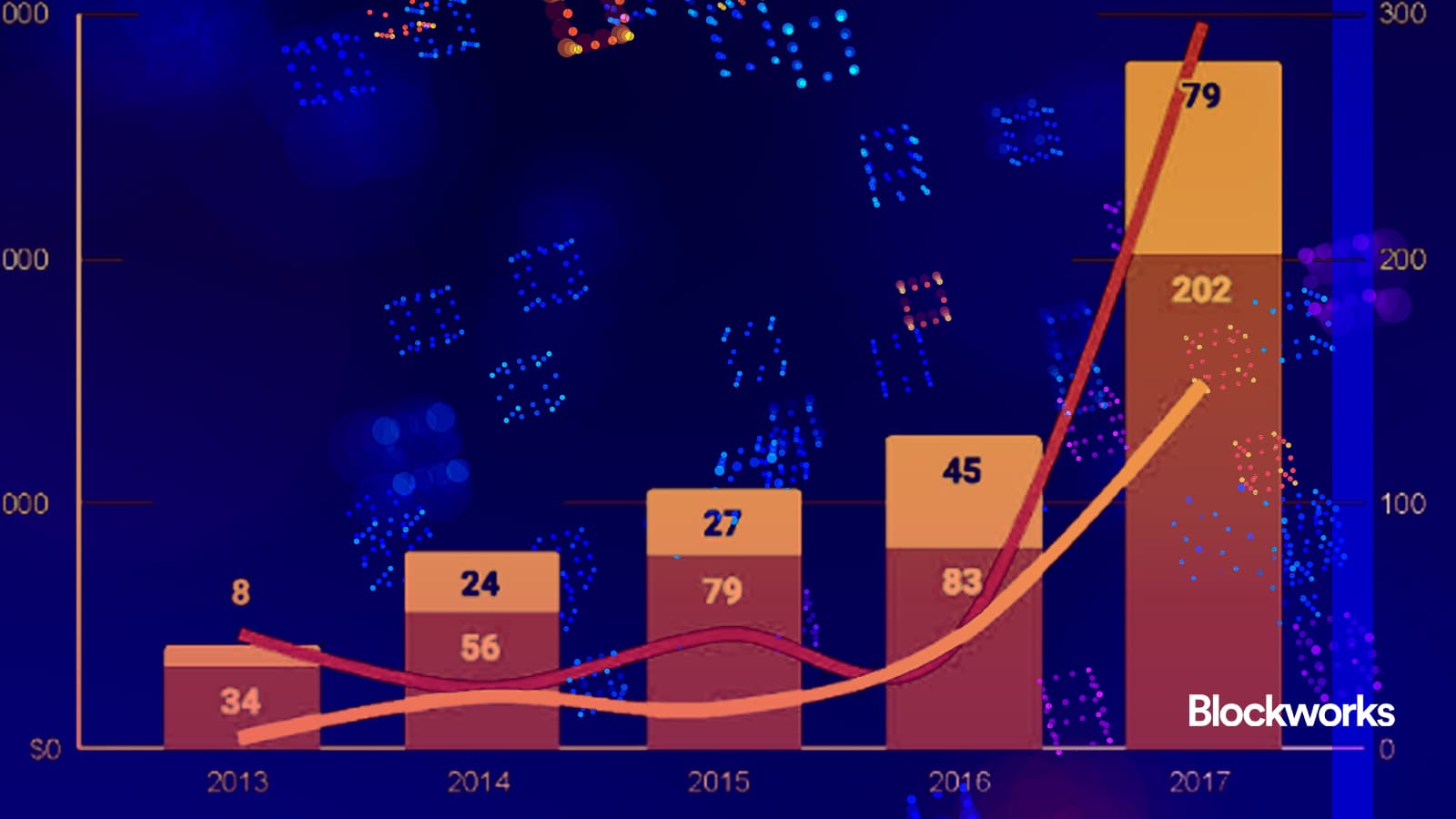
Fun fact: Consumer apps ironically received the lion’s share of venture funding vs. infrastructure back in 2013-2017 (Joel Monegro’s Fat Protocol thesis was written in 2016).
 Source: Outlier Ventures
That has, of course, flipped today. Is there some reason why application funding has fallen out of favor with VCs?
Take it from 1kx, which claims to be one of the most active investors in consumer apps.
1kx partner Peter Pan told me: “Applications live and die by their traction and follow through — it’s an immediate feedback loop. Whereas with infrastructure, you can continue to find funding in a pre-launch state based off existing market comps, and push reality further and further out.”
Pudgy Penguins, Axie Infinity, Off The Grid, Rodeo and Layer3 are some examples of apps that have surmounted that feedback loop, Peter said.
Application revenues are also collectively outpacing the underlying protocol’s revenue (measured by REV) on most chains today.

If free markets worked to correct L1 overvaluations, maybe the reverse can happen for application funding, too.
Get the news in your inbox. Explore Blockworks newsletters:
- The Breakdown: Decoding crypto and the markets. Daily.
- 0xResearch: Alpha in your inbox. Think like an analyst.