Staying hip in crypto is no easy feat
2019 was a long time ago, and the “it” tokens have changed dramatically since then
Akif CUBUK/Shutterstock modified by Blockworks
This is a segment from the Empire newsletter. To read full editions, subscribe.
Abe Simpson’s rant about the difficulties of staying hip as you age is just as insightful when applied to crypto.
Five years ago, you might have been with “it.” You might’ve stacked your portfolio with coins like litecoin, XRP, stellar and cardano, and maybe even zilliqa, waltonchain, lisk or omisego.
But the market soon changed what “it” was. Now what you’re holding isn’t “it” anymore, and what’s “it” seems weird (AI agent memecoins) and scary (pump.fun rugs).
It’ll happen to you!
While looking back, 2019 does feel like another world — years before Bored Apes, Ethereum layer-2s and memecoins other than DOGE — some things haven’t changed at all.
The top three coins this morning were BTC, ETH and XRP, just as they were back then. You can even go further into the past to July 2016 and find the exact same projects in podium positions.
Still, outside of those three, much of the market indeed looks vastly different than it did in previous cycles. Hundreds or even thousands of coins have fallen off.
NEO, IOTA, Tezos, Ontology, NEM and Zcash were top-25 projects in May 2019. Now Tezos is the only one barely in the top 100, replaced by Solana, Toncoin, Avalanche and Chainlink.
But as we all wait for altcoin season to lift boats, a string of dino coins are doing their best to keep ahead of the curve.
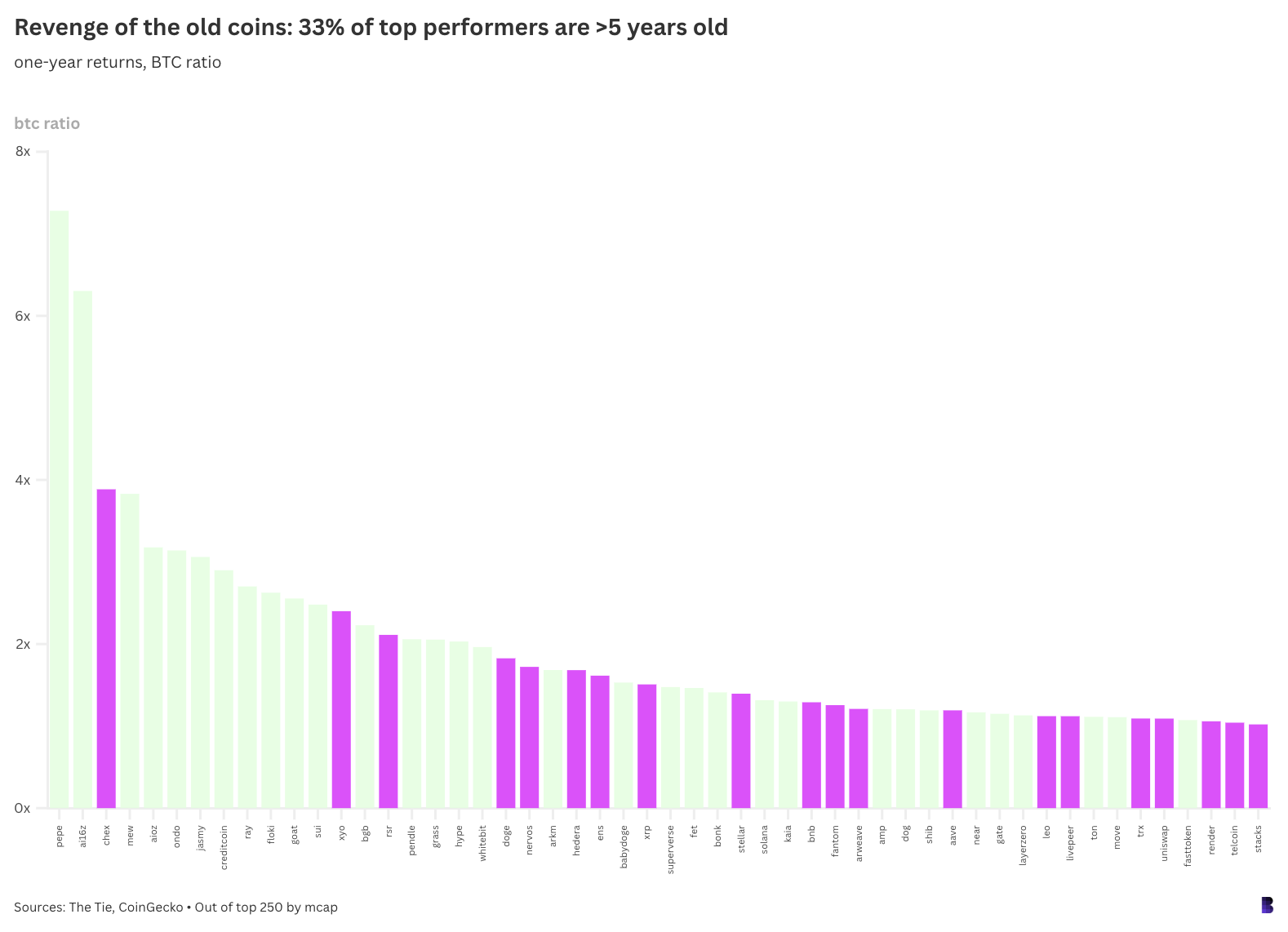
I spent the morning filtering price data for coins in the current top 250 by market cap, specifically their bitcoin ratios (their price in BTC).
You probably know, but when bitcoin goes up, the market tends to move everything else up to compensate. USD-denominated prices are then mostly noise — the signal is easier to find by comparing how coins are doing against bitcoin itself.
As it turns out, of the 188 coins in the top 250 that aren’t stablecoins, liquid staking or wrapped tokens, one-third (61) have had their bitcoin ratios rise in the past year (they’ve outperformed BTC).
And of those coins, almost one-third (20) are what you might consider dino coins — tokens tied to projects that were launched at least five years ago. Those are shown in purple on the chart above.
Still, newer coins absolutely dominate. The best-performing dino coin in the past year, CHEX, the native token for license-heavy RWA chain Chintai, has returned about 300% against bitcoin in the past year.
Meanwhile, I had to remove seven newer tokens from the first chart as their bitcoin ratios had ballooned by thousands of percent, completely dwarfing the rest of the coins. Four of them were memecoins (WIF, BRETT, POPCAT and MOG) as well as mantra, virtuals and aerodrome.
What’s cool is that the market also does seem to be paying attention to some more obscure dino coins.
There are the obvious ones: DOGE, XRP, XLM, BNB and TRX. which all rallied hard in the past few weeks. But there’s also coins like livepeer, telcoin, nervos, reserve rights and XYO, which rarely show up on many radars.
Calling it now: This altcoin season is one for the eclectic crypto hipster that doesn’t care what “it” is at all.
Get the news in your inbox. Explore Blockworks newsletters:
- The Breakdown: Decoding crypto and the markets. Daily.
- 0xResearch: Alpha in your inbox. Think like an analyst.