World Liberty Fi’s $259M crypto stockpile is off to a good start
Perhaps it’s not an official US crypto stockpile, but World Liberty Fi is definitely accumulating
President Donald Trump | Jonah Elkowitz/Shutterstock modified by Blockworks
This is a segment from the Empire newsletter. To read full editions, subscribe.
At face value, President Trump is well on his way to giving crypto what it wants.
A US government strategic crypto reserve. Or maybe it’s a stockpile. Is there a difference?
Anyone interested in wading into that debate is well covered on X and so on.
Same goes for those keen to moralize the implications of US government agencies accumulating coins other than bitcoin — perhaps even ones backed by funds and entities controlled by appointed officials like venture capitalist David Sacks.
I’m taking a different path. Let’s put aside the US strategic stockpile. It doesn’t exist, yet.
What does verifiably exist onchain is the growing crypto portfolio of World Liberty Fi, the DeFi project endorsed by the Trump family.
And because this is crypto — and it’s on Ethereum — we know exactly what it’s doing at all times, and whether it’s underwater or not.
I touched on this earlier this week, but World Liberty Fi has bought more crypto since Trump’s inauguration on Monday.
The chart below treats World Liberty Fi’s stockpile as a fund. Its performance is plotted by the blue line.
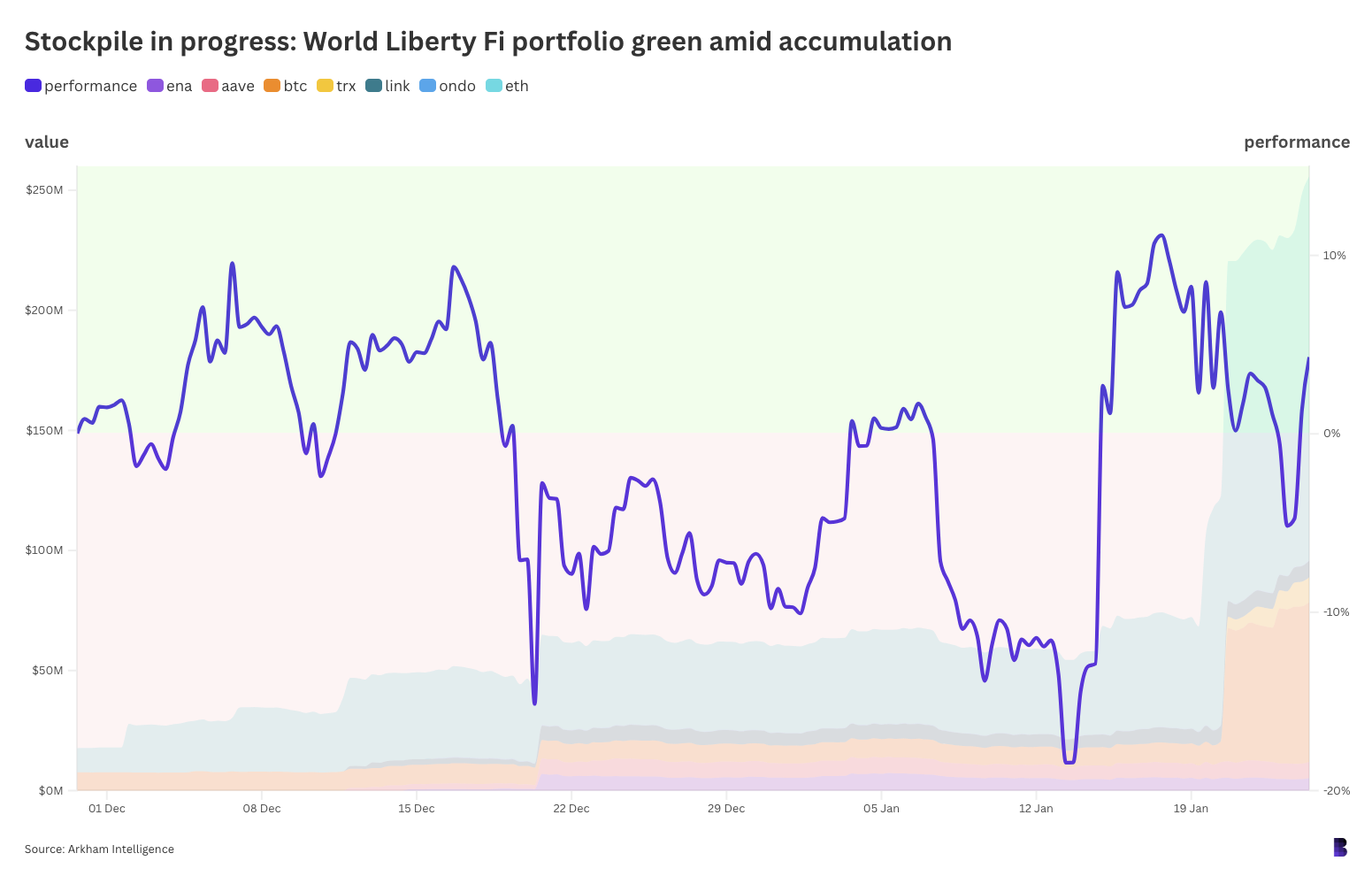 The crypto World Liberty Fi used to buy more coins came from its $300-million token sale. It currently holds a combined ~$53 million in USDT and USDT.
When the blue line goes into the red, World Liberty Fi’s accumulated portfolio is underwater. It’s otherwise ahead on its purchased crypto to date when it’s in the green area.
The portfolio is ahead by 4.3%, as of this morning, although there would be additional small gains related to liquid ETH staking which were not included in the analysis.
Most recently, World Liberty Fi spent $22.5 million on Thursday, on a mixture of ETH, TRX and wrapped BTC. That’s on top of the $2.65 million in TRX bought on Tuesday.
Those purchases brought World Liberty Fi total spend to $245.3 million across six different coins since it began at the end of November: the three above as well as LINK, ONDO, AAVE and ENA, a set which should integrate with the platform in some capacity in the future.
As you can see, the portfolio, now worth nearly $259 million, has spent about half the time ahead. That makes sense, considering it’s regularly accumulating crypto (although with no real stated goal for what it will be for as yet, other than for strategic purposes).
Sure, handwringing about how all this could go wrong is probably justified. Especially if World Liberty Fi’s portfolio indeed turns out to be Trump’s strategic crypto reserve.
It’s worth appreciating, however, that the very blockchain rails on which the stockpile exists make those concerns much easier to navigate. We can see what it’s doing. We can see when it buys, sells, stakes or otherwise transfers any of the coins it holds. And they will be forever trackable, at least within the current capabilities of analytics software.
The tools for everything to go right are there. We’ll just need to actually use them to make sure that it does.
Get the news in your inbox. Explore Blockworks newsletters:
- The Breakdown: Decoding crypto and the markets. Daily.
- 0xResearch: Alpha in your inbox. Think like an analyst.
