If companies, countries and ETFs are buying bitcoin — who’s selling?
Searching for someone to blame for bitcoin’s price
Art by Crystal Le
This is a segment from the Supply Shock newsletter. To read full editions, subscribe.
Who’s selling bitcoin?
It’s a question that’s popping up routinely. The wonder is somewhat justified: Strategy alone is buying up billions in bitcoin every other week — so there must be an equivalent force dumping coins at the same time.
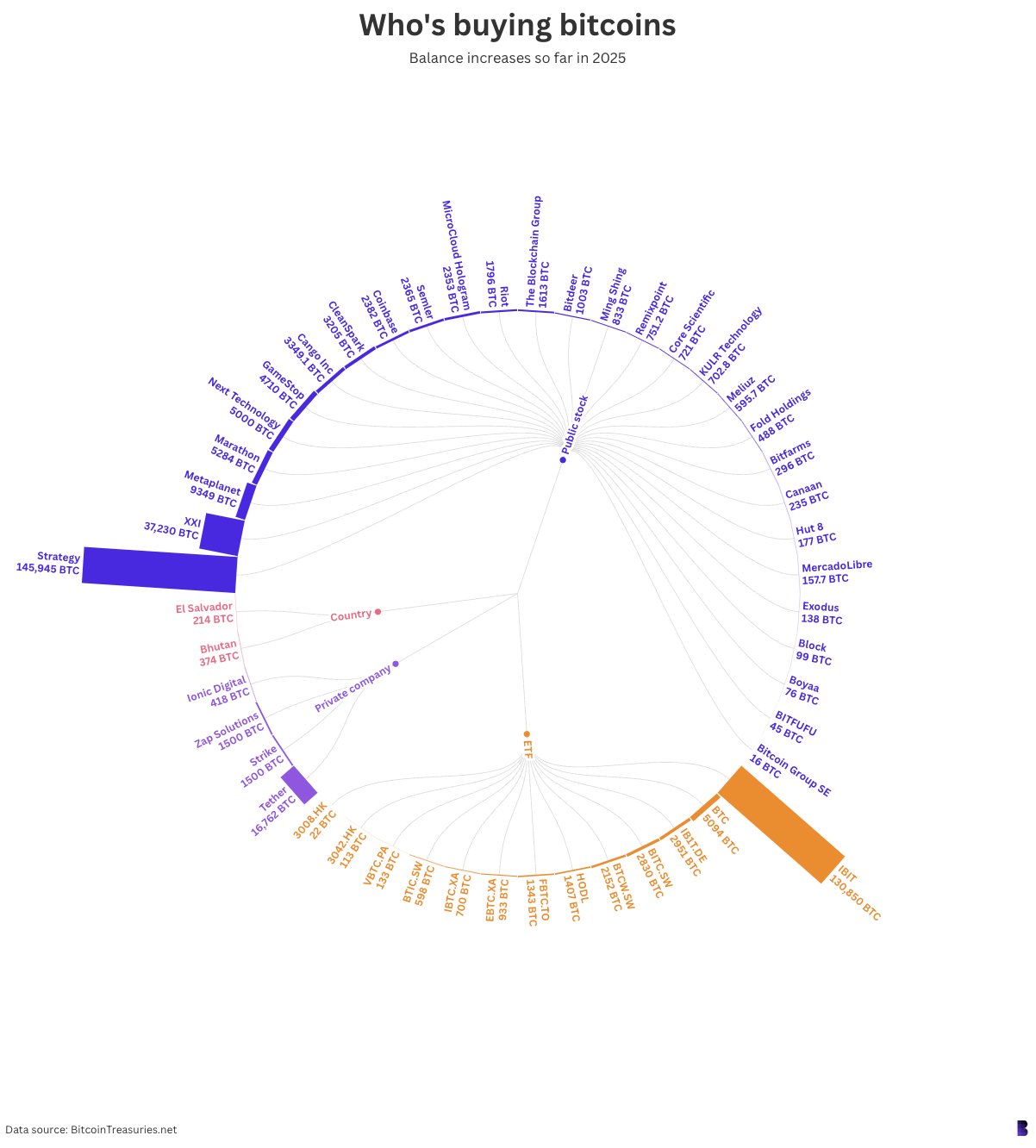
For more context, public stocks like Strategy, Metaplanet, Semler, Coinbase and two dozen others have scooped up about 251,700 BTC since the start of the year, a sum currently valued at $26.51 billion.
That’s more than 3x the number of fresh coins that were mined in the same period. And that’s not counting the 20,800 BTC ($2.2 billion) collected by private companies like Tether and countries such as Bhutan and El Salvador.
ETFs from around the world have bought an additional 149,100 BTC ($15.7 billion) on behalf of shareholders — predominantly BlackRock’s IBIT, which is holding 130,850 ($13.8 billion) more coins than it was on Jan. 1.
All told, going by the latest available disclosures, more than 400,800 BTC has been stashed away by governments, private and public companies and ETFs this year — equal to 2% of the circulating supply.
But that’s only counting companies that have increased their holdings.
As for who is actively selling, on the surface level, there doesn’t appear to be one major cohort that’s the culprit.
Still, miners have been slowly offloading their stock. CryptoQuant data shows miner balances overall are down about 2,000 BTC since the start of the year while retaining an eye-watering 1.8 million BTC ($191.4 billion, over 9% of the circulating supply). The US dollar value of collective miner holdings is, however, at an all-time high.
Otherwise, more than half of all ETFs have been selling the pico top. Fidelity’s FBTC has shed over 6,500 BTC this year while Grayscale’s Bitcoin Trust has sold more than 20,000 BTC, with its mini-trust making up only a fraction of the difference. Many other funds have released thousands of coins in the first six months of this year.
It may not be a perfect counterbalance to Strategy, the Saylor clones, and the ETFs that are buying, but it’s clearly adding up.
Get the news in your inbox. Explore Blockworks newsletters:
- The Breakdown: Decoding crypto and the markets. Daily.
- 0xResearch: Alpha in your inbox. Think like an analyst.
