Actors and TV Personalities Testify as Warren Introduces Anti-privacy Crypto Bill
Wallet providers, miners and validators would have to complete know-your-customer checks, per the new bill
Maverick Pictures/Shutterstock.com modified by Blockworks
As the second day of FTX-related testimony kicked off on Capitol Hill Wednesday, a group of bipartisan senators released their latest legislative plans for cracking down on money laundering in crypto.
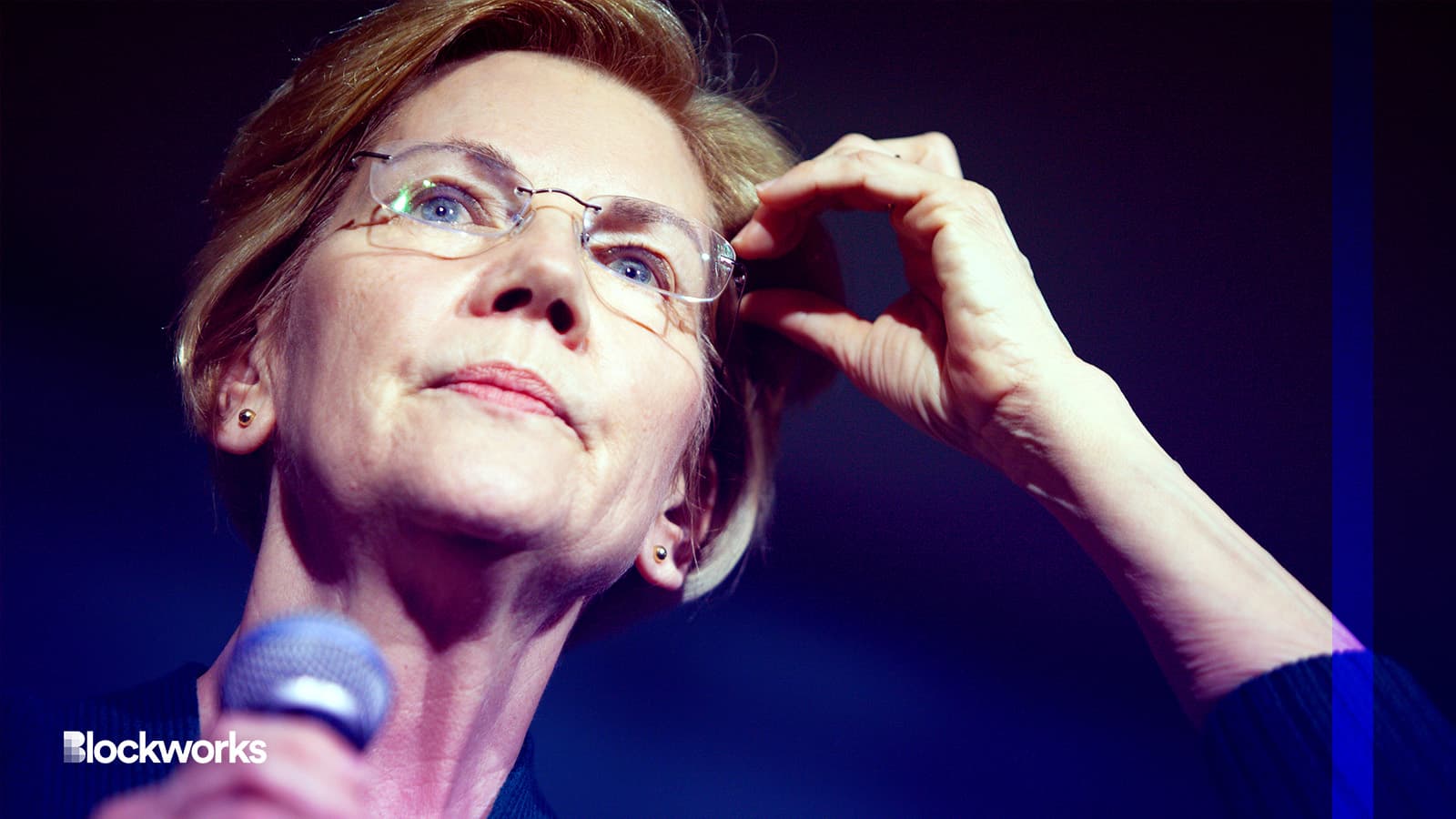
Sens. Elizabeth Warren, D-Mass., and Roger Marshall, R-Kan., introduced the “Digital Asset Anti-Money Laundering Act Of 2022,” a bill that would reclassify crypto companies, including wallet providers and miners, as money services businesses.
The bill also prohibits financial institutions from engaging with cryptocurrency mixing services, privacy coins or “other anonymity-enhancing technologies,” according to the draft legislation.
The legislation comes as members of Congress attempt to get to the bottom of how FTX imploded last month through a series of hearings. The House Financial Services Committee heard from newly-appointed FTX CEO John Ray Tuesday.
Ray testified that the restructuring team discovered mismanagement and duplicity that makes the exchange’s fraud “worse than Enron.” He added that there is evidence FTX was commingling funds, and the exchange handled accounting and invoices through messaging app Slack and accounting service QuickBooks.
The Senate Banking Committee gathered four witnesses Wednesday, including actor-turned-author Ben McKenzie and FTX spokesperson Kevin O’Leary. O’Leary testified he received $15 million from Bankman-Fried, in addition to $3 million “to cover taxes.”
“The collapse of FTX is nothing new,” O’Leary said. “While this situation is painful for shareholders, employees, account holders…In the long run, it does not change this industry’s promise.”
Others were less optimistic. McKenzie, whose book deriding all of crypto as a fraud is expected to be released in 2023, likened investing in cryptoassets to gambling on poker. Fellow witness Hilary Allen, a professor at American University’s Washington College of Law, questioned whether any entity in the industry is truly decentralized.
“To be clear, decentralization won’t protect us from future crypto fraud, because even if DeFi is technologically decentralized, it is not economically decentralized,” Allen said. “If one person owns 90% of the governance tokens that control the software, which is quite common in DeFi, then they could cause it to perpetuate shady behavior.”
The draft of the bill, released Wednesday, comes days after the Bahamian government indicted and arrested FTX founder Sam Bankman-Fried. The former CEO faces a number of charges, including wire fraud and money laundering.
US Attorney Damian Williams referred to Bankman-Fried’s crimes as “one of the biggest financial frauds in American history” during a press conference detailing the indictment Tuesday.
Bankman-Fried’s extradition to the US is underway, Williams added.
With Congress set to adjourn in the coming weeks, Sens. Warren and Marshall will have to reintroduce the bill during the next session to advance the measure.
News analysis by Macauley Peterson
It looks like we’re finally going to see an ideological fight over some of crypto’s first principles. The battle lines are drawn. The industry now has to make its case to politicians and regulators for why features such as self-custody, decentralization, disintermediation, and privacy are valuable traits that empower individuals and improve the efficiency of our financial system.
It’s easy to bring in expert witnesses that begin their inquiry into the technology with the rhetorical question, “Am I crazy, or is this all a total scam?” and then get the testimony that all of crypto is a scam. But it’s not terribly informative to the public.
Nor is trying to learn about DeFi from someone who seriously asserts it’s “quite common” for one person to own 90% of the governance tokens — that’s a wild exaggeration.
While it’s fine to question certain assumptions about decentralization, and in fact we should challenge crypto projects to demonstrate the veracity of their claims to the decentralized label, we also can examine public blockchains and see how those claims stack up to reality.
The Digital Asset Anti-Money Laundering Act Of 2022, would compel the Financial Crimes Enforcement Network (FinCEN) to classify “custodial and unhosted wallet providers, cryptocurrency miners, validators, or other nodes who may act to validate or secure third-party transactions, independent network participants, including MEV searchers, and other validators with control over network protocols as money service businesses.”
Current guidelines stipulate that money services businesses have to be businesses — it’s right in the name — individuals who are frequently among the “network participants” mentioned are generally exempt from being considered money transmitters, and for good reasons.
A “wallet provider” is a software developer publishing code. “Unhosted” is a political term for self-custody — the whole purpose of wallets. It would be like asking Louis Vuitton to register as a money transmitter for giving individuals a piece of folded leather that they can use to transport dollars.
Sen. Warren just wants Congress to declare it otherwise, presumably because she doesn’t see the value in taking a more nuanced approach.
The bill sees privacy tools — or “anonymity-enhancing technologies” as it calls them — as serving no purpose other than to facilitate money laundering.
That perspective is only valid if you uncritically assume that all crypto is a fraud and a scam.
Which is both intellectually dishonest and fundamentally incorrect.
As written now, it would go a long way towards enshrining a dystopian surveillance state when it comes to individuals transacting on blockchains.
Even crypto-skeptic law professor and political adviser Rohan Grey is concerned.
The bill, which would direct the Treasury Department to “promulgate a rule that prohibits financial institutions from…handling, using, or transacting business with digital assets that have been anonymized by the technologies described…,” would strongly curtail the ability of law-abiding citizens to protect their privacy on public blockchain networks — a form of censorship.
It’s ultimately a question of fundamental rights in a liberal democratic society. As CoinCenter’s Peter van Valkenburgh put it, crypto transactions provide a counterweight to electronic transactions which “force citizens to rely on a class of centralized gatekeepers who can freely censor every transaction and amass and abuse a comprehensive dossier of every citizen’s intimate activities.”
Physical cash is important in open societies to maintain citizens’ rights and privileges. And as all assets become digitized, only cryptoasset networks provide a digital cash analog.
Sens. Warren and Marshall overlook the rights of ordinary citizens, instead treating all actors in the crypto space as dangerous and in need of constraint. That’s largely a function of misunderstanding and poor guidance, but it’s also a challenge to the basic argument for why crypto matters. And it’s that argument that opponents of the measure will have to make, forcefully.
Get the news in your inbox. Explore Blockworks newsletters:
- The Breakdown: Decoding crypto and the markets. Daily.
- 0xResearch: Alpha in your inbox. Think like an analyst.
