From promise to niche: The rise and decline of Vyper
Ethereum’s Python-inspired smart contract language recently celebrated a birthday, despite funding challenges and waning adoption

DSlight_photography/Shutterstock modified by Blockworks
Vyper, Ethereum’s Python-inspired smart contract language for the Ethereum Virtual Machine (EVM), recently marked an anniversary. However, chatter out of Devcon suggests its development team is struggling with underfunding.
Conceived by Ethereum co-founder Vitalik Buterin in November 2016, Vyper set out to provide a simpler, more secure alternative to Solidity.
Vyper’s clean, Python-inspired syntax prioritizes readability and restricts complex features to minimize vulnerabilities — a boon for developers focused on writing secure and robust smart contracts.
Curve Finance was a high profile application of the language, and founder Michael Egorov took to his Telegram channel over the weekend to reminisce.
“I started using Vyper in 2019 when I started creating Curve. Just like in 2005 I fell in love with Python, same happened with Vyper,” Egorov wrote, noting that it is “probably the best way to write safe smart contracts for [the] Ethereum ecosystem.”
Security has always been a cornerstone of Vyper’s philosophy. It has generally enjoyed a strong track record, though a 2023 high-profile exploit in the Vyper compiler caused a lot of damage to Curve.
Read more: How DeFi users are navigating post-Curve exploit landscape
Today, Egorov noted, Vyper boasts a well-documented history of audits, with all reports available publicly on its GitHub repository. Vyper developers have also implemented processes for managing vulnerabilities, as highlighted in its security advisories.
The emphasis on transparency and public reviews aligns with Ethereum’s broader ethos of decentralization and community trust.
Vyper’s influence in the Ethereum ecosystem has seen a steady decline over the past few years. Once commanding a notable share of the total value locked (TVL) in DeFi, Vyper peaked at 30% in August 2020.
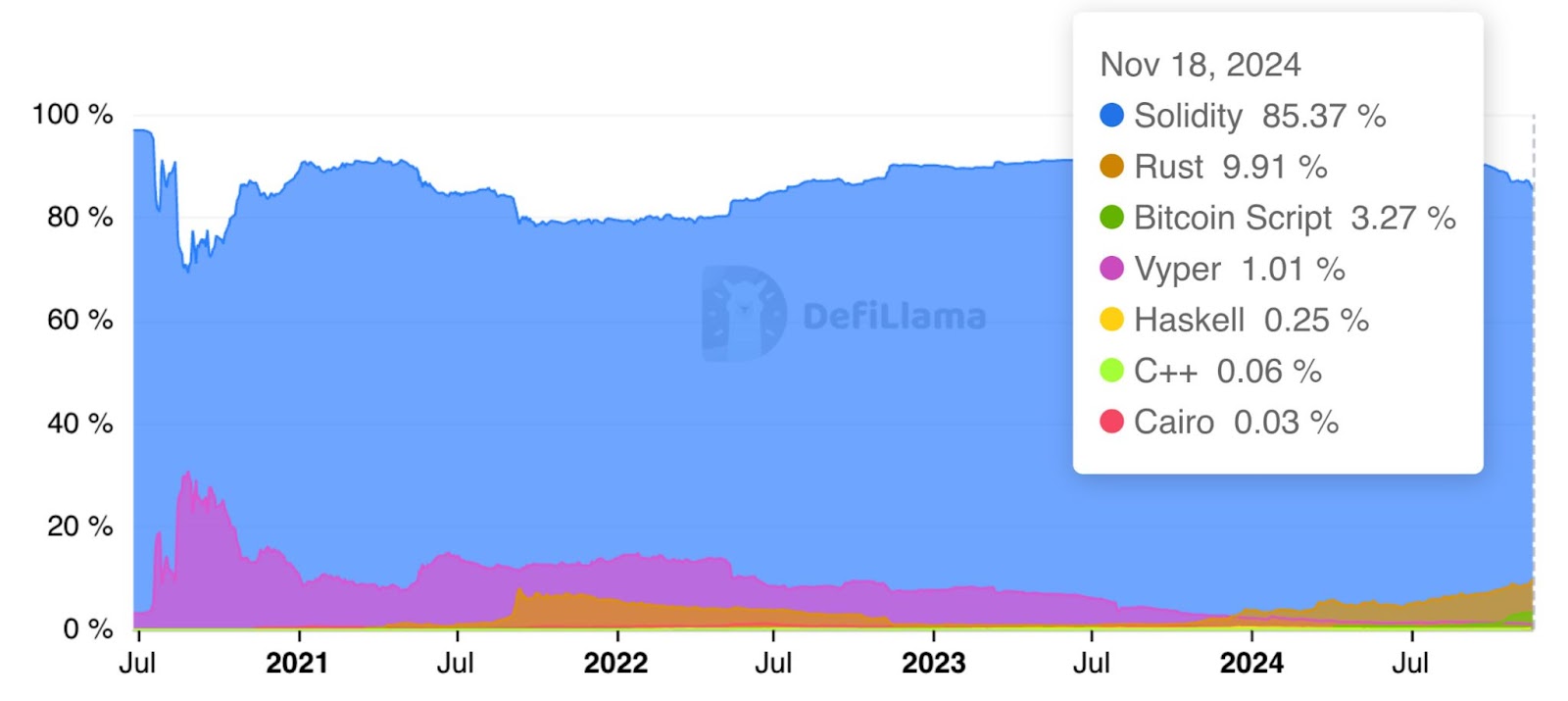 DeFi TVL dominance by smart contract language | Source: Defillama
Its share has steadily eroded since, falling to 13.8% by early 2022, 7.6% by the start of 2023, and just 2.2% at the beginning of 2024. As of this month, Vyper accounts for only about 1% of DeFi TVL, illustrating how the language has struggled to maintain momentum against Solidity’s dominance.
Vyper and Solidity differ significantly in design philosophy and features. In contrast, Solidity’s JavaScript-like syntax is more complex but allows for greater flexibility, catering to developers with experience in traditional programming languages.
Solidity benefits from a mature and extensive ecosystem, with a wide range of tools, libraries and community support, making it the standard for the vast majority of Ethereum projects.
This expansive tooling and the Web3 developer mind share around Solidity have likely contributed to this shift, although it must be noted Vyper’s decline mirrors the rise and fall of TVL within Curve itself.
Despite its shrinking share, Vyper remains a valuable option for security-focused projects, even as its influence in shaping Ethereum smart contract development has waned over time.
Perhaps it is time for a reversal?
According to Egorov, history offers an interesting parallel: In 2005, Python was also a niche language overshadowed by PHP and Java. Over time, Python’s clarity and versatility propelled it to dominate industries like AI and data science. Similarly, Vyper’s focus on security and readability could spark a renaissance as a future-proof language for the next wave of dapps.
There are a ton of Python developers in the world, a fact that Algorand is banking on to bring in a fresh class of developers following the adoption earlier this year of Python as its canonical language.
For Ethereum developers, Vyper may now serve a niche audience — those prioritizing security and simplicity over extensive features. Yet, for projects needing concise and secure smart contracts, it remains a compelling option.
Get the news in your inbox. Explore Blockworks newsletters:
- The Breakdown: Decoding crypto and the markets. Daily.
- 0xResearch: Alpha in your inbox. Think like an analyst.