It’s time to stop theorizing about Satoshi Nakamoto
Satoshi’s identity is crypto’s version of the moon landing
Istvan Csak/Shutterstock modified by Blockworks
This is a segment from the Empire newsletter. To read full editions, subscribe.
Humanity clings to mysteries that border on compulsions at this point.
The moon landing — did we actually go, and if we did, is the footage real? And what about the pyramids — built by laborers and farmers, or were those 80-ton granite blocks actually set in place by ancient alien technology?
Satoshi Nakamoto’s true identity has fast become another cultural oddity that just won’t quit.
Craig Wright was the ringleader of that particular media circus for years, until courts took action against him. Now that Wright is finally proven to be totally wrong, it’s the rest of us that are doomed to be repeatedly punished for the closure.
In the past six months alone, we’ve had multiple fresh attempts at reviving the Nakamoto narrative. First was HBO’s Money Electric: The Bitcoin Mystery, from documentarian Cullen Hoback, and a new documentary from the UK’s Channel 4 lacked compelling evidence, let alone a tangible theory.
You can read my thoughts about HBO’s take, but ultimately it came to the laughable conclusion that long-time Bitcoin contributor Peter Todd was in fact Satoshi, hiding in plain sight.
In between those releases, we were also subjected to threads on X, including one from Matthew Sigel, head of digital asset research at VanEck, which suggested that tech billionaire Jack Dorsey is the man behind the Nakamoto moniker.
Veteran Bitcoiner Jameson Lopp shared his method of debunking the Dorsey theory during a premiere episode of Supply Shock on Thursday — a brand-new Bitcoin brand and podcast hosted by Bitcoin Historian Pete Rizzo.
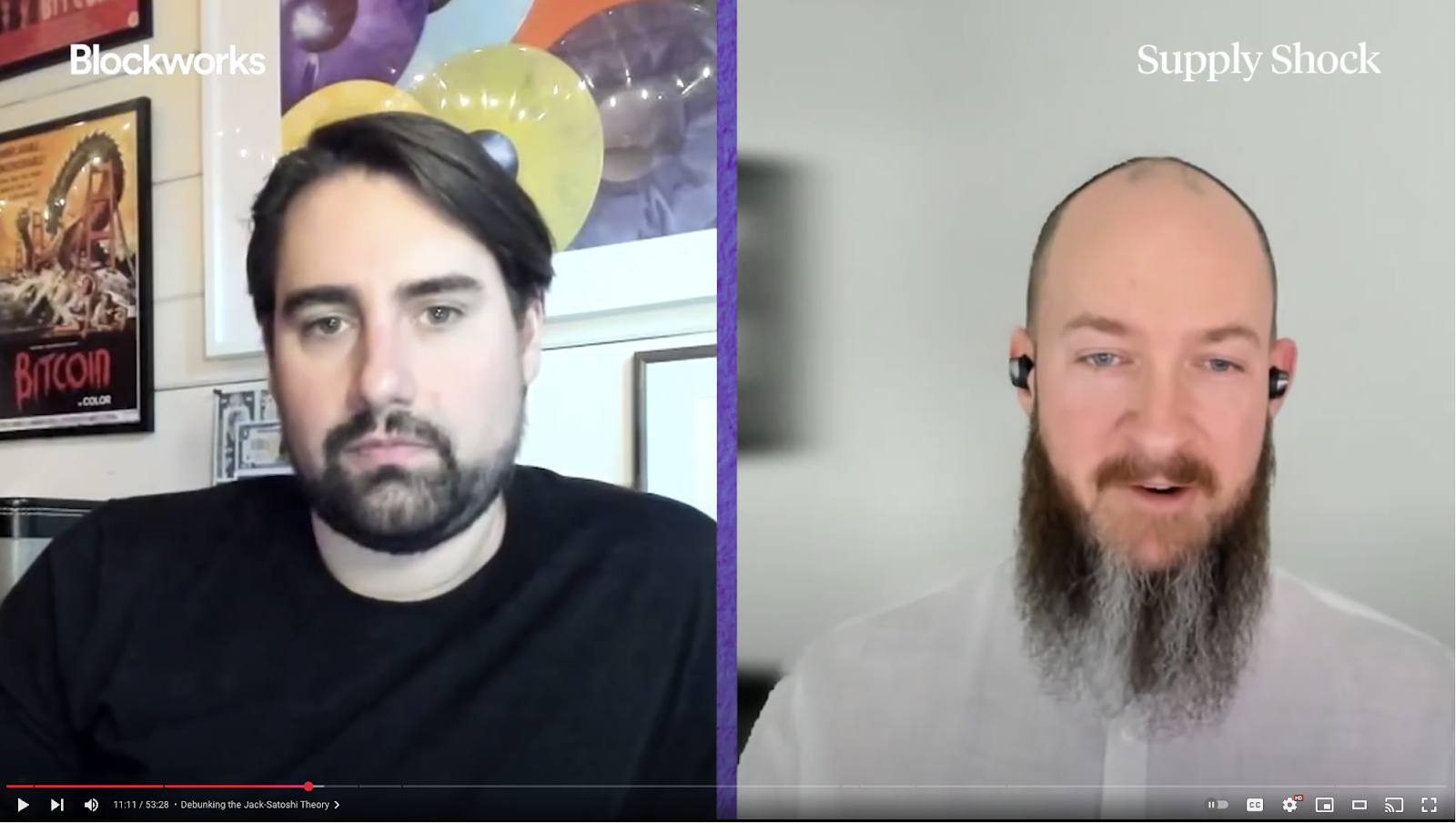 Check out the full episode of Supply Shock on YouTube
Lopp had previously busted an earlier suggestion that Hal Finney was Nakamoto by showing Finney had competed in a 10-mile race in Santa Barbara at the same time Nakamoto was emailing early developer Mike Hearn.
Eventually, Lopp found enough instances, after trawling through Dorsey’s old Twitter posts, where it would have been almost impossible for Dorsey to coordinate a double life as Nakamoto to consider the theory bunk.
“I think a lot of the people who are accused of being Satoshi candidates are Bitcoin legends in their own right,” Lopp told Rizzo.
“Like they don’t have to be Satoshi — they have contributed in a variety of different ways to being Satoshi in the way that we are all Satoshi, right? It’s like anyone who contributes to [Bitcoin] is essentially building upon the legacy where Satoshi, you know, left the project open to the world so that anyone who cared could contribute to it.”
If it weren’t obvious by now, here it is: Nobody can ever prove any theory in any case. The only legitimate proof would be to sign a transaction with one of Satoshi’s keys — but even if someone did, we would likely never know for sure how those keys came into their possession — sending us on a never-ending loop of inconclusive proof.
It’s high time we relegate the Satoshi question to the annals of boring normie talking points, like the moon landing and pyramids, and move on.
Speaking of, you won’t see me much around Empire for the foreseeable future. I’m headed on a spirit quest to learn more about this whole Bitcoin thing, I hear it might be a big deal. It’s been a pleasure.
Get the news in your inbox. Explore Blockworks newsletters:
- The Breakdown: Decoding crypto and the markets. Daily.
- 0xResearch: Alpha in your inbox. Think like an analyst.
