How Ross Ulbricht could’ve been the richest Bitcoiner on Earth
You can’t put a price on freedom, but this comes close

Freeross.org and Adobe modified by Blockworks
This is a segment from the Supply Shock newsletter. To read full editions, subscribe.
I subscribe to the multiverse theory.
So, drifting in an endless sea of cosmic baubles beyond the borders of our universe, is a world where Ross Ulbricht has more bitcoin than any other person on Earth.
Unfortunately, the following happened in our shared reality.
It was around this time in 2014 that the US government, through the Marshals Service, was preparing its first ever bitcoin auction: almost 30,000 BTC seized from the Silk Road master wallet.
The coins would’ve technically been worth around $18 million back then, the equivalent of nearly 20% of the average daily BTC trading volume, per Bitcoinity data. Currently, they’d fetch $3.3 billion.
Ross was arrested eight months earlier and had been held at MDC Brooklyn as he awaited trial, which wouldn’t start for another half a year.
On this day, 11 years ago, the US Marshals goofed: The agency accidentally reply-alled to an emailed question from a prospective buyer, revealing the names and/or email addresses of all 40 bidders on the auction list.
US Marshal auctions are meant to be anonymous, so it was clearly a SNAFU.
CoinDesk identified 17 individuals as a result of the incident — all executives from in and outside crypto — including Barry Silbert, Fred Ehrsam and Michael Moro. A USMS spokesperson quickly apologized.
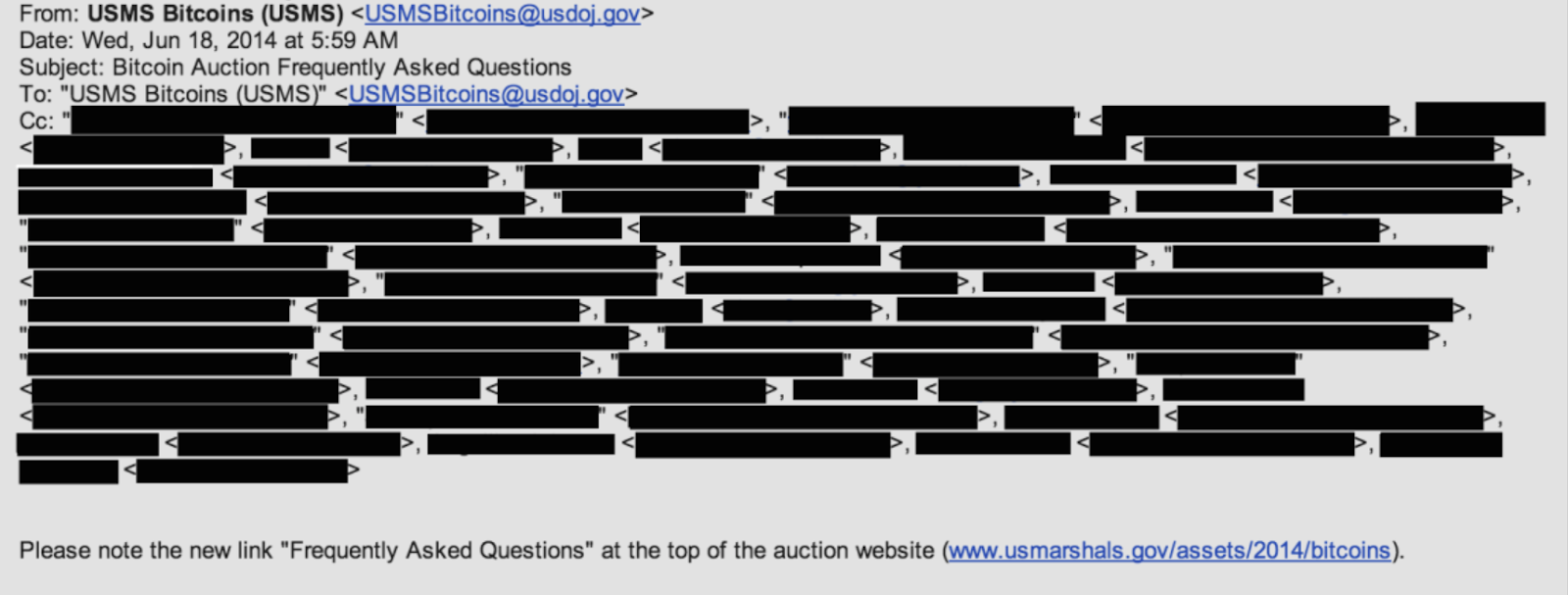 A copy of the email with names and emails redacted (source).
In the end, someone who wasn’t identified ended up winning the whole stash of coins: legendary VC Tim Draper, who paid about $19 million. Draper said he would use the coins as liquidity to back an institutional-grade Bitcoin exchange and financial services platform, Vaurum, which was later rebranded to Mirror.
Mirror never made it out of its invite-only phase. After a series of pivots, the platform quietly went defunct in late 2018.
As for the rest of Ulbricht’s coins, authorities seized 144,336 BTC personally belonging to Ross shortly after his arrest.
Ross initially fought to block the sale of those coins but was unsuccessful, with the government making only $48 million at auction. Their current value would be in excess of $15 billion.
A combined 120,045 BTC was later seized from two individuals who had hacked Silk Road’s operational wallets on separate occasions.
In that alternate universe, where Ross still controls all of Silk Road’s bitcoin as they were in 2013, and his personal stash, his total balance would be 294,045 BTC ($30.7 billion) — about half Strategy’s current BTC treasury.
If pooled into one address, it would be the largest bitcoin balance on the entire network. Of course, Ross could’ve done anything with those coins between then and now, in that other universe.
At least in this one, Ross still got his freedom.
Get the news in your inbox. Explore Blockworks newsletters:
- The Breakdown: Decoding crypto and the markets. Daily.
- 0xResearch: Alpha in your inbox. Think like an analyst.
