Bored Ape, CryptoPunk NFT Floor Prices Lag Bitcoin
NFT marketplace volumes are at their highest point since May, while average sales for blue chips are rising
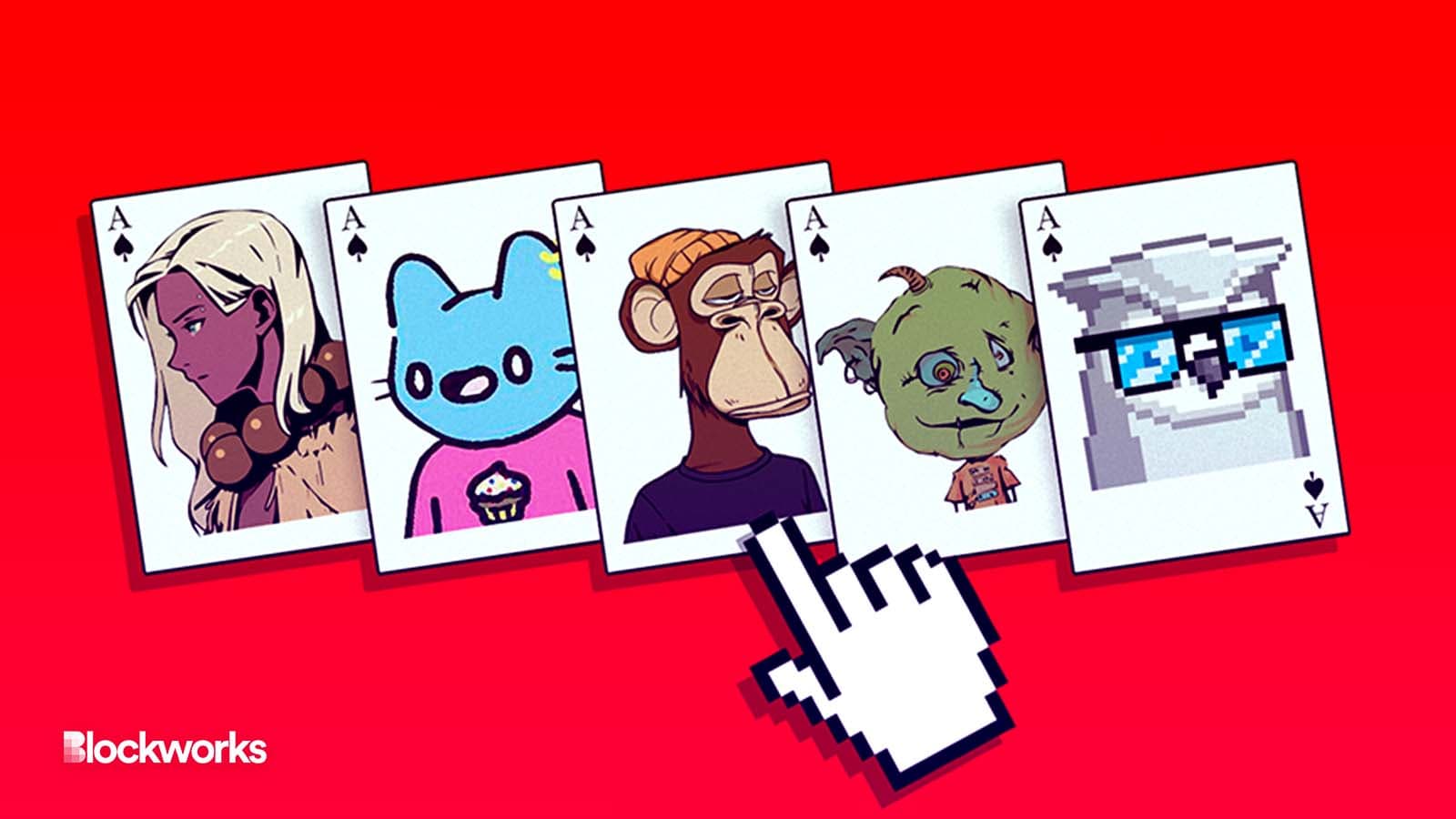
Blockworks exclusive art by Axel Rangel
Rising bitcoin and ether prices have offered short-term reprieve for battered crypto markets, but floor prices for Bored Apes and CryptoPunks have barely budged.
Both bitcoin (BTC) and ether (ETH) are up nearly 40% year to date, both reaching highs not seen in around five months.
On the other hand, Bored Ape Yacht Club (BAYC) and CryptoPunks’ floor prices — representing the last sale price of the cheapest NFT in each collection — are down between 5% and 8% since Jan. 1, hovering at 66 ETH ($107,000) and 63 ETH ($102,000), respectively.
It’s worth noting that floor prices are generally denominated in ether, which has indeed appreciated in US dollars. So, some assets have seen softening floor prices to adjust for those rises; Azuki’s floor is up a meager 8% year to date while Art Blocks’ Chromie Squiggles’ has dropped 17%, per NFTFloorPrice.
Average sale prices, however, are faring better, even when denominated in ether. All aforementioned projects have seen upticks between 14% and 35% over the past 30 days, led by Azuki.
Those figures were propelled by trades at the top end of each collection — the most expensive sales for Chromie Squiggles, Azuki and CryptoPunks are up hundreds of percentage points over the past 30 days, while BAYC’s has dropped 27%.
Marketplace volumes have also surged since the start of December, when about $160 million in NFTs flowed through venues like OpenSea and Blur, the buzzy new platform promising to reward NFT traders with a token airdrop on Valentine’s Day, next month.
Those marketplaces recorded nearly $231 million over the past week, per a Dune Analytics dashboard, marking their highest point since May — a 40% jump.
“This shows how NFT trading volume is subject to market sentiment and bitcoin’s volatility, after bitcoin experienced a 50% move over the past few weeks,” Marcus Sotiriou, market analyst at GlobalBlock, told Blockworks.
ApeCoin rallies alongside NFT volumes
While BAYC trade volumes have diminished 30% over the past 30 days, creator Yuga Labs has seen success with an adjacent NFT collection. Sewer Pass, launched on Jan. 18, is a free mint meant for existing BAYC and Mutant Ape Yacht Club holders.
Sewer Pass is a significant development for many speculators who wondered how Yuga’s ecosystem would develop beyond BAYC. It essentially provides access to a game called Dookey Dash, which is a component of Yuga’s ‘Jimmy the Monkey’ storyline. The game started on Jan. 18 and can be played until Feb. 8.
Sewer Pass NFTs have crossed $14 million in secondary sales volume, raking in $700,000 in secondary sale revenue (based on a 5% royalty for Yuga as of Jan. 20, according to Galaxy Digital).
Those gains have been reflected in ApeCoin (APE), the cryptocurrency central to Yuga Labs’ in-development BAYC metaverse, which has jumped nearly 65% year to date.
Less positively, German automobile maker Porsche debuted its first NFT this week, but it failed to take off as its floor price fell within hours of the mint.
Updated Jan. 24, 2022 at 12:58 pm ET: Added context for floor price denomination.
Get the news in your inbox. Explore Blockworks newsletters:
- The Breakdown: Decoding crypto and the markets. Daily.
- 0xResearch: Alpha in your inbox. Think like an analyst.
