Busting the myth of efficient markets
How financial markets actively shape the reality they’re meant to measure

Overearth/Shalitha Ranathunge/Shutterstock and Adobe modified by Blockworks
This is a segment from The Breakdown newsletter. To read full editions, subscribe.
There’s a profound difference between knowing something intellectually and knowing it viscerally — like reading a physics textbook versus watching MythBusters explode a water heater.
The textbook tells you that heating water in a closed system builds hydraulic pressure as the water’s volume tries to expand.
You read the words, you understand the theory of phase-change physics.
But MythBusters demonstrates how pressure can turn a water heater into a rocket that shoots 500 feet in the air.
You watch their YouTube video, you understand the reality of a catastrophic steam explosion.
Showing can be more valuable than telling.
Last week, Brian Armstrong showed us George Soros’ theory of reflexivity in a real-world experiment that would make the MythBusters proud.
After fielding questions from analysts on an earnings call for Coinbase, Armstrong read out all the remaining words that people in prediction markets had been betting he might say.
“I was tracking the prediction market about what Coinbase will say on their next earnings call,” he said at the very end of the call. “And I just want to add here the words Bitcoin, Ethereum, blockchain, staking, and Web3.”
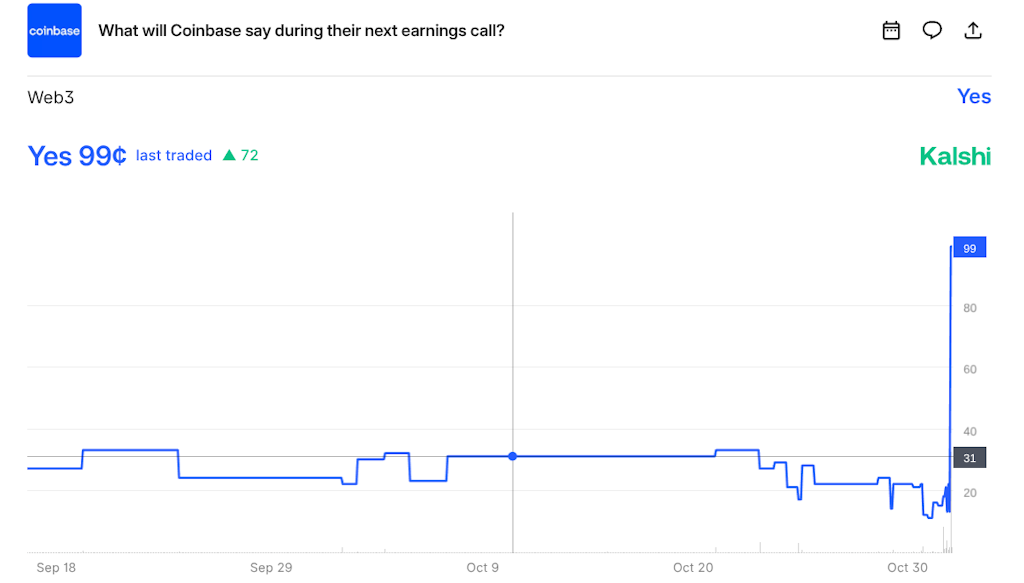
This got mixed reviews, with some finding it an amusing stunt and others calling it market manipulation.
I’d argue it was neither.
Instead, I view it as a vivid illustration of how most financial markets work, as explained by George Soros’ theory that market prices affect the value of the assets they’re attempting to price.
Soros, who aspired to be a philosopher before deciding to be a billionaire hedge-fund manager, credits his success to identifying a flaw in the theory of efficient markets: “Market prices always distort the fundamentals.”
Instead of passively reflecting an asset’s fundamentals, as conventional wisdom assumes, financial markets actively shape the reality they’re meant to measure.
Soros cites the 1960s craze for conglomerates as an example: Investors believed these companies could create value by buying smaller, cheaper companies, so investors bid up their stocks — which, in turn, allowed them to create value by using their inflated share prices to buy smaller, cheaper firms.
In short, this created a “continuous and circular” feedback loop where participants’ thinking influenced the events they were betting on — and those events in turn influenced their thinking.
Today, Soros might cite the example of digital asset treasury companies like Strategy, which Michael Saylor pitches to investors with the circular logic that they should value Strategy shares at a multiple of NAV because trading at a multiple of NAV makes the shares valuable.
Writing in 2009, Soros used his theory of reflexivity to argue that the root cause of the Great Financial Crisis was the basic misperception that “the value of [real estate] collateral is independent of the availability of credit.”
The prevailing view was that banks had merely overvalued the real estate securing their loans, while investors had overpaid for the derivatives backed by those loans.
And that is sometimes how it works — a simple mispricing of assets.
But Soros argued that the monumental scale of the financial crisis in 2008 could only be explained by a feedback loop. Investors overpaid for credit, which drove up the value of the collateral that backed it: “When credit becomes cheaper and more easily available, activity picks up and real estate values rise.”
And higher real estate values, in turn, encouraged credit investors to overpay even more.
In theory, prices for credit derivatives like CDOs should reflect real-estate values. In practice, they helped create them.
That, at least, is how a textbook would explain Soros’ theory of financial reflexivity.
But Armstrong didn’t just explain it, he demonstrated it, MythBusters-style.
By saying the words people were betting he’d say, he showed that participants’ views (the prediction market) can directly shape an outcome (what he said) — exactly what Soros meant when he said market prices can distort the underlying fundamentals.
This is a timely lesson because the current AI bubble is Armstrong’s experiment at a multitrillion-dollar scale: People think AGI will happen, so they’re investing in OpenAI, Nvidia, data centers, etc, which makes AGI more likely to happen, which makes more people invest in OpenAI…
This captures the full meaning of Soros’ famous comment on bubbles: He rushes in to buy because buying makes prices go up and higher prices strengthen the fundamentals — which draws in even more buyers.
But Soros would warn investors against believing in self-fulfilling prophecies because, in the extreme case of a bubble, investors drive up prices faster than prices can drive up fundamentals.
“A positive feedback process that runs its full course is initially self reinforcing,” Soros wrote with the Great Financial Crisis in mind, “but eventually it is liable to reach a climax or reversal point, after which it becomes self reinforcing in the opposite direction.”
In other words, trees don’t grow into the sky and bubbles don’t inflate forever.
There’s no real-world, MythBusters-type experiment to demonstrate that, unfortunately.
At the very least, though, we now know that market prices can make things happen, like words in an earnings call transcript.
So why not AGI too?
Get the news in your inbox. Explore Blockworks newsletters:
- The Breakdown: Decoding crypto and the markets. Daily.
- 0xResearch: Alpha in your inbox. Think like an analyst.
