MicroStrategy spent $17.5B on bitcoin in the last 2 months
Most of that cash has come from buyers of its zero-percent convertible bonds

Tigarto/Shutterstock modified by Blockworks
This is a segment from the Empire newsletter. To read full editions, subscribe.
MicroStrategy is sucking most of the air out of the room right now. But there are even bigger forces at play.
As debate rages over whether Saylor is a once-in-a-lifetime financial genius or just another overleveraged trader, stablecoins are bringing even more liquidity to crypto.
At least, that’s in terms of raw dollar value being pumped into the space right now.
MSTR has now spent $17.5 billion on bitcoin in the past two months alone, as shown by the orange areas on the chart below. Most of that cash has come from buyers of its infamous zero-percent convertible bonds.
MicroStrategy’s purchases can then be viewed simply as accepting dollars with one hand and plowing them into bitcoin with the other. Fast and cheap liquidity in return for exposure.
In the same period, bitcoin ETFs in the US have gained an additional $16.5 billion in net inflows. ETH ETFs have otherwise net added $3 billion, and together those flows are in blue on the chart.
ETFs follow much the same process as MicroStrategy but without the bonds. They take investor cash to buy an equivalent amount of bitcoin or ether, passing on exposure to shareholders minus a fee.
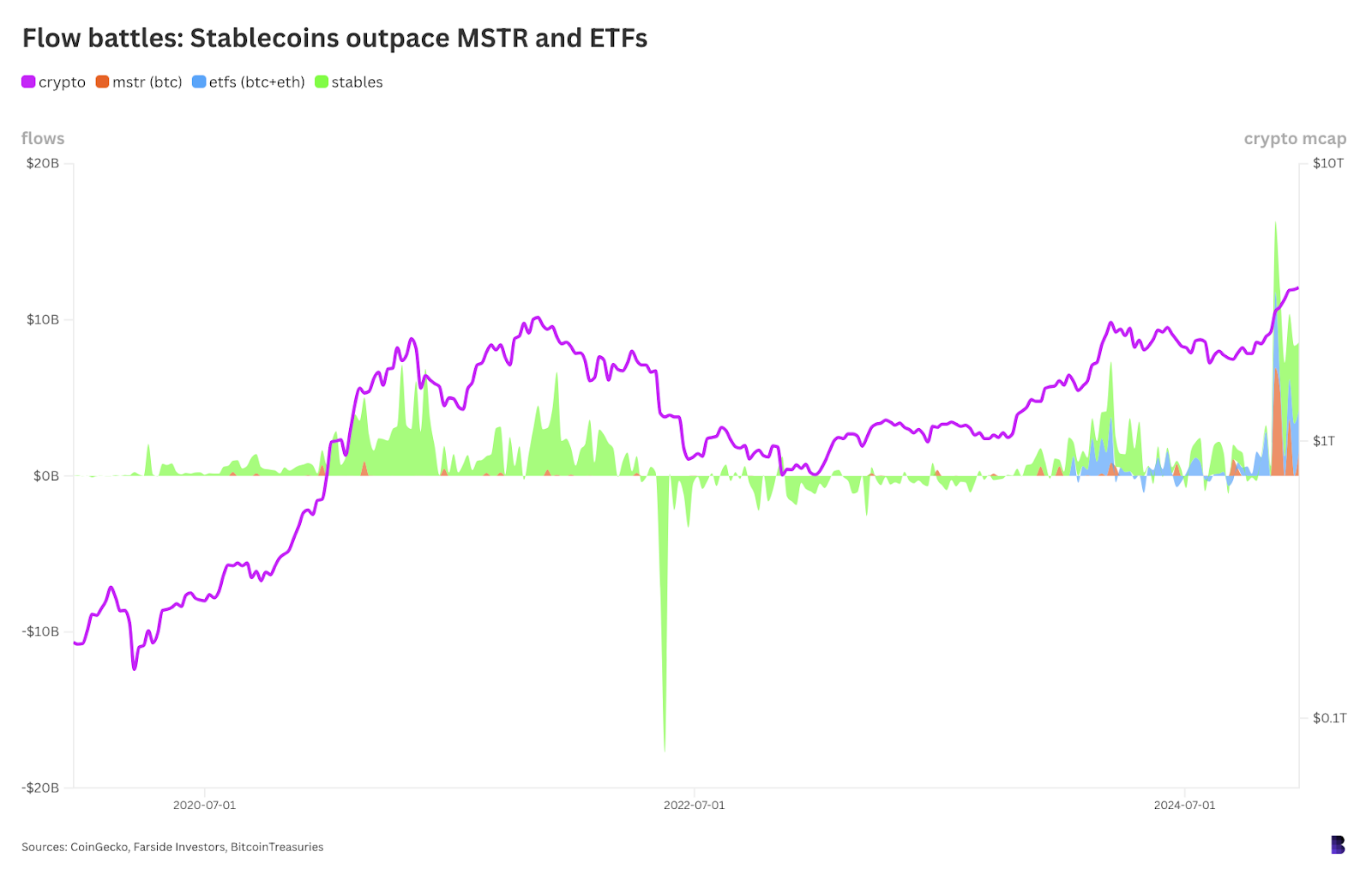 Stablecoins, MicroStrategy’s bitcoin buys and ETF inflows converged in November
And then there’s stablecoins. Since mid-October, stablecoins issuers have collectively minted an additional $30.8 billion tokens. Over 92% of those inflows have gone to USDT and USDC.
Outside of Sky’s USDS and the more exotic alternatives that have emerged, such as Ethena’s USDe and Usual’s USD0, stablecoin managers generally take US dollars, buy short-dated Treasurys and other cash equivalents and then issue the same amount of fresh token supply to whomever wired them cash.
Obviously, stablecoins flows aren’t really the same thing as ETF inflows or MSTR’s cash pipeline.
But they do represent something similar: a widespread urge to enter crypto markets across a multitude of avenues.
That’s now to the tune of almost $68 billion in the past nine weeks — easily the biggest liquidity wave on record, at least by my count.
Get the news in your inbox. Explore Blockworks newsletters:
- The Breakdown: Decoding crypto and the markets. Daily.
- 0xResearch: Alpha in your inbox. Think like an analyst.
