Why the market isn’t buying the bitcoin dip
A Glassnode report found that the accumulation range for bitcoin is ‘weak,’ indicating a decline in demand
Gabriele Paoletti/Shutterstock, modified by Blockworks
This is a segment from the Empire newsletter. To read full editions, subscribe.
Bitcoin’s had some strong sell-side pressure since the start of the year.
I know, not shocking. But bear with me, yeah?
Glassnode tracked bitcoin’s cyclical behavior, finding that the latest “distribution phase” (aka selling) started back in January.
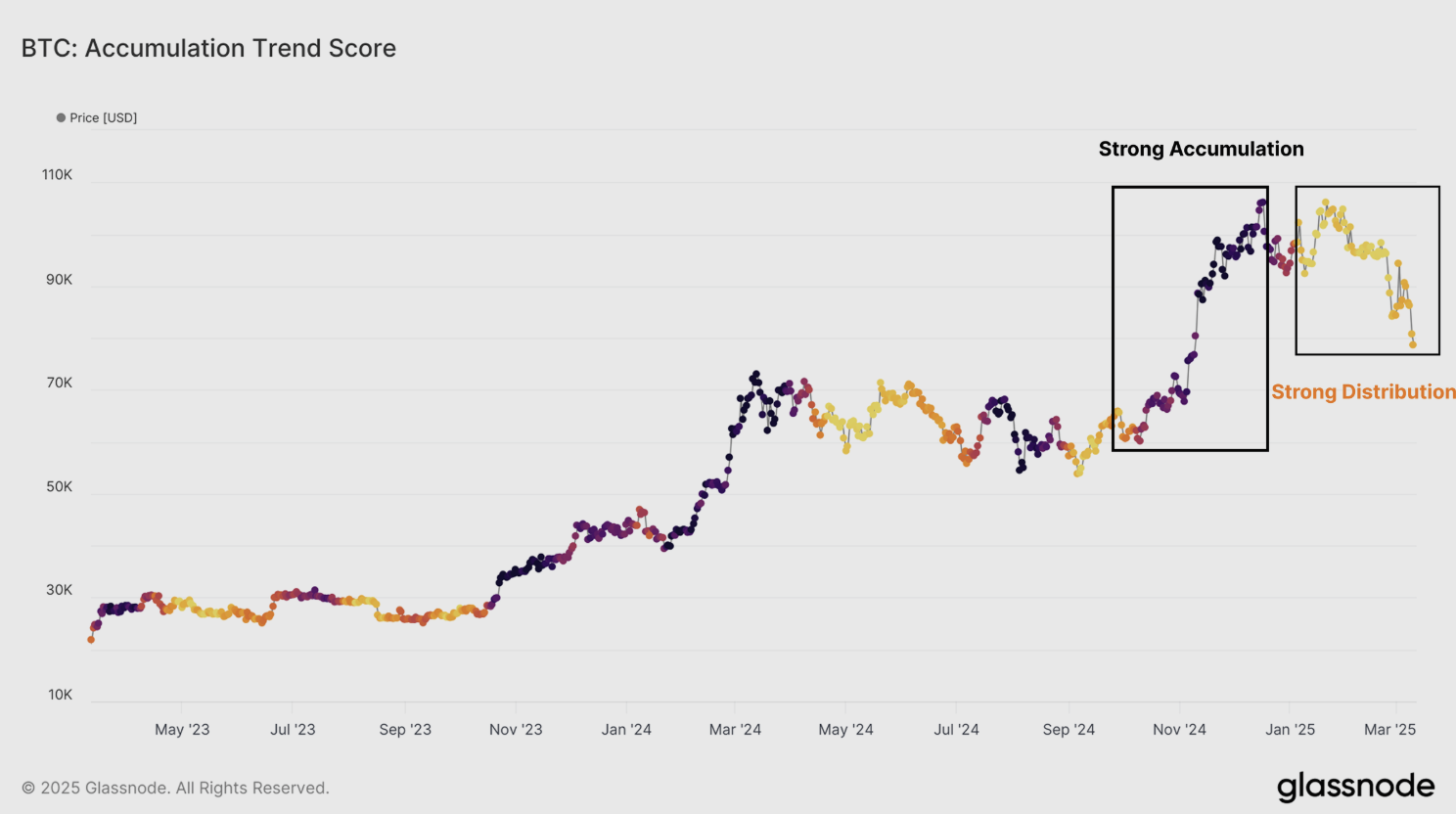 Chart showing bitcoin accumulation trends in the past 2 years
The Accumulation Trend Score, which “measures the relative change in aggregate onchain balances,” is still signaling that there’ll be more sell-side pressure. Unfortunately, the score is also influenced by the moves of larger entities.
Prior to late February, there was a pattern of adding to bitcoin positions in the $95,000 to $98,000 range, but that fell off as liquidity conditions changed (thanks, macro).
 A look at the accumulation range and its subsequent dip
Now the accumulation range sits between $78,000 and $92,000, which Glassnode labeled as “weak.”
 See? Glassnote chart of “Weak Accumulation” period, from Feb. 23-Mar. 9
So it’s starting to look like we’re not getting as many folks interested in buying the dip right now.
“Using the cost-basis of Short-Term Holders, we can see that market momentum and capital flows have turned negative, signaling a decline in demand strength, and investor uncertainty is affecting sentiment and confidence,” Glassnode wrote.
Reading into this: I’m not all that surprised, especially given the headlines around a potential US recession and some weaker-than-we-wanted economic data.
And I know what you’re thinking: “Investing in bitcoin diversifies your portfolio away from the macro of it all!”
You’re not wrong. But you’re also not entirely right. Glassnode’s note ー that a lot of this is coming from bigger entities ー means that the institutions who are getting exposure to bitcoin will also be more likely to offload it as a risk asset when the environment becomes a bit too risk-on.
We’re just not there yet in the whole “bitcoin’s digital gold” argument. But hey, we’re making strides every single cycle.
Get the news in your inbox. Explore Blockworks newsletters:
- The Breakdown: Decoding crypto and the markets. Daily.
- 0xResearch: Alpha in your inbox. Think like an analyst.
