Liquity aims to build on safety record with V2 using staked ether
The team behind the decentralized ether-backed stablecoin LUSD hopes to solve the “stablecoin trilemma”

WindAwake/Shutterstock modified by Blockworks
The team behind decentralized stablecoin protocol Liquity lifted the curtain on a long-awaited sequel to its ether-backed LUSD on Monday, this time using staked ether as collateral and a new reserve mechanism.
In the current version, borrowers use ether as collateral to mint LUSD at a 0% interest rate, after a one-time borrowing fee — currently 0.5%. The team made the new version public at EthCC in Paris.
Ever since liquid staked ether gained traction, Liquity community members in the project’s Discord have speculated about a new version of the system to take advantage of staking yields.
LUSD is small by stablecoin standards, with a supply that peaked at $1.5 billion in May 2021, and now sits at under $300 million. That’s partly a result of its design.
Just as there’s a blockchain trilemma, there’s a trilemma specific to stablecoins comprising decentralization, stability and scalability.
LUSD is decentralized — its smart contracts are immutable — and stable, but not scalable because it relies on overcollateralization of ether, currently at 260% of LUSD.
These properties have earned it a “A” safety rating from Bluechip.org, a new nonprofit organization dedicated to evaluating stablecoins, according to Garett Jones, co-founder and chief economist.
“We’re basically doing the equivalent of a value at risk assessment,” Jones told Blockworks. “Even in the worst 30-day period that Ethereum has had since inception, [Liquity’s collateralization] would still be sufficient.” And it’s not susceptible to governance attacks that have haunted some stablecoin efforts.
The problem for scaling LUSD is that ether is a productive asset — with demand from staking surging — and locking up 200% percent to borrow a stablecoin is not very capital efficient. But if you could power your borrowing with a yield-generating asset, that’s another story.
The rise of LST-based forks
Until recently, the team has been coy about their plans for a new version.
And it would have to be completely new; like Uniswap, Liquity’s smart contracts cannot be upgraded. But unlike virtually all DeFi protocols, Liquity doesn’t have its own front-end website, preferring to outsource that function to the community.
The main impediment to a new version is the relative immaturity — and therefore increased risks — of the various flavors of liquid staking tokens (LSTs) that could conceivably be employed.
Maintaining flexibility by launching an upgradeable version of Liquity would run counter to its decentralized ethos.
It has been clear for some time that there was going to be market demand for such a product, however.
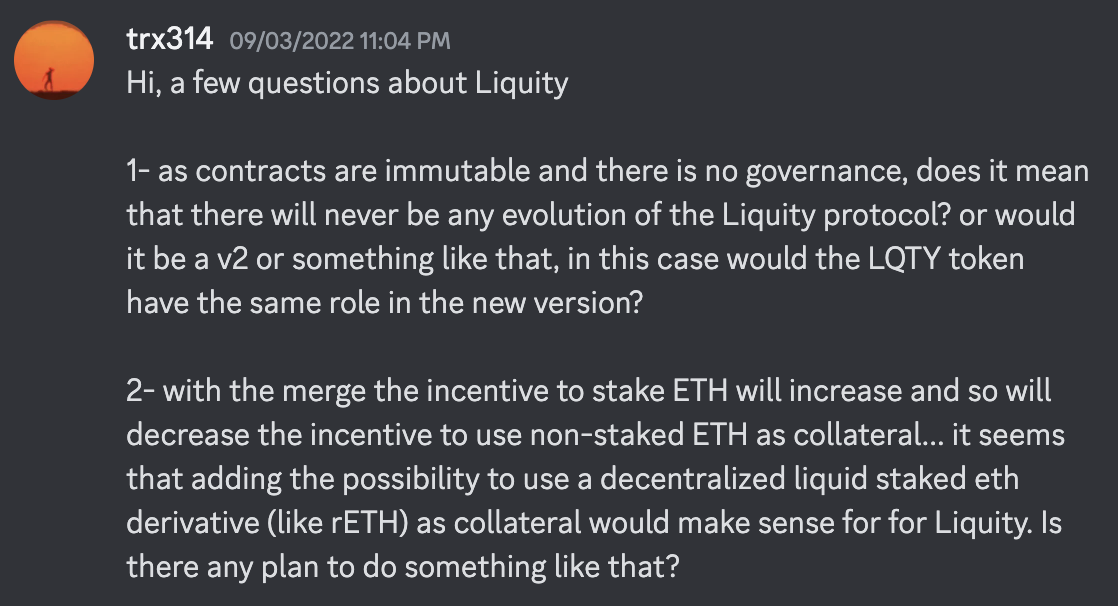
By the time of Ethereum’s Shapella upgrade, which enabled withdrawals and significantly de-risked the use of LSTs, the team was well aware that multiple projects were working on a Liquity-like product using Lido’s stETH and other LSTs.
Raft Finance, announced its intention to do so on March 20, and Gravita and Lybra soon followed in April — all forked from Liquity’s open-source code, with none connected to the Liquity team.
Collectively, the upstarts have minted about $243 million in stablecoins, R, GRAI and eUSD on Ethereum, although these have tended to drift more than 1% away from their $1 peg thus far.
The decentralized reserve
One challenge to stablecoin stability is maintaining sufficient liquidity on decentralized and centralized exchanges, said Robert Lauko, Liquity’s founder, in his Paris presentation.
“Normally you would need to pay out a lot of incentives to have liquid secondary markets,” he said. That’s why Liquity intends to use a newer approach to collateral backing, which Lauko calls “a decentralized reserve.”
The design has yet to be finalized, but the basic idea is to combine a delta-neutral hedging mechanism with an attractive leverage product that includes some principal protection to remove the risk of liquidation.
The protocol will both act as its own market maker and insurance fund, while protecting itself from bank runs, Lauko said.
“We are now in a phase where we want to open up our research…we would love to hear your insights, criticisms, reactions about the new project and product and also see whether we can take it to the next level.”
The new protocol — which will likely receive its own brand name — is expected to go live in 2024.
Get the news in your inbox. Explore Blockworks newsletters:
- The Breakdown: Decoding crypto and the markets. Daily.
- 0xResearch: Alpha in your inbox. Think like an analyst.