Jim Cramer is right: Dog coin ETFs are this bull market’s missing spark
There will be no altcoin season until we get ETFs for all the dog coins

a katz/Shutterstock modified by Blockworks
All things considered, there probably won’t be a BONK ETF anytime soon.
But the notion that cryptocurrencies might one day invade the stodgy stock market via ETFs is seriously compelling.
Mad Money host Jim Cramer was on the right track during his CNBC appearance yesterday. “Why shouldn’t there be a BONK ETF?” Cramer asked SEC Chair Gary Gensler.
However, the real trick to getting SEC approval has turned out to be courting CME, which is regulated by the CFTC — and not Gensler’s agency. Bitcoin and ether both had futures markets for years before spot ETFs were approved.
Perhaps a dog coin fund might be an easier sell. Coinbase Derivatives, which is also regulated by the CFTC, launched its own dogecoin futures markets not long ago.
CME Group denied it had any plans for dogecoin futures when rumors circulated in 2021. What better time to revisit that decision than now?
CNBC talks memecoins — a bull signal?
It wasn’t even just a BONK ETF that was floated on CNBC yesterday. Cramer also made the case for ETFs backed by sushiswap, polkadot, cardano (he called it “cordano”), immutable, ronin and osmosis and myneighbouralice.
“[They have] all traded millions — I’m talking millions of dollars this very morning… I would think that BONK is a natural, and osmosis… shouldn’t we have some sort of product?”
Gensler sidestepped by redirecting the question to the matter of disclosure. Today is the SEC’s 90th birthday, he said, and reminded the audience (talking into the camera) that President Roosevelt created the Commission to ensure sellers of securities openly inform prospective investors so they can make better decisions.
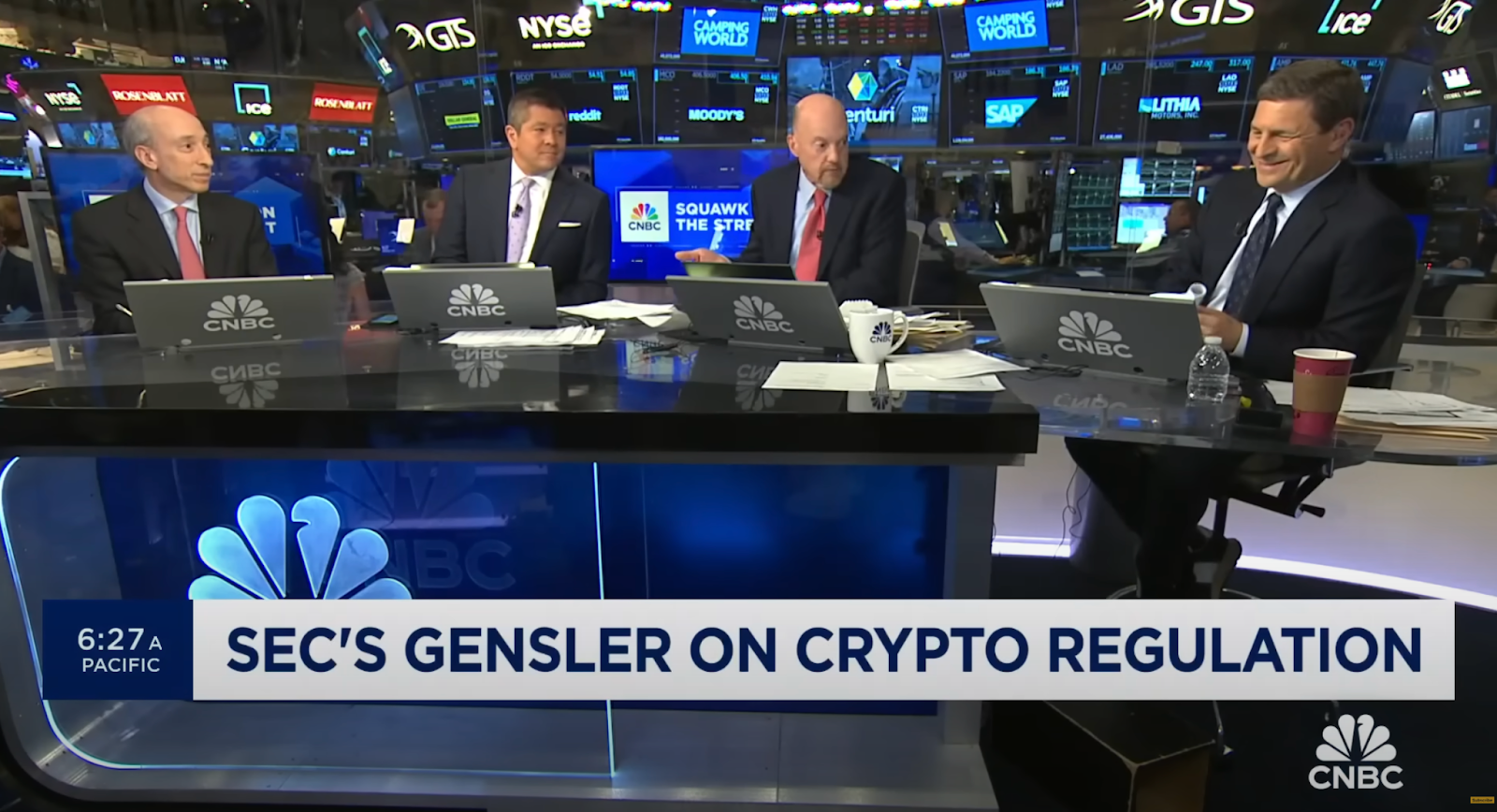 The moment Gensler found out about $CRAMER, which spiked up to 500% following the segment (Source: CNBC Television)
Gensler’s point was that those disclosures supposedly aren’t happening across crypto. If you ask lobbyists, industry lawyers and founders, this is because issuers and protocol stewards simply don’t consider the tokens securities or investment contracts — so there’s no disclosure required. And in many cases, there’s no centralized entity through which to disclose.
Read more from our opinion section: Memecoin mania can teach us something
Then Gensler came for the crypto exchanges.
“These crypto exchanges, Jim, are doing things we would never allow this New York Stock Exchange to do,” Gensler said. “Our laws don’t allow you to trade against your customers.”
But the previous questions were awkward for Gensler, even before Cramer brought up memecoins that borrow likenesses of celebrities and other media personalities, including himself and the SEC chair.
(Gensler said those should be registered as securities, but it’s unclear whether he fully grokked the concept of memecoins about public figures that weren’t issued by the actual person.)
Cramer may not have remembered, but the SEC already labeled cardano a security in both Coinbase and Binance lawsuits filed last June, alongside a dozen others including solana, polygon, BNB, internet computer, filecoin and Axie Infinity.
So far, the companies and entities working to build out those ecosystems haven’t been sued — just crypto exchanges found listing them. Tron founder Justin Sun was sued separately months before over TRX and bittorrent (BTT), while the SEC stung Ripple Labs for XRP in December 2020 and sent Uniswap Labs a Wells notice in April.
Still, the Binance and Coinbase lawsuits coincided with a severe drop in the bitcoin ratios for the tokens singled out by the SEC.
Most had fallen more than 10% against bitcoin in the three days following the suits, with those losses doubling over the next two weeks or so. Bitcoin itself dropped around 7% over the same period.
To date, only bitcoin ratios for solana and near have made it back out of the 13 tokens named by the SEC, followed by ICP, which is only just short. Ironically, near and ICP have been largely invigorated by the AI narrative, of which Gensler is a huge fan.
However, beating bitcoin (and thus growing the bitcoin ratio) has been tough this bull market, and tons of cryptocurrencies that haven’t been named as securities by the SEC have underperformed.
This bull market has been lacking a true altcoin season. Perhaps a few filings for dogecoin ETFs will be the catalyst.
Get the news in your inbox. Explore Blockworks newsletters:
- The Breakdown: Decoding crypto and the markets. Daily.
- 0xResearch: Alpha in your inbox. Think like an analyst.
