French Central Bank Trades Debt Securities on Private Blockchain
European plans for a Central Bank Digital Currency (CBDC) are moving from a research and experimental phase to practical applications.
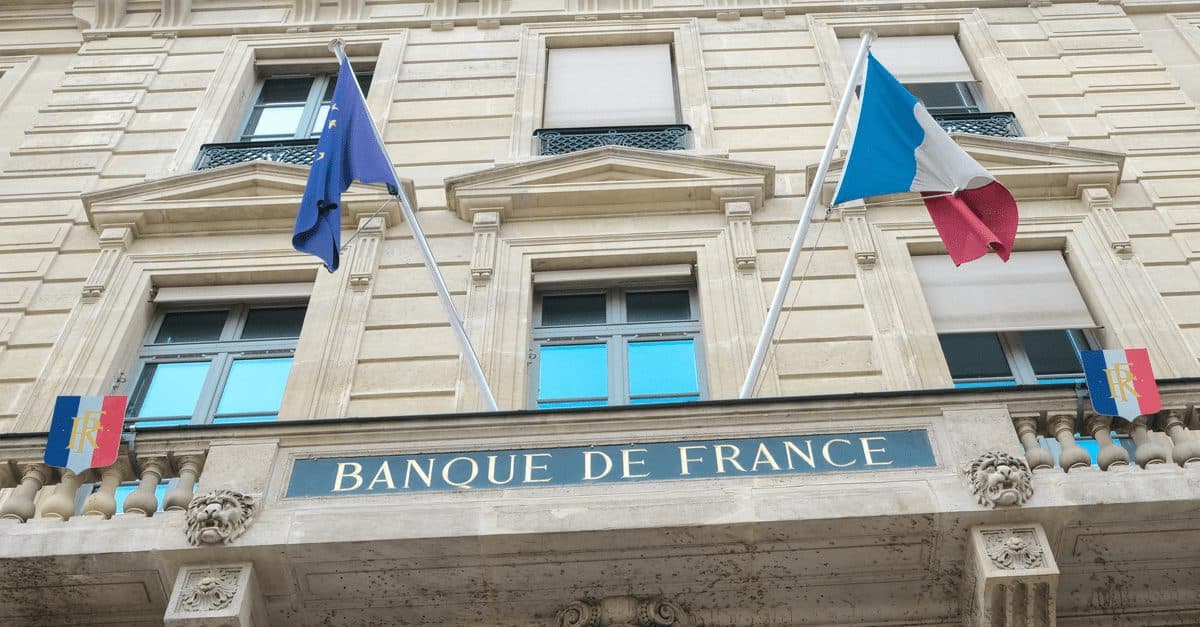
Bank de France; Source: Shutterstock
- A consortium of banks and financial institutions including BNP Paribas, HSBC and Société Générale participated, along with Agence France Trésor, the Debt Management Office of the French government
- Goal of the project was to look at how blockchain could reduce the overall cost and increase the efficiency of the capital markets
The French central bank — Banque de France — embarked on a test of a digital euro in March 2020, to learn how a European CBDC could be used in the exchange and settlement of tokenized financial assets using a permissioned blockchain. A consortium of banks and financial institutions including BNP Paribas, HSBC and Société Générale participated, along with Agence France Trésor, the Debt Management Office of the French government.
According to a report published by Euroclear, a Belgium-based financial services company that led the project, the experiment “showed the capacity of blockchain platforms to coexist and interoperate with existing settlement infrastructures.”
“By attracting more direct market participants on a common ledger for post trade operations, blockchain could also reduce the overall cost and increase the efficiency of the capital markets,” the report states.
An embrace of blockchain, Euroclear concludes, provides opportunities for the market to “change the way it organised so as to reduce trade to settlement cycles, increase direct market participation and reduce reconciliation efforts.”
These are advantages — in short, speeding transaction settlement and reducing costs — that have been long championed by advocates of DeFi, but they can also serve public and private institutions that rely on more centralized infrastructure.
A permissioned blockchain
The French project is not operating on a public blockchain, such as Ethereum, nor do they regard a public blockchain as desirable for the intended use case, where “a framework of control, privacy and confidentiality” were requirements. Instead, with IBM as a technology partner, a permissioned blockchain using Hyperledger Fabric was employed to run the experiment via just three network nodes. (For comparison, Ethereum’s mainnet has about 3,740 nodes currently.)
The parties were aiming to simulate real market activity at scale, with Agence France Trésor issuing securities tokens and Banque de France issuing CBDC tokens using the IBM-built blockchain. The securities’ had an International Securities Identification Number (ISIN) generated by smart contracts, which also managed the auto-collateralization on settlement flows.
In a video posted to YouTube by Eurorclear, Guénolé de Cadoudal, of Crédit Agricole, said, “the tested on-chain business logic demonstrated the benefits of an automatic cash and security liquidity pool by leveraging on-chain portfolios as collateral.”
The participants also found that a token-based approach proved to be just as efficient as an account-based one, with the former better able to facilitate cross-border funds flows.
Euroclear’s Philippe Verriest calls the experiment a success that “demonstrates that a broad range of post-trade operations can be run on blockchain,” adding that, “we believe the blockchain technology could increase the overall efficiency of post-trade operations.”
While blockchain aficionados and industry participants are likely to read this as restating the obvious, it is important to see major public and financial institutions acknowledge the technological merits.
The next step will be to compare these experiments to those running on public infrastructure. Société Générale has recently undertaken to embark on one such effort by posting real estate bonds as collateral with MakerDAO.
For now, the reports’ authors conclude:
“It does not seem possible for a public blockchain model to meet all the regulatory requirements to run post-trade activities.”
Perhaps as the technology matures, French institutions can reassess which is more compatible with the principles of liberté, égalité, fraternité.
This story was updated on October 20, 2021, at 10:13 am ET.
