The long wait for crypto’s “coffee pot” moment
In the 90s, rapt audiences worldwide watched a coffee pot — will that fascination ever turn to crypto?

mtkang/valeriya kozoriz/Shutterstock and Adobe modified by Blockworks
This is a segment from The Breakdown newsletter. To read full editions, subscribe.
“Technology is everything that doesn’t work yet.”
— Danny Hillis
The world’s first webcam was an inadvertent hit.
Computer scientists at a University of Cambridge lab, to avoid the disappointment of walking to the kitchen only to find their communal coffee pot empty, cobbled together a network application called XCoffee.
A spare video camera, mounted in the kitchen and connected to the laboratory’s network via Ethernet, was programmed to send low-resolution photos of the coffee pot to the scientists’ desktops every 20 seconds or so.
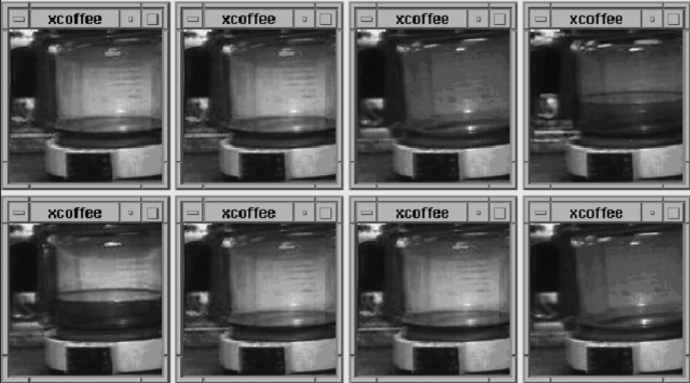
It was a novel arrangement in 1991 — and when the researchers migrated it from the laboratory network to the still-novel world wide web in 1993, it became the world’s first webcam.
It also became the web’s first mainstream use case.
The world wide web was a lonely place in 1993, with few web pages to look at and no search engines to find them with.
Somehow, though, people found their way to the coffee pot webcam.
These early surfers of the internet were so eager to do something — anything! — on the web that they found themselves enthralled by a fixed view of a standard coffee pot.
Is it almost empty? Is the coffee getting darker? Has someone had a cup while I was away???
It was reality TV at its very worst.
It was also a hit.
The opportunity to keep tabs on a Cambridge coffee pot must have spread strictly by word of mouth, because there was no social media to share it on, no search engines to find it with.
But the pot’s audience grew steadily, with the lab’s servers receiving first hundreds and then thousands of visitors — and then exponentially: Millions of people were soon using the web to monitor someone else’s coffee.
One of the lab’s researchers received emails from Japan requesting that the kitchen light be left on overnight so that people in different time zones could have a chance to watch the (presumably empty) coffee pot.
The Cambridge, England tourist information office began offering directions to the lab to visitors hoping to see the star coffee pot in real life.
Finally, peak coffee pot mania hit in 2001, when the lab’s decision to permanently unplug its webcam made front-page headlines.
By that time, there were more substantial things to do on the internet, of course, like watching cat videos and pirating music — and not much later, there would be all-consuming things to do like scrolling through Facebook and posting videos on TikTok.
None of that was imaginable in 1993. But the popularity of the coffee pot webcam was a first hint that the world wide web would soon go mainstream: People’s eagerness to use the web to watch coffee stay warm was a clear sign they’d also want to use it for anything and everything.
This is a hallmark of great technology: If people are eager to use new tech when it’s not very good (three-frames-per-minute video) and for unexpected reasons (watching coffee), it’s a surefire bet that much bigger things are coming.
So, here’s something on my wishlist for 2024 2026: Crypto has its coffee pot moment.
Get the news in your inbox. Explore Blockworks newsletters:
- The Breakdown: Decoding crypto and the markets. Daily.
- 0xResearch: Alpha in your inbox. Think like an analyst.