Crypto fundamentals are back
As speculative hype fades, investors are revisiting fundamentals, favoring price multiples and token buybacks

Master1305/Shutterstock modified by Blockworks
This is a segment from the 0xResearch newsletter. To read full editions, subscribe.
The permissionless nature of crypto means anyone with a computer and internet connection can have a bag. That makes it really hard to value tokens.
Price-to-sales multiples of L1s like Cardano or Ripple trade at absurd four to five figure ranges, far above actual value-generating L1s like Solana (32x) and Ethereum (227x).
Then there are tokens like OM (who?) that are clocking in the highest price gains of 47.6% since the industry’s biggest liquidation earlier this month.
No rational explanation exists. It’s all narrative and “speculative premiums.”
But is that going to stop investors from trying to formally value tokens? No, because there is a lot of money to be made from unearthing the gems.
In the short history of this industry, investors have tried to value L1s with a variety of now-abandoned tools like the stock-to-flow model, total-value-locked to market cap ratios or proof-of-stake staking cash flow yields.
The latest shift in investor sentiment around token valuations is doubling down on an emphasis on the importance of fundamentals.
Maelstrom fund points to Vertex perps DEX, arguing that markets are “underestimating” the DEX’s growth and that it “should” be trading at a 200% to 300% greater valuation in line with its peers.
1kxnetwork fund’s recently published Ronin chain thesis points to the gaming chain’s deflationary burn of SLP, plus rising daily active users and breakout revenue-generating game Pixels ($20.7 million in 2024).
Applications like Raydium, Hyperliquid, Metaplex, GEODNET, and Jupiter are all trading at reasonably “rational” P/S ratios that are based on consistent cash flows and more measurable growth potential.
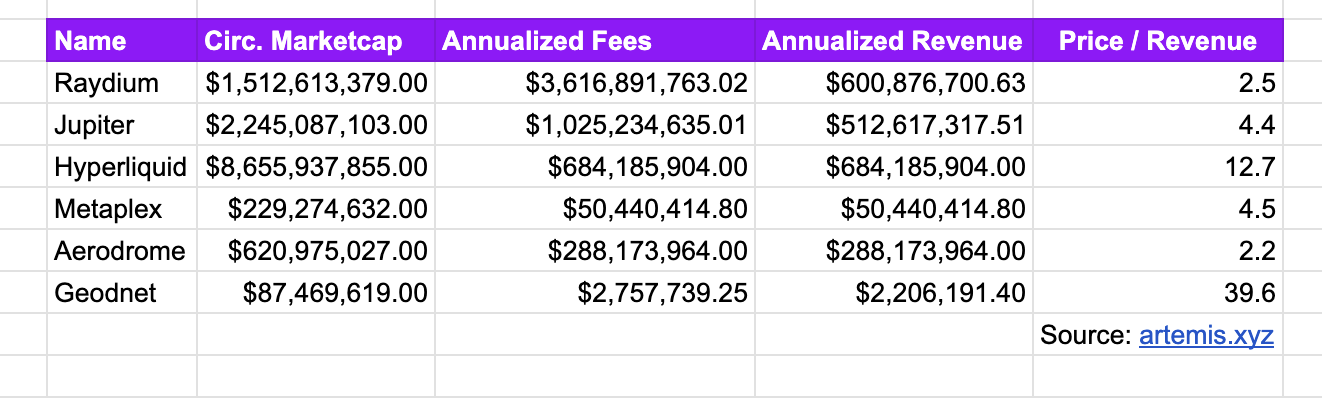 Source: Artemis
Many of these projects are also engaging in huge token buybacks, often perceived as a “fundamentals-driven” strategy to improve the attractiveness of price multiples.
Jupiter’s token buyback program may quite possibly be the largest (in USD terms) with a commitment of 50% protocol fees. That comes up to a buyback of ~9.4% of JUP’s total circulating supply, based on this rough estimate.
Supporting the point that “fundamentals are back” is also the ugly reality of declining L1/L2 valuations.
The fabled “Layer-1 premium” is slowly evaporating. L1s in the previous cycle like Starknet raised at eye-popping valuations of $8 billion, while newer L1s command less than half of those valuations (Berachain $420 million, Story Protocol $2.25 billion, Celestia $3.5 billion).
The down-only price action of most L1s/L2s in the last 12 months will likely grind future valuation numbers down even further.
Application revenues are also beginning to outpace the revenues of the underlying L1 and L2 protocols, Blockworks’ Dan Smith points out.
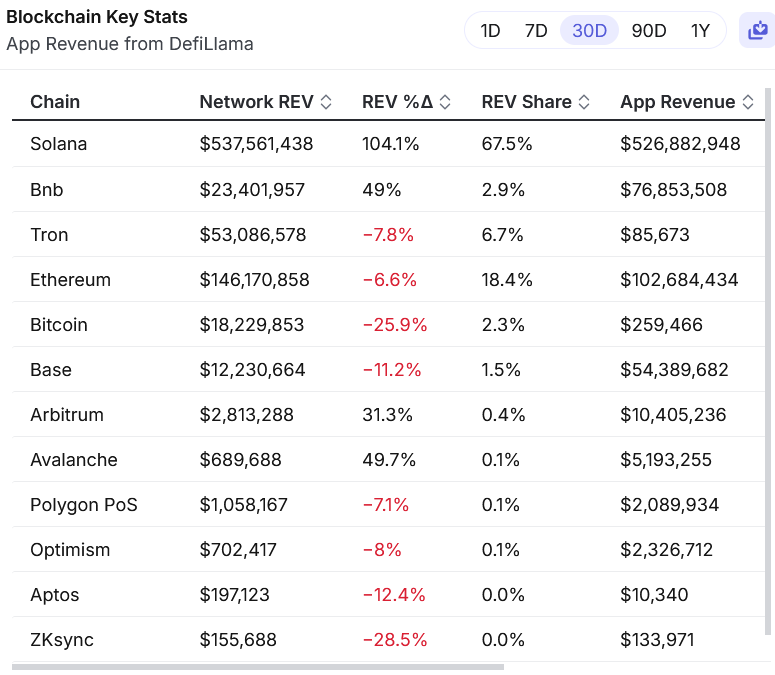 Source: Blockworks Research
This all hinges on the growing disdain of the industry’s infrastructure bloat. The fat protocol thesis is no longer, now is the era of the fat app thesis.
Get the news in your inbox. Explore Blockworks newsletters:
- The Breakdown: Decoding crypto and the markets. Daily.
- 0xResearch: Alpha in your inbox. Think like an analyst.
