CME data suggests institutions are field-testing new crypto moves
CME’s large bitcoin contracts are so big that investors are turning to micro bitcoin contracts

CME Group global head of cryptocurrency products Giovanni Vicioso | Ben Solomon Photo LLC for Blockworks
This is a segment from the Empire newsletter. To read full editions, subscribe.
We’re just barely halfway through the month and CME’s crypto unit is already logging its best month since it launched bitcoin futures contracts way back in 2017.
As many loyal Empire readers know, I like to look at CME data to understand where traders and institutions are putting their money.
So, yesterday I caught up with Gio Vicioso, CME’s head of crypto. Turns out, the firm is averaging “a little bit over $10 billion a day across our futures suite.”
“Just comparing November this year to last, our volume and contract terms are up more than 5x … and then we’re also seeing increases or records in terms of open interest, where November is also the record month, averaging more than 166,000 contracts. And that’s up 60% compared to October, and up over 3x compared to November 2023,” Vicioso said.
The large bitcoin contracts offered by CME are becoming so big that investors — primarily retail — are turning to CME’s micro bitcoin contracts.
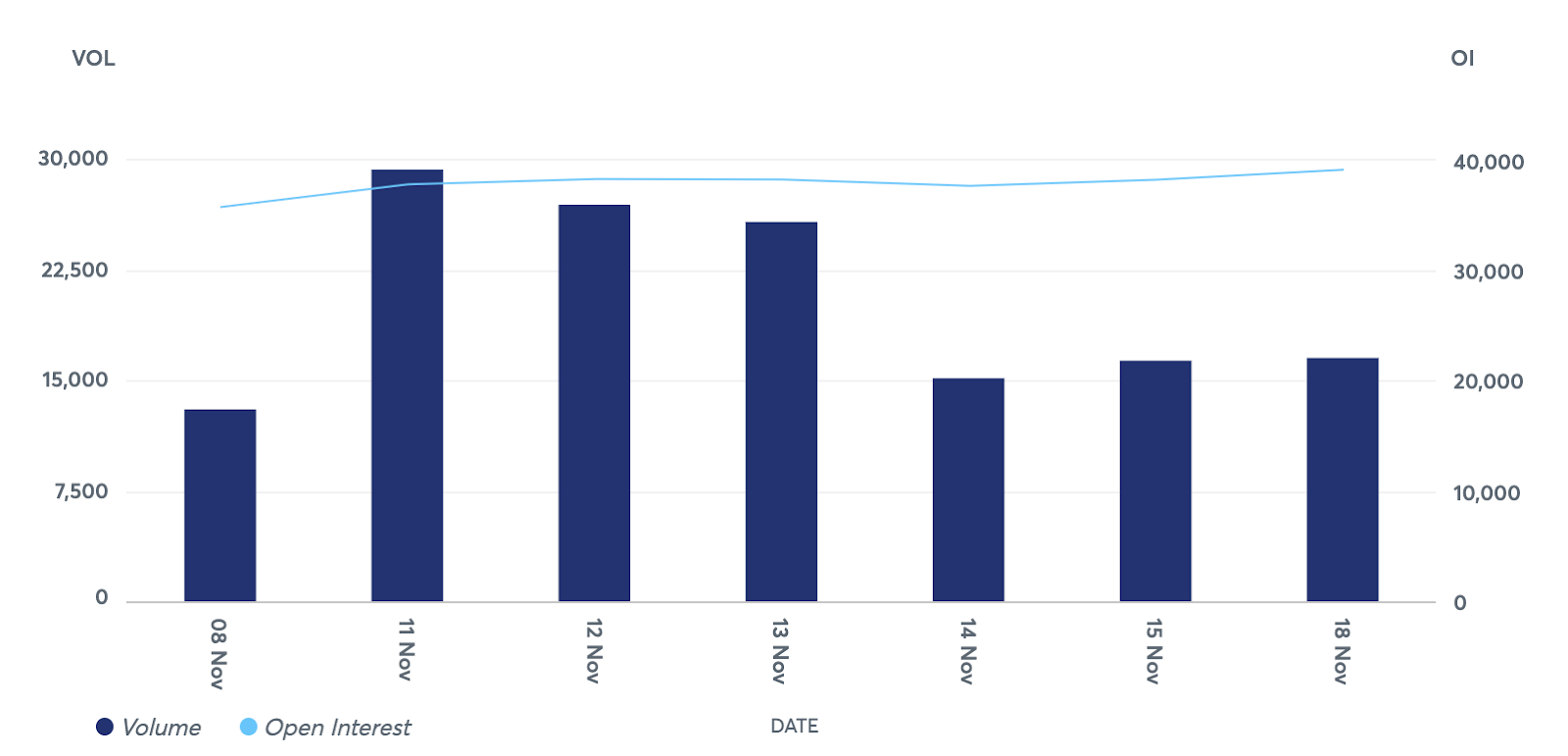 A look at the volume CME’s seen since the election
“Now we’re seeing an increase in volume in terms of our micro contracts, where those contracts, over the last couple weeks, have been averaging more than a billion dollars a day. When we look at the year, our micro bitcoin contract was averaging between $200 to $300 million per day, and we’re also seeing an uptick in terms of the representation of that smaller contract to the larger contract, whereas for the year, micro bitcoin futures volume represented roughly 6% of bitcoin volumes,” he said.
“Over the past few trading sessions, we’ve seen a micro contract represent now north of 15% or so of the large bitcoin contracts. We’ve really seen increases across the board.”
The makeup of participants is mixed, Vicioso noted. Micro contracts are seeing a fairly even spread of retail and institutional buyers given that the margin is a more “manageable” number. The readthrough for institutions, in that case, is that they could be testing out fresh strategies and finetuning their exposure.
 Source: CME
With all of this interest, there is a pickup in volatility across both ether and bitcoin. Vicioso said it’s “par for the course” and isn’t terribly worried. But he noted that the momentum we’ve seen from bitcoin has carried through a lot of this year and it looks to be a continuing trend.
Large Open Interest Holders — which means any entity holding over 25 contracts — is soaring. As of last Friday, CME recorded a record of around 600 large open interest holders in their futures contracts.
“So both our standard BTC and ETH contracts, as well as our micro BTC and ETH contracts, all achieved records in terms of the number of large open interest holders holding those contracts,” Vicioso said.
Updated Nov. 19, 2024 at 2:36 pm ET: Corrected Open Interest to Large Open Interest Holders.
Get the news in your inbox. Explore Blockworks newsletters:
- The Breakdown: Decoding crypto and the markets. Daily.
- 0xResearch: Alpha in your inbox. Think like an analyst.
