Cardano Price Rests at 2017 Levels Following Crypto’s 5th Birthday
The veteran top-10 crypto has been chugging along since 2017, but with little adoption to show for it

Source: Shutterstock
- Cardano has been a member of the top 10 by market cap for most of its existence
- ADA is down 86% from its all-time high, the second-biggest decliner among the top 10 next to DOGE
Cardano, the so-called “third-generation blockchain,” has been a first-class loser when it comes to price this far into the 2022 bear market.
The perennial top-10 crypto, which briefly reached as high as the number 3 spot behind ether and bitcoin for a few months in 2021, has fallen about 86% from its September 2021 peak of just over $3 per coin.
The chain’s total value locked (TVL) has similarly slid 77% from a March 2022 peak, according to DefiLlama — and now stands at roughly $76 million, good for the 27th by that metric.
Among the project’s latest highlights: an effort to authenticate wine from the nation of Georgia, and “crypto-backed algorithmic stablecoin that acts as an autonomous bank,” dubbed Djed — a tough sell in a post-Terra environment.
Its decentralized applications (dapps) have also struggled to compete with other layer-1s. The so-called Plutus smart contracts underlying dapps are unique to Cardano and written in a relatively uncommon coding language, Haskell. That means dapps cannot be easily ported over from Ethereum, the way they can be deployed to an Ethereum virtual machine (EVM)-compatible layer-1 blockchain.
Cardano has taken steps to attract developers and has ranked well in developer activity metrics, according to analytics firm Santiment. But a year on from the Alonzo hard fork, which first added smart contract functionality, its largest DeFi decentralized exchange, Minswap, is recording less than $1 million in volume on a typical day.
From Byron to Voltaire
The ethos of Cardano has been slow, meticulous progress along a roadmap of five eras named for famous writers: Byron, Shelley, Goguen, Basho and Voltaire.
Now, in the Basho era, the most recent upgrade, Vasil, was, in terms of complexity, on par with the Ethereum Merge, according to Cardano founder Charles Hoskinson.
The upgrade brings with it a version 2 of Plutus, expected to increase dapps’ throughput from about 1.5 transactions per second (TPS) to as much as nine. That may not sound like a lot compared to Ethereum layer-2s or Solana, but proponents point out that comparing Cardano’s Unspent Transaction Output (UTXO)-based model to an account model such as Ethereum’s is not exactly apples to apples.
Even so, according to Starbloom Ventures’ Evan van Ness, the bulk of Cardano’s transaction activity is simple cardano (ADA) transfers, not smart contract activity.
Like the historic Ethereum switch to proof-of-stake, Vasil provided no immediate boost to the ADA price.
Both its price and its market cap remain stuck in the Byron era, finding support at around $0.42, since the May crypto market crash, but setting progressively lower highs.
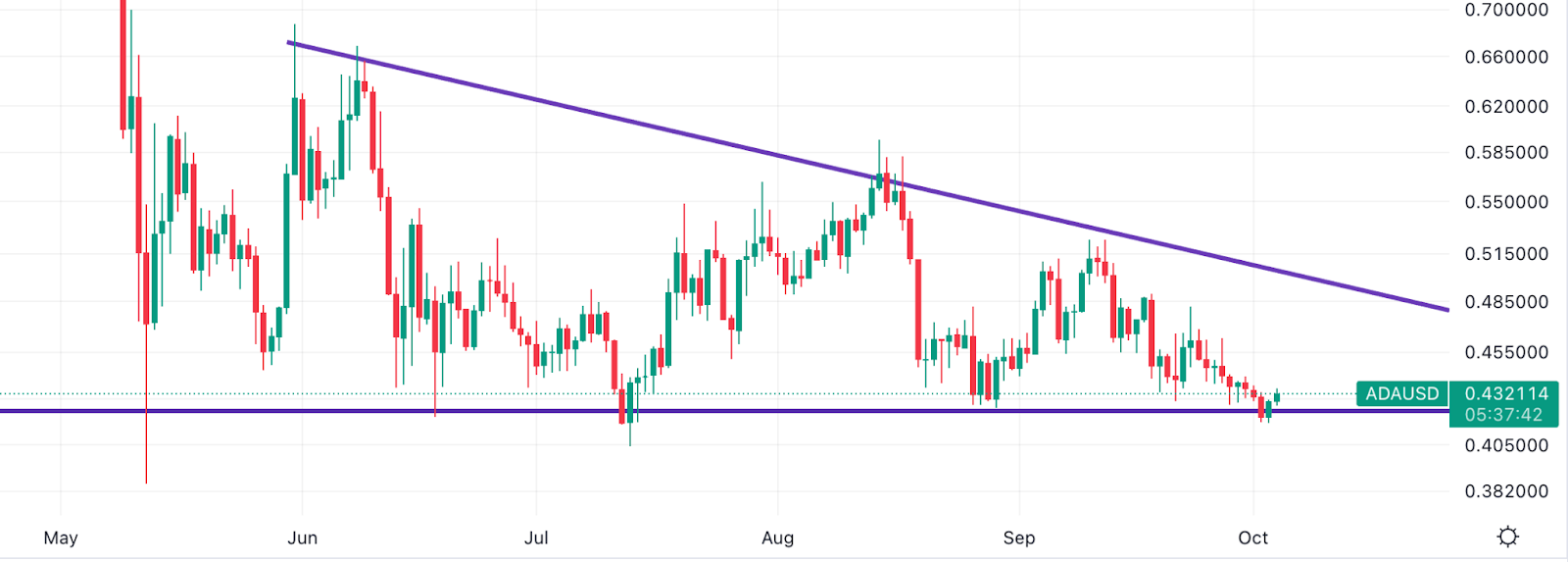
It’s not clear whether Basho’s focus on scaling will be enough of a catalyst to turn that around.
Cardano’s original roadmap is set to come to a close in 2023, Hoskinson said, calling it “the strongest, most resilient self-governing organism ever conceived, with a population in the millions and much utility for all.”
Added Hoskinson: “There are many challenges to come; there’s many upgrades to do.”
Get the news in your inbox. Explore Blockworks newsletters:
- The Breakdown: Decoding crypto and the markets. Daily.
- 0xResearch: Alpha in your inbox. Think like an analyst.
