Why Bitcoin’s biggest mixer walked away from ‘huge profits’
The writing was on the wall for BitMixer

vectorfusionart/Shutterstock and Adobe modified by Blockworks
This is a segment from the Supply Shock newsletter. To read full editions, subscribe.
A few years back at Bitcoin Amsterdam, I watched Core contributor Sjors Provoost make a point about the right to financial privacy in today’s digital world.
“I go to the bathroom at the train station right now. If I pay with my debit card, these records are kept for at least a decade. So the bank can actually look up, 10 years from now, exactly at what time I went to the bathroom. I think that is ridiculous, and I think everybody would agree that’s ridiculous.
“I think we should change the financial system to [stop doing] that.”
The panel featuring Provoost was about how the Financial Action Task Force (FATF) threatens Bitcoin privacy.
Which, to be fair, is something the intergovernmental agency has absolutely done over the past decade or so. FATF’s anti-money-laundering policies directly influence how worldwide regulators treat Bitcoin mixers and other privacy protocols built around more trustless implementations like CoinJoin.
Surprise, they really don’t like them.
It was on this day in 2017 that BitMixer, then considered the largest Bitcoin mixer by volume, bowed out altogether amid rolling raids on darknet marketplaces across the world.
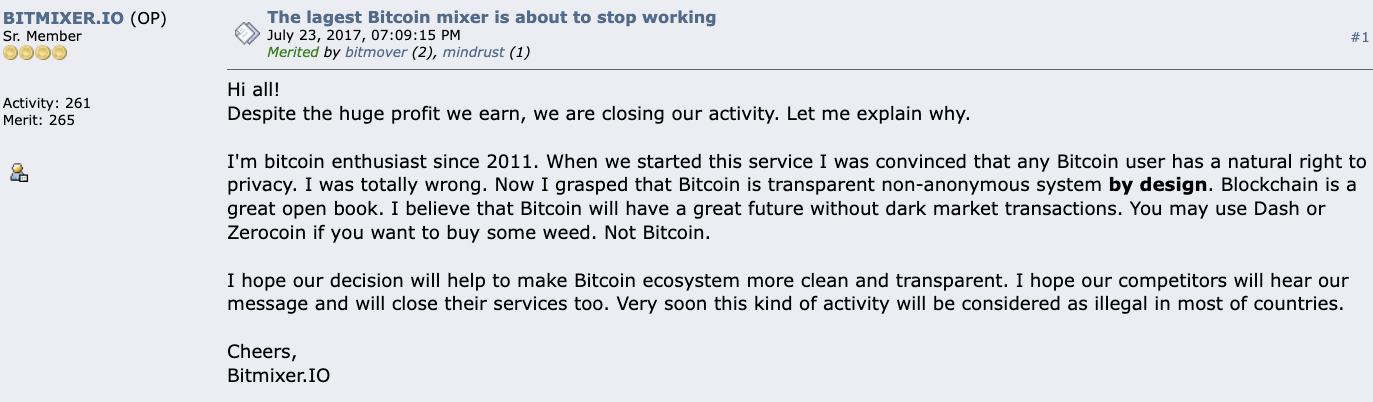 In the comments, the OP was adamant that they were not shutting down due to any interaction with authorities.
BitMixer was the quintessential centralized mixing service. Users would enter some parameters onto a website and send bitcoin to an address, after which they would receive the same amount of coins back, minus a fee. The bitcoin received was made of entirely different UXTOs, which helped to break any blockchain analysis that might link them to the original sender.
All standard for most Bitcoin mixers, including its predecessor Bitcoin Fog. Where BitMixer stood out was its reliability and speed, particularly for large orders, having accepted up to 2,000 BTC at a time ($5.4 million when it shut down and almost $236 million today), with operations backed by a larger liquidity pool than its competitors.
In November 2015, BitMixer had reported processing around 65,000 BTC in one month (around $44 million back then).
BitMixer’s owner also promised that the servers were out of reach of regulators. (“Our servers are located in a country where US authorities can’t get access to the server without a local court order. Bitcoin is not considered as money here, so we can’t be a money-laundering service.”)
They added that they use encrypted disks and delete all order data after 24 hours, including erasing used bitcoin addresses from the official wallet after mixed coins were distributed. “Even if the server is seized, they will find nothing,” the owner was quoted as saying.
Users could additionally generate a letter of guarantee signed by BitMixer’s PGP key that would represent an obligation to send the mixed coins, so that any shortchanging could be cryptographically verified.
It was no secret that BitMixer was relied upon by users of darknet marketplaces and ransomware hackers. And the service’s retirement post came only days after a multi-national sting on AlphaBay, which ran outgoing user transactions through unnamed tumbling and mixing services to provide users with privacy.
Over the following years and until today, a number of high-profile mixing services would either shut down voluntarily or be forced to close by authorities, including Helix (with the owner later indicted and sentenced), BitBlender, Bestmixer, Blender.io, ChipMixer, Sinbad.io and Bitcoin Fog. Darknet markets followed a similar trend.
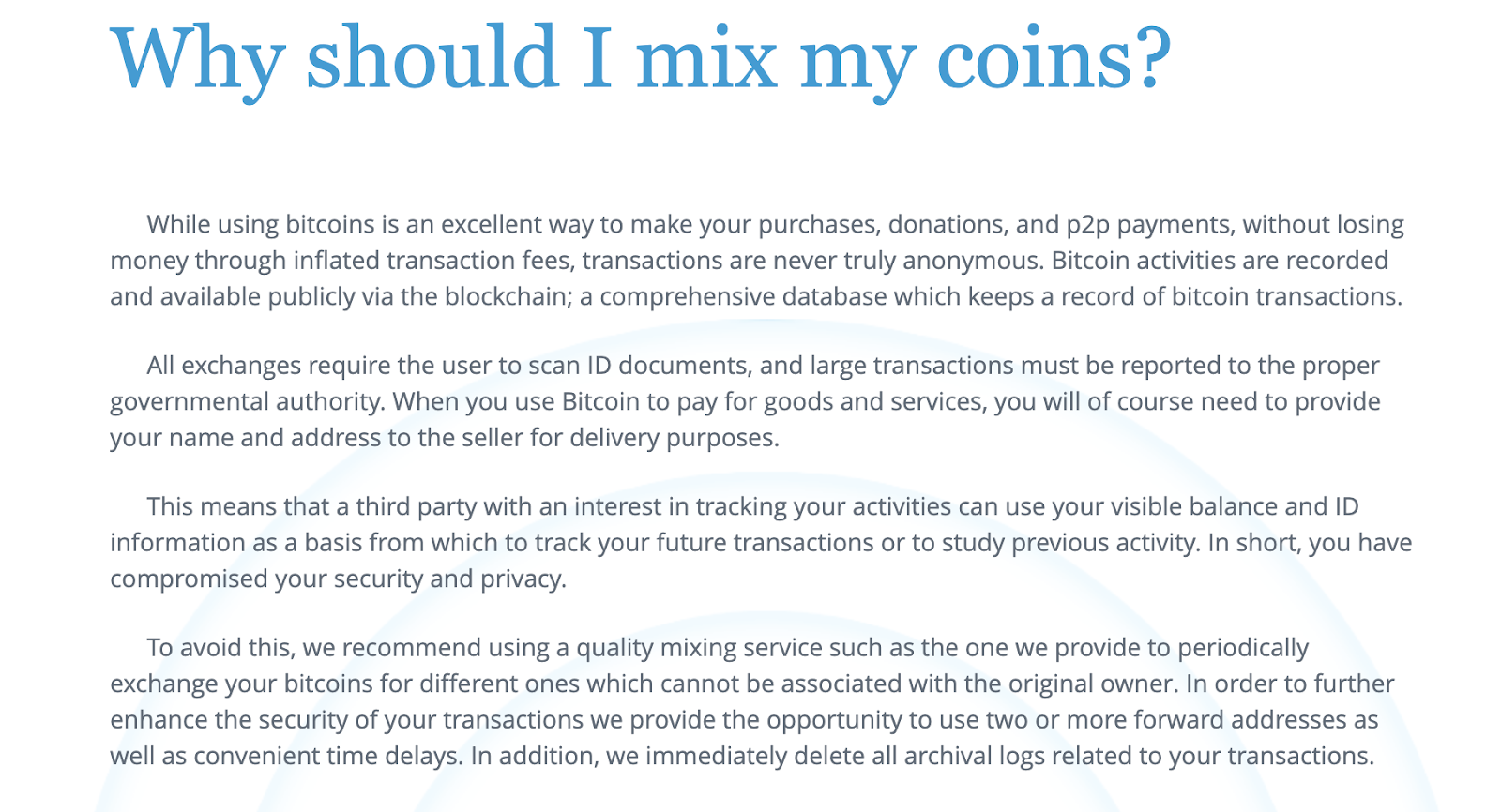 A helpful explainer on the philosophy behind BitMixer was posted to its website. (NB: Take caution in interacting with any service using the same domain or name today.)
Of course, regulators eventually came for decentralized alternatives through the case against Samourai Wallet, which is still pending pre-trial motions set for later this year.
Meanwhile on Ethereum, smart contracts and their developers have been under fire via the Tornado Cash case, which has seen one co-founder given a 64-month prison sentence, now under appeal, while the other continues to face up to 45 years in prison.
So, where does that leave Sjors’ quest to keep our bathroom trips at European train stations private?
Frustrating as it may be, while these cases shake out, it might be safer to simply hold it until you get home.
Get the news in your inbox. Explore Blockworks newsletters:
- The Breakdown: Decoding crypto and the markets. Daily.
- 0xResearch: Alpha in your inbox. Think like an analyst.
