The ‘Solana Summer’ Never Ends
Live from Lisbon: September’s 10-hour outage and double-digit fall hasn’t slowed down Solana development — the network currently has one billion transactions and $15 billion in locked-in DeFi value.
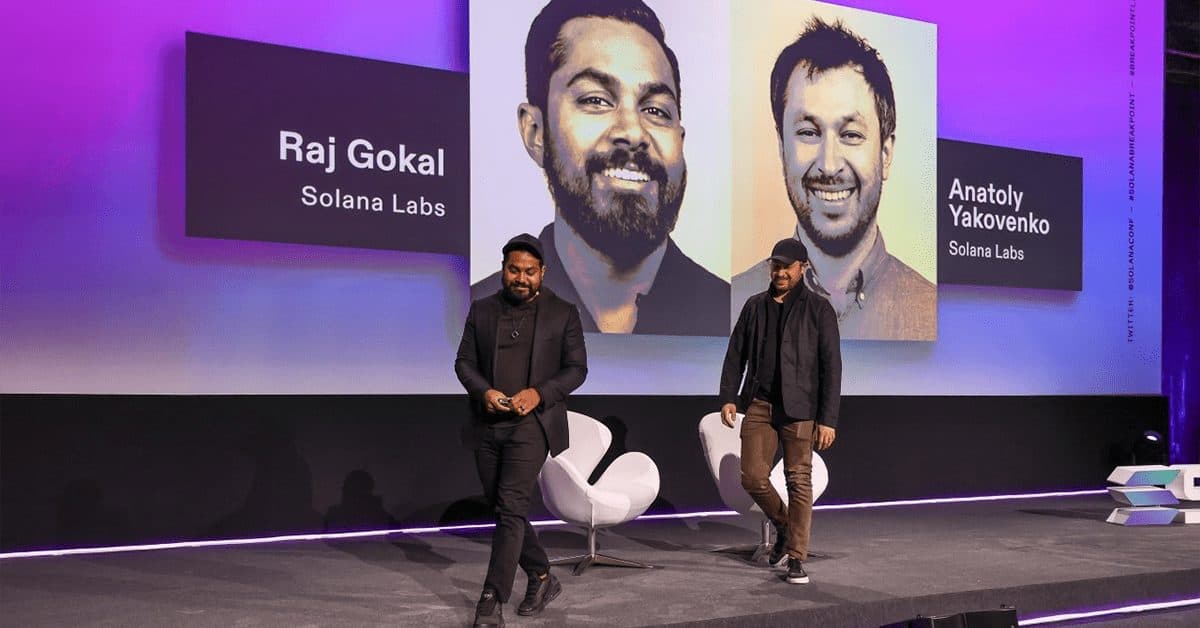
Raj Gokal and Anatoly Yakovenko at Breakpoint Solana 2021; Photo: Sam Reynolds, Blockworks
- Solana’s growth story is one that’s now defined in the billions, but there’s been some challenges along the way
- Solana Labs CEO says it’s in the group’s culture to embrace every challenge in the hardest possible way: ‘Eating glass’ while changing the world.
Breakpoint 2021, Lisbon, Portugal — There’s a lot going right with Solana and its ecosystem: $15.2 billion in total value locked into DeFI projects on the protocol; $2 billion in investment from the who’s who in the crypto ecosystem, and a sold-out Breakpoint conference in Lisbon.
But for everything that goes right with Solana, sometimes things also go wrong: In September the entire network suffered a brutal 10-hour outage with a double-digit fall in the token’s value.
It’s times like this, Solana Labs CEO Anatoly Yakovenko said on stage in Lisbon, that the team learned to “eat glass,” a metaphor for enduring a tough experience. The global state machine, as Yakovenko calls the Solana network, isn’t without its challenges. But the team, he says, enjoys this head-first journey into “maximum pain.”
Part of the evolving debate surrounding any growing blockchain is the extent to which it realizes the goal of decentralization, sometimes quantified as ‘the Nakamoto coefficient’, in reference to Bitcoin’s pseudonymous founder Satoshi Nakamoto. A network with high transaction throughput might be a highly centralized one, or one which is inherently insecure.
For Yakovenko, this isn’t a trade-off, as one of his goals is to change paradigms and behavior so that “voting power and the distribution of nodes actually maximizes the Nakamoto coefficient.” It can only go one-way, as he explained on stage. Rather than stress decentralization, for now the network’s success is measured in terms of the nearly 40 billion transactions and 1.26 million active accounts transacting without nagging gas fees.
“The hard part is finding the humans that want to run the network,” he said, giving an anecdote on how there are validators in the middle of Russia that use the country’s naturally chilly temperature as a reason to set up data centers in the middle of barren fields. The technical requirements to run a Solana node are quite steep relative to nodes on Bitcoin or Ethereum.
For the Solana team, the next challenge will be to expand the number of validators dramatically. Currently, there are around 1,150 but as the race to validating 100,000 transactions per second continues, there’s going to need to be a lot more of them.
But finding these next humans might not be quite as much of a glass eating challenge; it could be harder to match Ethereum’s massive lead in developer talent, with tens of thousands of active devs according to the Enterprise Ethereum Alliance. By contrast, there were 100 participants at Solana’s first hackathon. Now, and the most recent one here in Lisbon, that number is closer to 600.
Yakovenko wants more. “1 million is our goal, that’s a 1000x growth,” he said, mirroring the “One Million Devs” initiative for Ethereum undertaken in 2019 by ConsenSys.
Solana’s token, SOL, is currently trading for $247 according to CoinGecko data, up 20% on-week.
Get the day’s top crypto news and insights delivered to your inbox every evening. Subscribe to Blockworks’ free newsletter now.
