Thailand’s SCB is Buying 51% of Bitkub
Here’s why Siam Commercial Bank is continuing to signal its support for digital assets with Bitkub investment.
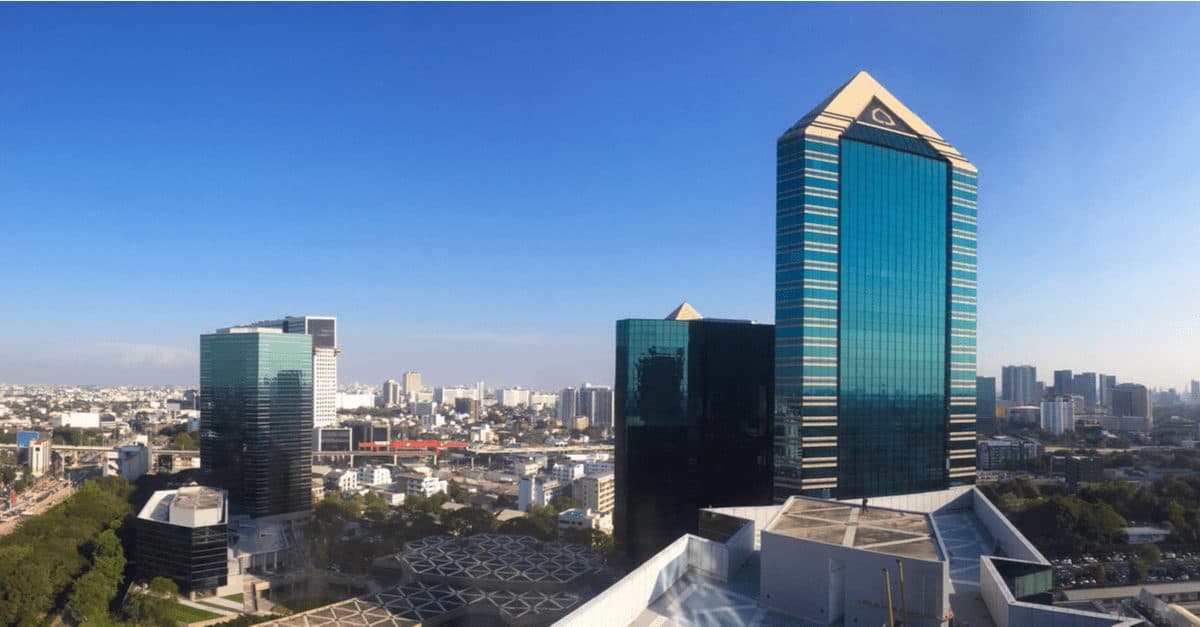
Siam Commercial Bank Head Office in Bangkok; Source: Shutterstock
- SCB announced Wednesday that it is taking a 51% stake in Thai SEC regulated exchange Bitkub. In July the bank also announced it was launching a fund to invest in DeFi projects in order to prepare for “an era of disintermediation”
- This continues a trend of Asia’s emerging banks investing in digital assets. Earlier this year, Korean banks began to invest in some of the country’s largest exchanges as local regulators required a partnership in place for tax compliance reasons
Thailand’s Siam Commercial Bank (SCB) announced Wednesday that it was taking a 51% stake in locally licensed crypto exchange Bitkub, pushing the exchange into Southeast Asia’s small unicorn club with a valuation just over $1 billion.
The terms of the deal published by SCB show the bank will take the majority stake in Bitkub for $535 million. Bitkub’s eponymous token, a rough proxy of a public listing for the exchange, shot up by 74% since the deal was announced according to CoinGecko data and is now trading at $2.44.
“Overall the market reacted very positively to the event, SCB share price went up nearly 10% this week, increase market cap by over $900 million (30 billion THB), approximately double the deal size to buy Bitkub exchange,” Varit Bulakul, head of digital assets at Bangkok’s Brooker Group, told Blockworks in an email.
This is SCB’s second major investment in digital assets this year. In July, the bank announced the founding of its digital assets themed venture fund, SCB 10x, with a specific DeFi mandate.
SCB’s rival, Kasikorn Bank, is also doubling down on digital assets, opening an NFT marketplace earlier in October.
“The best way to do that is to invest in DeFi very actively to learn and prepare the bank, find DeFi partners, integrate DeFi into traditional finance, become a player in this area, and potentially be the disruptor in this area,” SCB 10x’s Chief Venture and Innovation Officer Mukaya Tai told Blockworks in an interview at the time.
“My view is that in the future, there will be an integration of traditional finance with DeFi.”
Asia’s emerging banks betting big on crypto
While Hong Kong is often associated with Asia’s premier financial center, it certainly doesn’t carry that crown in the era of digital assets. Instead, emerging banks around Asia are picking up the slack and doubling down on crypto.
In Korea, there’s a strong interest in digital assets infrastructure by legacy financial institutions, first spurred by rules requiring banks to partner with crypto exchanges attaching a bank account to every account on an exchange. This form of Know-Your-Customer authentication is a way to combat tax evasion, and is said to have attracted interest in Bithumb from Morgan Stanley, though a deal never materialized.
However, in the time since, all four of the major Korean exchanges now have strategic investment and partnerships with legacy banks in the country, including KB Bank, the largest in Korea.
Back in Thailand, Brooker Group’s Bulakul thinks that this move by SCB as well as Kasikorn Bank, will mean regulators will act quickly in Thailand and put forward an industry-friendly digital assets framework.
“Now that the top two banks are pursuing digital assets, we can expect to see regulations to support the growth of digital assets in Thailand in the near future at a much faster speed,” Bulakul said.
“SCB and Kasikorn Bank will definitely push for mass adoption in Thailand, using the existing customer base. Another reason for fast regulation: these banks will be unable to compete with global and regional peers if they have to endure through regulatory delays,” Bulakul added.
Of course, the elephant in the room is that retail investors in Asia appear to be more interested in crypto than they are traditional equities.
In Korea, the combined volume of the four major digital asset exchanges in the country — Upbit, Bithumb, Coinone and Kobit — is $14.6 billion, surpassing the local stock index called KOSPI’s volume of $14.5 billion.
Down in Thailand, crypto exchanges licensed by the Thai SEC have a monthly turnover of around $3 billion (100 billion THB) while the country’s largest stock exchange, the SET, reaches that volume in a day.
But with two of the country’s largest banks betting big on crypto, that figure might change.
