StarkWare’s plans add momentum to Bitcoin upgrade
Bitcoin Improvement Proposal 420 — or “CAT” — gets a push
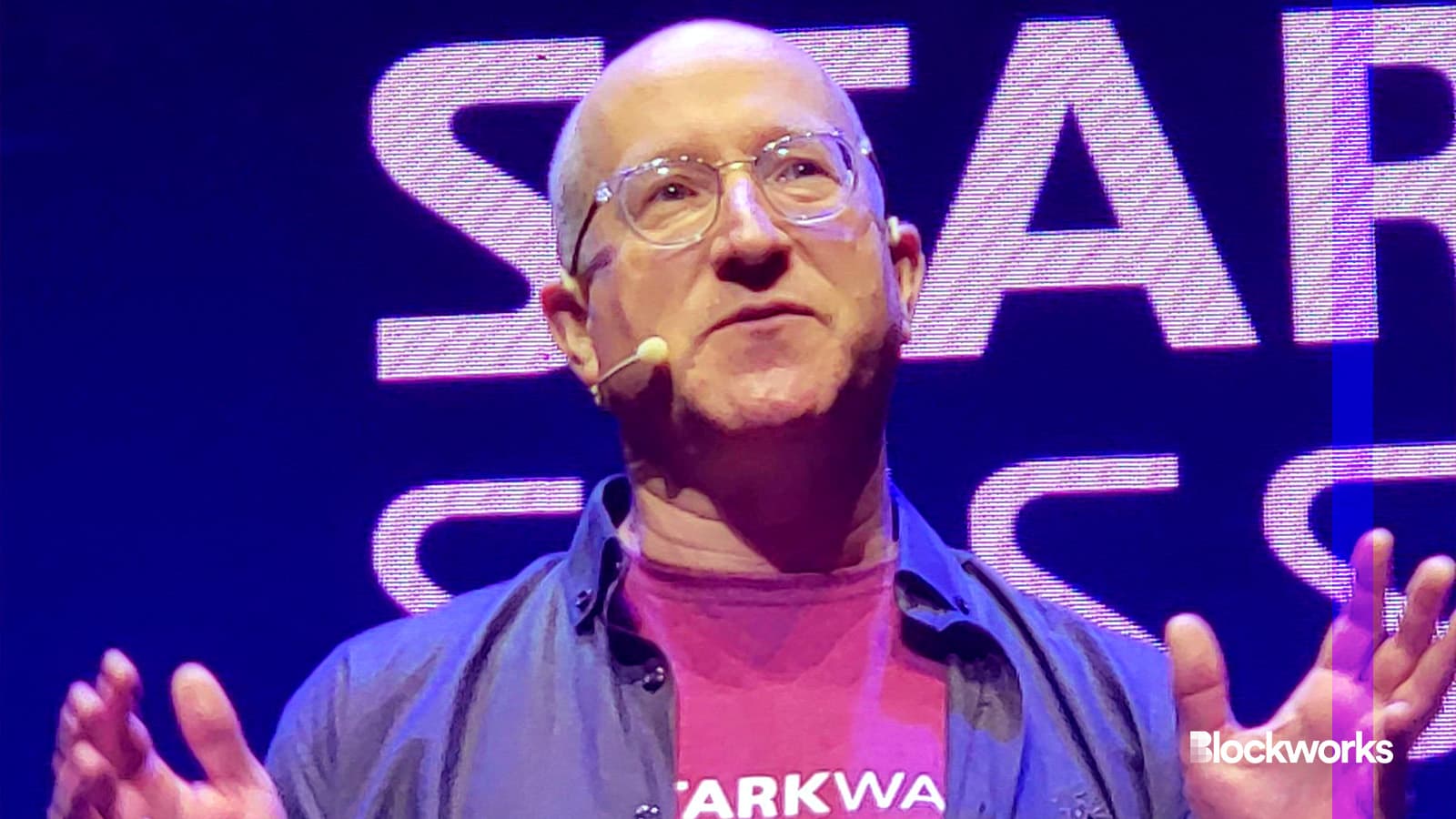
StarkWare co-founder and CEO Eli Ben-Sasson | StarkWare modified by Blockworks
When it comes to upgrading Bitcoin, no one fully knows how it works. Unlike other chains, the original cryptocurrency doesn’t have a clear process to upgrade.
Progress happens along a slow-moving social consensus, a delicate dance between researchers, coders, project maintainers, full node operators and miners.
Sometimes you can spot an inflection point, though.
Last week offered up solid evidence of the growing momentum for proponents of OP_CAT — or just CAT for short — now also known by the memey moniker BIP-420.
Read more: Satoshi-era Bitcoin code idea gets a boost from Taproot Wizards
Bitcoin’s creator, Satoshi Nakamoto, originally introduced OP_CAT. He then removed it without giving a reason — the deletion relegated to a “miscellaneous” section of a GitHub pull request.
“No one knows why because he didn’t say,” said Udi Wertheimer on an X Space discussing the prospective upgrade last week.
Wertheimer speculated that Satoshi probably didn’t fully recognize the potential of CAT, and simply disabled it because no one was using it at the time.
As a member of the Quantum Cats, and among the chief advocates for reintroducing the opcode, Wertheimer’s fond of pointing out that Satoshi introduced it in the very first release of Bitcoin in 2009, and that it represents a mere eight lines of code.
“It’s really crazy because it’s such a simple change,” Wertheimer said, but one which modern cryptographers have worked out to enable a whole host of features such as trustless BTC bridging, offchain layer-2s, AMMs, simplified Runes trading, privacy solutions and payment systems.
Fellow Quantum Cat co-founder Eric Wall chimed in to say that the group gets “way too much credit.”
The basic need for “covenants” — restrictions placed on how coins can be spent in the future, based on specific conditions — has been a consensus view for years in Bitcoin circles.
One alternative, OP_CTV, is seen by some as too big of a change, Wall said.
Read more from our opinion section: Don’t fossilize Bitcoin
“OP_CAT is extremely simple — it doesn’t make any changes to the script interpreter of Bitcoin,” Wall said, so it hasn’t met the same resistance from other Bitcoiners.
“It’s just a downhill slope, so if you actually put some weight behind that, that wagon would slide down the hill way easier than any of these other covenants OPcodes,” he said.
StarkWare adds its heft
StarkWare is predominantly associated with scaling Ethereum via its Starknet zk rollup. For years, StarkWare co-founder Eli Ben-Sasson has had in the back of his mind the idea of scaling Bitcoin using STARK proofs.
“I was red-pilled at the Bitcoin conference in 2013,” Ben-Sasson told Blockworks, noting it was “always a dream” for Starknet to connect to Bitcoin.
The 2021 Taproot upgrade was one step closer to making that a reality. CAT would be another.
“We strongly believe in the power of this math to solve this problem,” Ben-Sasson said. If covenants via CAT are adopted, then you will be able to verify STARKs. “That’ll be the gold standard,” he said.
To stay true to Satoshi’s vision, Bitcoin scaling needs to preserve a self-custodial nature, with sovereign individuals, and be resistant to censorship.
Current sidechain solutions contain too many compromises, according to Ben-Sasson, who proposes that Starknet become the first network to simultaneously scale Bitcoin and Ethereum.
StarkWare is putting up $1 million to fund research towards this goal, alongside a commitment to publicly champion CAT.
Wertheimer is now confident the upgrade will be activated this year.
“I think this community started looking at this as something that is real, and that made a massive difference,” he said, noting CAT is like a meme — it becomes stronger as more stakeholders rally behind it.
StarkWare, bitcoin miners, core developers, people who support the Lightning Network, “they all want this and that’s why I’m pretty sure it’s going to happen,” Wertheimer said.
How does a soft fork get passed?
Tyler Whittle, who calls himself a Taproot Wizards “sorcerer,” has put together BIP Land in “an attempt to elucidate the [soft fork] process in a lighthearted but cutting manner.”
He described it as “historical artifacts about how Bitcoin has been upgraded in the past.”
CAT is at the “testnet graveyard” stop, meaning it has been deployed on Signet — a testing network where the bitcoin has no value — so that developers can start building on it today.
But no developers decide by fiat whether something can get included in a BTC Core software upgrade.
“Many people will tell you Bitcoin isn’t ever upgraded the same way twice,” Whittle said.
Wertheimer wants to bring back a more practical builder and tinkerer mentality to Bitcoin development with CAT.
“The problem right now with Bitcoin development is that everything is so hypothetical and theoretical, and no one really can spend the resources to really get into the weeds and build things out to see what you need,” he said.
To the extent that there are builders on Bitcoin, they’re working with what they have today.
Alexei Zamyatin, co-founder of a hybrid layer-2 combining Bitcoin and Ethereum (BOB), told Blockworks he’s “on the conservative side” when it comes to CAT.
“Anything that makes Bitcoin more expressive is helpful to build better bridges, better custody models and ultimately is relevant for any project building on Bitcoin, especially [layer-2s] like BOB,” Zamyatin said.
But he’s not in a rush to see the change implemented. The code base is different, the scale is bigger, the stakes higher.
“What we need now to get this over the finish line, if this is ever to happen, [is] people to experiment with it on testnet, build apps, showcase how it works and see where the issues lie and what the risks involved [are],” he said.
There are also options for Bitcoin scaling that don’t require a soft fork, such as BitVM, which Zamyatin said is “the best tool that we have to actually get a zk verifier to work in some way on Bitcoin” for now.
Read more: Bitcoin research expands on design space for smart contracts
He is encouraged by StarkWare’s involvement, however.
“It’s great to see that more and more projects realize the potential of going beyond culture wars and actually trying to get the best out of Bitcoin and Ethereum,” Zamyatin said.
Jesse Eisenberg, co-founder and chief technology officer at DLC.Link, thinks much of CAT’s potential “is still yet to be discovered.”
“It would be like a Swiss-army knife for Bitcoin, but inside a bit of a black box, as it’s quite difficult to reason about,” Eisenberg told Blockworks.
Read more: Building a better wrapped bitcoin for DeFi
But, like Zamyatin, he’s cautious and suggests OP_CTV or OP_VAULT could be the preferred option, although these wouldn’t provide all the same functionality as OP_CAT, such as recursive covenants.
“This seems to have lots of potential, but there are risks of powerfully simple systems that are hard to reason about,” Eisenberg said.
Get the news in your inbox. Explore Blockworks newsletters:
- The Breakdown: Decoding crypto and the markets. Daily.
- 0xResearch: Alpha in your inbox. Think like an analyst.
