Safenet is Safe’s bid for an ‘onchain VisaNet’
Safenet is setting its sights on instant cross-chain execution, unified balances and enhanced security

Safe and Adobe stock modified by Blockworks
New cross-chain solutions are tackling persistent challenges presented by Ethereum’s rollup-centric roadmap.
Safe’s Safenet, planned for release in 2025, aims to operate as a transaction processor network atop existing blockchains, offering execution guarantees for cross-chain transactions.
Safenet’s design — announced today — introduces a set of capabilities targeting longstanding issues in DeFi, such as speed, security and liquidity fragmentation. It reimagines transaction processing by unbundling execution and settlement, akin to VisaNet’s architecture.
At its core, Safenet aims to dramatically improve transaction efficiency, processing transactions in under one second thanks to an intents-based solver network. This level of performance would bring cross-chain operations closer to real-time usability, allowing users to move assets or execute transactions between different blockchains almost instantaneously.
Read more from our opinion section: Want cheaper and safer interoperability? Drop traditional bridges
Whether transferring tokens or interacting with dapps, delays in moving across chains have traditionally hindered such activity, leading to a siloed user experience.
“Safenet addresses DeFi’s biggest challenges: fragmentation, latency and complexity,” Lukas Schor, co-founder of Safe, said.
By leveraging Safenet Processors, users gain access to instant liquidity and secure, composable transactions that span onchain and offchain networks.
The network is secured by user-defined policies and a decentralized validator network — staking the SAFE token — and the system is geared towards providing robust protection against risks like address poisoning and other vulnerabilities.
Validators actively oversee processor activity, and can flag any malicious behavior. This oversight, combined with user-set transaction rules, creates a defense-in-depth security layer that reduces exposure to common threats.
On the chain abstraction front, Safenet’s ability to unify balances across chains represents a major step forward in usability. Instead of requiring users to manage separate wallets or bridge assets manually, Safenet plans to present a single, consolidated view of their holdings.
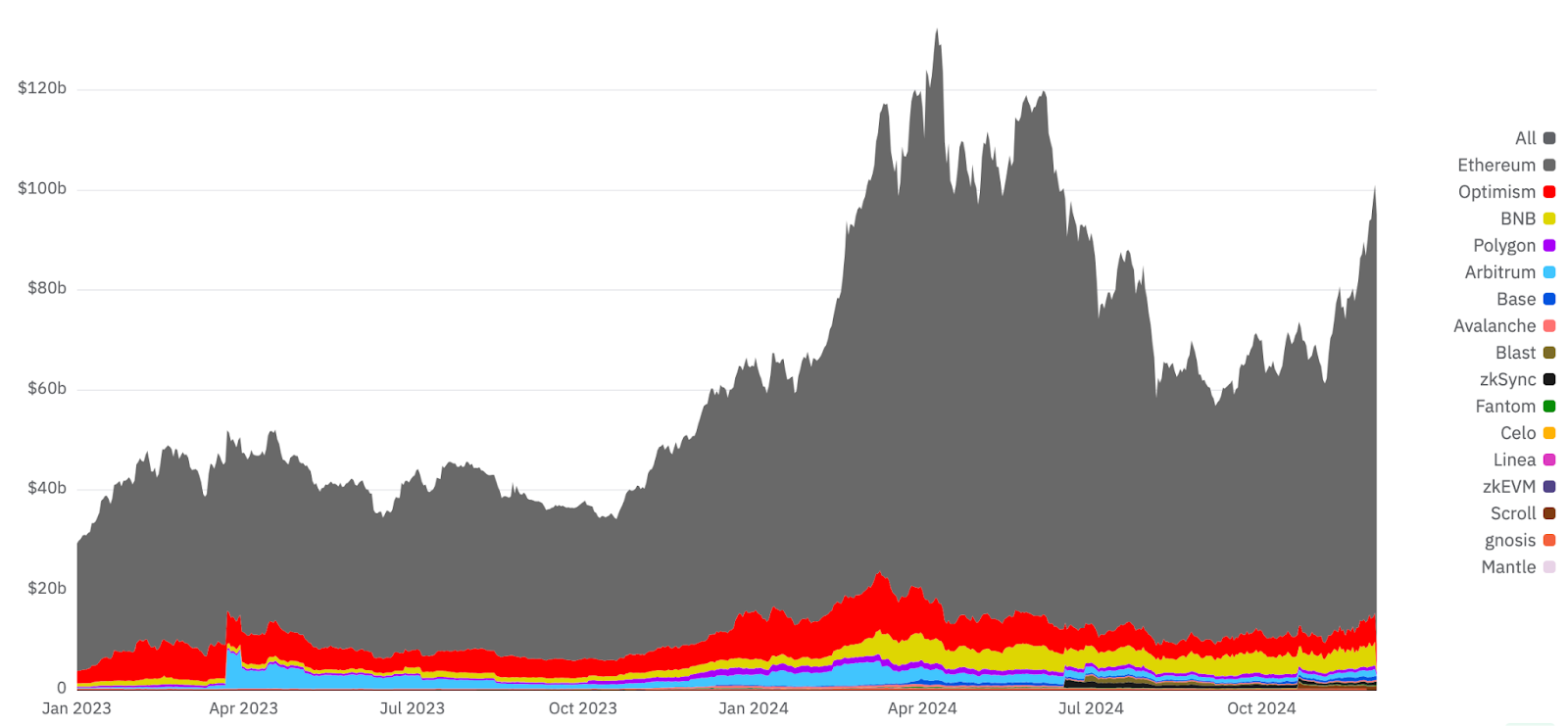
Current Safe wallets secure $112 billion in assets, 75% of which is on Ethereum. They already allow for switching between multiple networks, deploying the same Ethereum address across many chains, but Safenet extends the abstraction beyond EVM-based networks to incorporate non-EVM-compatible chains like Solana, according to the Safe team.
 Safe TVL over time | Source: Dune / Safe
Safe expects to bridge the gap between onchain and off-chain ecosystems as well, for example by enabling users to interact with centralized exchanges and payment systems using the same unified asset balance. This flexibility simplifies asset management while expanding the ways users can engage with their holdings.
DEX activity accounts for about 5% of the Total Volume Processed (TVP) on Ethereum mainnet by Safe accounts, according to Richard Meissner, co-founder of Safe.
“The remaining volume is a mix of asset transfers, treasury management, DAO governance actions and complex DeFi operations like liquidity provisioning,” Meissner told Blockworks.
He notes that what differentiates Safe’s wallet from other solutions is its focus on providing smart accounts.
“By advancing smart accounts, we offer features not possible with traditional EOA accounts like multisig, private key recovery [and] automation,” Meissner said.
Safe is betting that features like these will make it appealing for businesses to move more of their operations onchain.
A key component of Safenet’s functionality is its integration with ERC-7579, a standard that defines interfaces and behaviors for modular smart accounts to ensure interoperability across different implementations or “modules.”
By adopting ERC-7579, Safenet can facilitate the unbundling of transaction execution and settlement, similar to how VisaNet operates in traditional finance.
To do so, Safe, in collaboration with Rhinestone, developed the Safe7579 Adapter, which enables Safe accounts to comply with the ERC-7579 standard.
Such standards are crucial for interoperability. For instance, modules such as spending limits, role-based account access and recovery can be incorporated into Safe accounts.
Safenet is set for alpha release in Q1 2025, initially supporting cross-chain accounts and basic liquidity functions. By mid-2025, Safenet will introduce third-party processors and compatibility with the Safe Apps SDK, enabling new use cases such as off-exchange settlement and subscription services.
Get the news in your inbox. Explore Blockworks newsletters:
- The Breakdown: Decoding crypto and the markets. Daily.
- 0xResearch: Alpha in your inbox. Think like an analyst.
