Regulators May Be ‘Speeding Up Their Timeline’ on Cryptocurrencies
Increasingly sophisticated due diligence is en vogue when it comes to digital asset custody for institutional investors
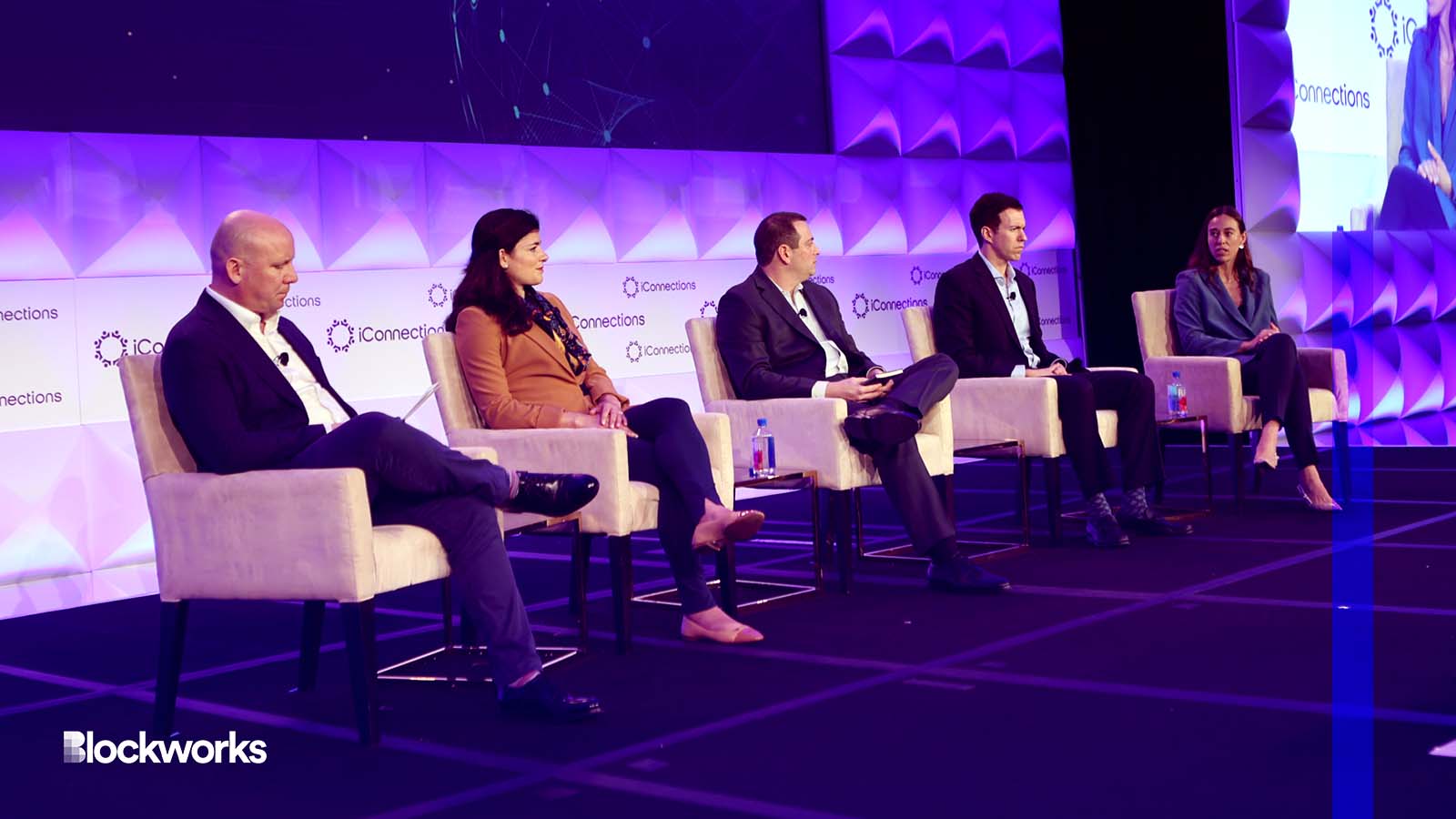
iConnections Global Alts modified by Blockworks
Properly measuring counterparty risk in crypto has rarely been more crucial.
This is the clear message emanating from a panel at the iConnections Global Alts conference in Miami on Tuesday featuring executives from Anchorage Digital, Bitgo, Coinbase and One River Digital.
Participants tapped the intended topic, the “evolution” of crypto custody, as a springboard to dive into all things due diligence in a post-FTX digital assets landscape.
Especially with heightened US regulatory scrutiny on the horizon.
Sarah Schroeder, a One River portfolio manager, said that “ultimately, this is a counterparties question.” She drew a parallel to Wall Street’s practices for safeguarding customer assets, including cash and derivatives. It’s “very easy” for institutional investors to “call upon Goldman Sachs” and its peers for that crucial function, she said.
But how cryptoassets are custodied is another question entirely for newcomer traders and allocators — with passive and active approaches alike — to wrap their heads around. How? By whom? And why?
There is no shortage of mechanisms these days, some more complex than others, for keeping digital assets under lock and key. There are more solutions being added by the day — especially after the historic implosion of Sam Bankman-Fried’s FTX, plus the subsequent shutdowns and deep rooted complications for a number of crypto’s erstwhile giants.
Some of those custodial offerings, according to Adam Sporn, BitGo’s head of prime brokerage, have been around since crypto’s last major cycle. Some are still very much a moving target.
Drawing particular institutional interest of late from the likes of venture capitalist and family offices, Sporn said, are cold storage solutions. Cold storage works by keeping the private keys that govern ownership of digital assets offline, as opposed to a “hot wallet” that is connected to the internet and may be hosted by an exchange.
READ MORE: Everything you need to know about hot vs. cold wallets
Rush for exchange exits
Both retail and institutional investors alike yanked their crypto assets off of exchanges in the wake of the wave of service provider bankruptcies and related freezes on customer withdrawals.
It’s been a bit of a slog for outright custodians to regain trust in markets that were already deemed risky by much of the mainstream.
BitGo, according to Sporn, has picked up on a trend: Crypto-native funds “don’t care about the cold storage” and instead have been using hot wallets as much as ever. High-frequency digital asset hedge funds and proprietary trading entities typically have little use for storing their cryptocurrencies offline.
But other portfolio managers with less time-sensitive trading styles have been carving out a middle ground, Sporn said, keeping something like 2% of their book in hot wallets for ‘liquidity needs” and locking up the remainder elsewhere.
Neither trend is especially new when it comes to family offices and venture capitalists. But industry eyes and ears have been following the money — and, more precisely, how the money moves — since crypto markets collapsed in the fourth quarter of 2022.
What to do about custody?
In that (brutal) context, industry participants are now looking for options when it comes to the digital asset products at their disposal, according to Yuriy Anosov, Anchorage’s head of trading. The longtime custodian is working on setting up a settlement and exchange layer similar to setups that have been commonplace on Wall Street for a while, Anosov said.
Anchorage is now supporting a couple of hundred cryptoassets, according to Anosov — adding that it’s now “really important to see what the inter-party agreements are like.” Anosov was referring to relationships between a protocol, or a DAO, and its own counterparties.
The basic idea is that limited partners and general partners ought to do their homework on the service providers they choose to entrust with their capital. And, in turn, those service providers ought to carefully parse the internal governance of cryptocurrencies and Web3 initiatives they choose to bring onto their platforms.
Those dual layers of due diligence have become paramount, according to Lauren Abendschein, Coinbase’s head of institutional sales for the Americas.
“We saw this with FTX, not having properly experienced individuals, particularly in control functions — and a well-documented history across those control functions,” Abendschein said. “It applies to crypto very much, as it does every other industry.”
The SEC and the CFTC have taken note. Anosov said that he thinks “regulators are actually going to be speeding up their timeline in the case of actually [moving] regulations forward” in 2023.
There are a number of pending US legal and regulatory initiatives the panelists said they’re following. Among them: digital asset taxation and stablecoin oversight.
Jiri Krol, a top AIMA executive who moderated the iConnections conversation, said that “hopefully we get something done this year, but I’m not holding my breath.”
Get the news in your inbox. Explore Blockworks newsletters:
- The Breakdown: Decoding crypto and the markets. Daily.
- 0xResearch: Alpha in your inbox. Think like an analyst.
