Permissionless III: DeFi phoenix looms as OG builders forecast next phase
Kain Warwick, Stani Kulechov and Sam Kazemian explored DeFi’s maturation and the shift from experimentation to consolidation
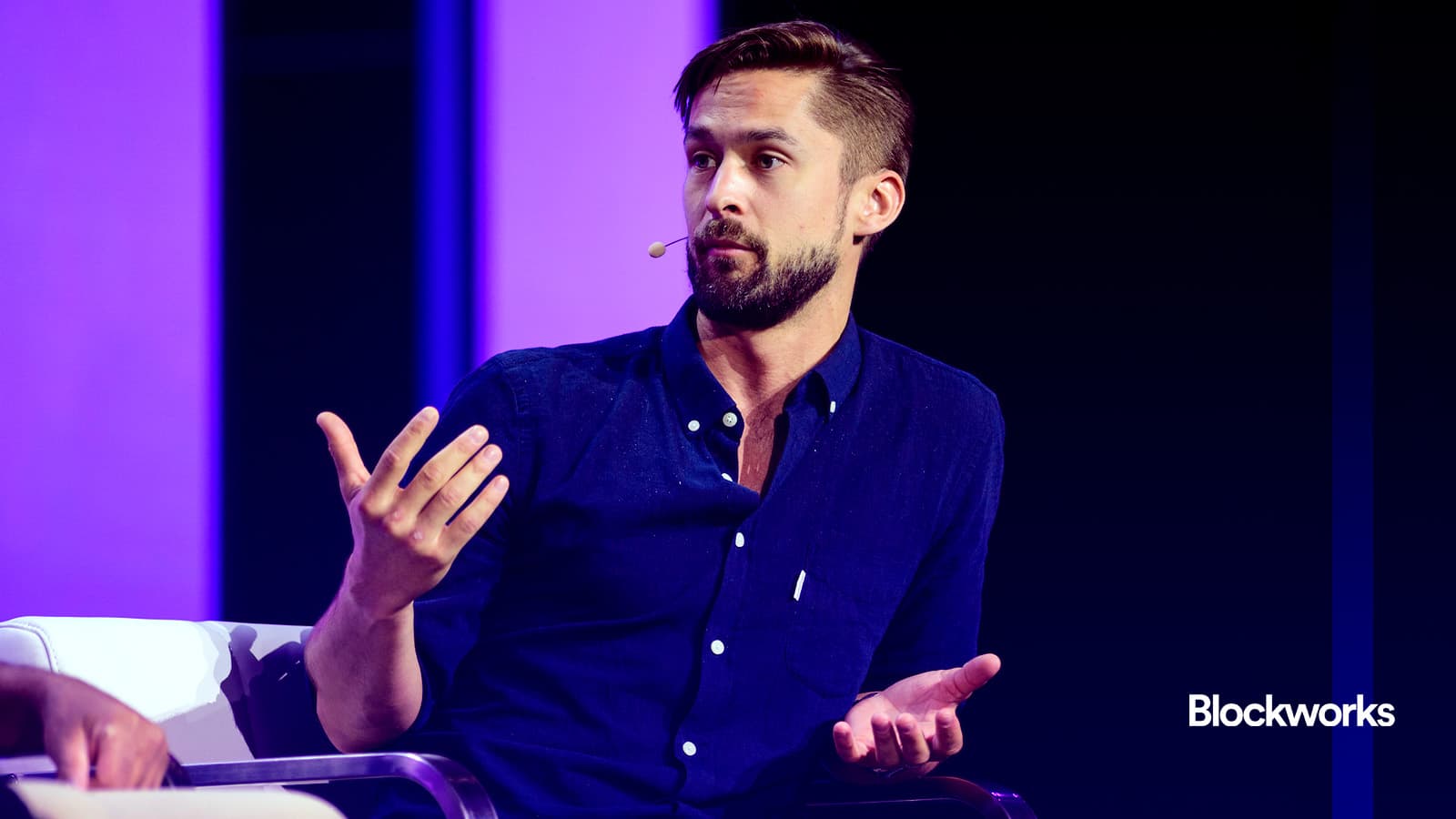
Bankless co-owner David Hoffman | Permissionless III by Mike Lawrence for Blockworks
DeFi is getting top billing on day three of Permissionless III, with a high-profile main stage session and its own breakout track.
After lying in wait during recent years, DeFi is on the brink of a renaissance, according to panelists who discussed the category’s future role in crypto on Friday morning. Kain Warwick, Stani Kulechov and Sam Kazemian delved into the maturation of DeFi, the prospects for new innovations, a shift from experimentation to consolidation, the next phase of scaling and competing with centralized services.
Moderator David Hoffman kicked off the session with the observation that we haven’t seen much evolution since the heady days post-DeFi summer. Warwick, the founder of Synthetix credited with creating the concept of yield farming, suggested that innovation in DeFi typically stems from combining new technologies.
Read more: Politics and memecoins drive the conversation on day 2 of Permissionless
“We’re sort of waiting for that next thing to combine,” Warwick said, noting that Synthetix spin-off Infinex was built to integrate newer primitives that improve user experience and help those technologies gain distribution. He believes the DeFi market still holds immense potential, particularly among users currently “trapped” in centralized services.
Kulechov cited the shift away from experimentation and towards profitability as indicative of DeFi protocols reaching a stage of maturity, with select DAOs leading the charge. The next phase of DeFi’s growth will focus on building trust, network effects and brand value, positioning DeFi as a serious alternative to centralized exchanges, Kulechov said. That’s already happened with centralized lending, largely supplanted by non-custodial alternatives, the Aave founder added.
Read more: Trump’s World Liberty Financial is using Aave
Kazemian of Frax Finance praised the growing number of decentralized chains. He referenced Uniswap’s launch of Unichain yesterday as a vindication of Frax’s earlier decision to launch its own chain, Fraxtal. He envisions a future where most computation occurs on decentralized chains rather than centralized servers. This shift, according to Kazemian, will blur the lines between centralized and decentralized services, further enhancing interoperability.
The group noted the trend of centralized exchanges launching or closely affiliating themselves with their own chains, with varying degrees of decentralization. While these went unnamed, chief examples are Binance and BNB Chain, Coinbase and Base, Bybit and Mantle, OKX and X-layer, Crypto.com and Cronos.
In some respects, exchanges were the first cross-chain interoperability solutions, Kazemian said. DeFi has historically catered to fervent enthusiasts and “decentralization maxis,” Warwick pointed out, a strategy that has limited mainstream adoption. The focus must now shift toward simplifying user experience and expanding market access.
Read more: A16z’s Chris Dixon pushes for bipartisan legislation at Permissionless III
“We can’t keep doing the same thing over and over — we’re not breaking through this enthusiast wall,” he said.
So, what are centralized services weak points, asked Blockworks co-founder Michael Ippolito. Unichain is also a hallmark of a trend towards vertical integration in DeFi, he said. That’s a departure from how we’ve viewed dapp development in years past. As applications move into various layers of the stack, such as Uniswap, “it looks like they are just trying to own the entire thing,” in an attempt to mimic a centralized experience, Ippolito said.
There’s an inevitability to this, Warwick said, even at the cost of some censorship resistance. “If we can’t get through the problems in our own backyard, we’re not going to be credible in saying we’re going to take down banks,” he said. It doesn’t matter that Unichain may directly compete with Infinex — that’s fine, argued Warwick. “We’re all competing against Binance.”
Kazemian said the script has now flipped from “why do you need a chain” to “why don’t you need a chain?”
Get the news in your inbox. Explore Blockworks newsletters:
- The Breakdown: Decoding crypto and the markets. Daily.
- 0xResearch: Alpha in your inbox. Think like an analyst.
