Pentagon, Mine Bitcoin To Stay Superpower: Space Force Major
World superpowers should duke it out with hashrate over artillery in a digital Cold War for Bitcoin blocks, says one Space Force major
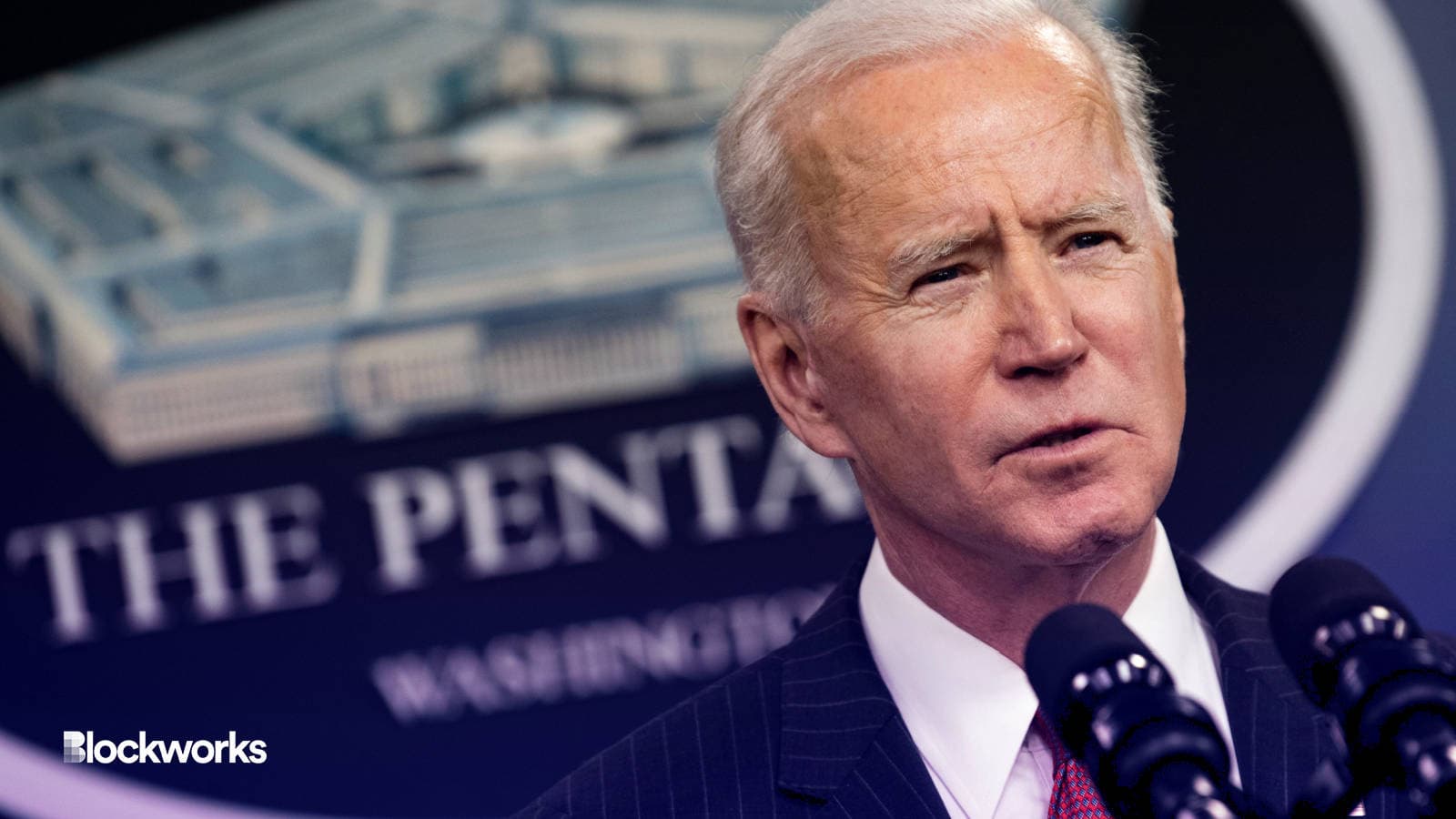
BiksuTong/Shutterstock, modified by Blockworks
A new MIT masters thesis from a US Space Force major contends bitcoin is not just a form of internet money — but a weapon to be utilized by the Pentagon in modern warfare.
In an exhaustive 400-page dissertation, Major Jason Lowery claims bitcoin’s proof-of-work consensus mechanism presents a massive shift in the way world powers could wage war.
Instead of boots on the ground or nukes in the air, Lowery suggests nations battle by competing for Bitcoin block rewards, Politico reported Thursday.
“Space Force” is the newest brand of the US Armed Forces, created in December 2019. It’s responsible for organizing, training and equipping military persons across the stars in a bid to protect US and allied interests.
Lowery is an active-duty US Space Force astronautical engineer and US National Defense Fellow at MIT whose job it is to advise senior military personnel on the implications of bitcoin, according to a bio of his latest book. Politico says it confirmed his rank with an Air Force spokesperson.
Lowery’s thesis was released as a book in February under the title “Softwar: A Novel Theory on Power Projection and the National Strategic Significance of Bitcoin.” It’s said to describe a scenario in which governments duke it out with hashrate; fighting something akin to a Cold War, where the spoils are bitcoin and bragging rights.
The blurb reads:
“Using scientific concepts from biology, evolution, anthropology, political science, and computer theory, Lowery summarizes the dynamics of power projection in human society and provides an argument for why emerging proof-of-work technologies (namely Bitcoin) will have a dramatic impact on how humans organize, cooperate, and compete on a global scale by empowering populations to project physical power in, from, and through cyberspace.”
Bitcoin’s consensus could also be harnessed to deter denial-of-service attacks, Lowery reportedly reasons, which would make it costly and therefore prohibitive for bad actors to spam software systems based on its principles.
Should the asset be viewed through that lens, it would serve the US’s interest to protect the network and foster an industry for domestic crypto mining, or so the thinking goes.
Bitcoin is a ‘national strategic imperative’
In a stark warning to US policymakers, the major contends the country should support and adopt bitcoin immediately in a bid to avoid losing its status as a global superpower.
That’s just the kind of message of which industry proponents have hoped for years. Although, it’s probably unlikely.
“Major Lowery concludes that Bitcoin represents a national strategic imperative that the US should support and adopt as quickly as possible, else it risks losing its lead as a global superpower in the 21st century,” states the book’s description.
Instead, the current campaign employed by US regulators and the White House has been to offer up no support in that regard, opting to regulate digital assets through litigation with little discourse, critics argue. Various arms of the US government have also routinely sold bitcoin seized as a result of criminal cases.
“Our first amendment rights to free speech will not protect you from government regulators who are actively maneuvering to ban bitcoin under the argument that it represents a threat to national security,” Lowery tweeted Tuesday.
“Your best bet is to argue that it would be a national strategic security hazard to ban bitcoin. It would be against the second amendment (not just the first). It’s an undefeatable argument, you just have to have the courage to use it,” he said.
Get the news in your inbox. Explore Blockworks newsletters:
- The Breakdown: Decoding crypto and the markets. Daily.
- 0xResearch: Alpha in your inbox. Think like an analyst.
