Solana tries to establish a pipeline of new graduates
Solana Boston attracted 250 attendees this past weeks, 90 of whom were students
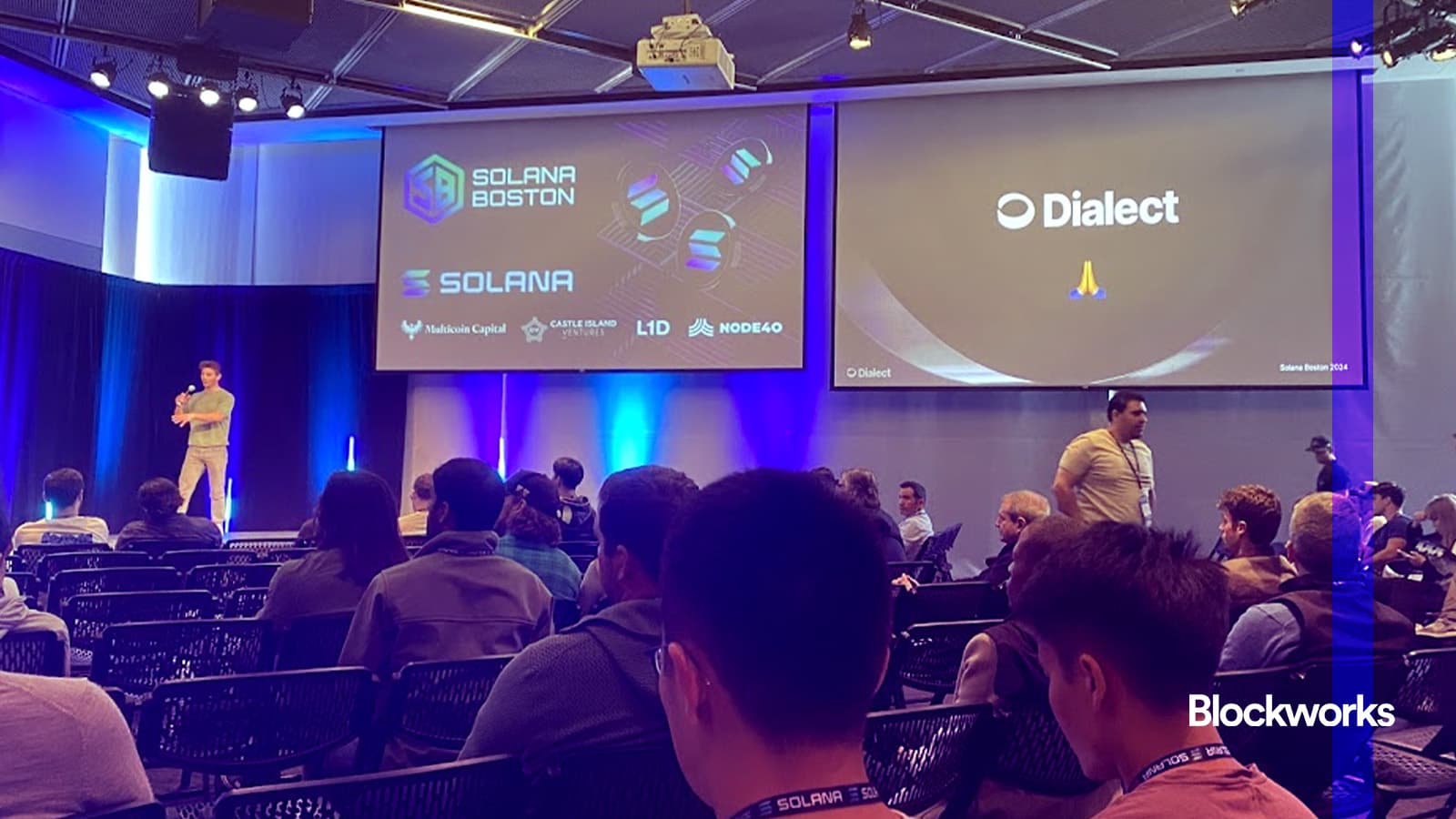
Solana Boston
Today, enjoy the Lightspeed newsletter on Blockworks.co. Tomorrow, get the news delivered directly to your inbox. Subscribe to the Lightspeed newsletter.
A block north of the Charles River and on the sixth floor of MIT’s media lab, Solana investors, founders, and community members were handed Red Sox-themed t-shirts and sipped Dunkin’ coffee during “Solana Boston,” the latest in crypto’s never-ending conference cycle.
This particular conference was much less ambitious than its predecessor in Solana Breakpoint. The venue consisted of two rooms for talks connected by a networking space. The most talked-about speaker seemed to be John Deaton, the crypto-friendly lawyer challenging Elizabeth Warren for her senate seat. There was also a voting-focused afterparty sponsored by the Coinbase-started advocacy organization Stand With Crypto.
I had conversations with multiple founders creating Solana-native apps outside the realm of memecoin trading. This perhaps gives some credence to the theory that after a prolonged stretch of building seemingly endless technological infrastructure for blockchains to use, crypto may finally be entering an era of usable apps chasing broad adoption.
But what the conference highlighted most of all for me was an effort to court students from highly-regarded schools like MIT following the industry’s high-profile PR debacles of the past couple years and the allure of other fields like AI.
Jake Lynch, one of the event’s organizers, told me that of the 250 registrants for Solana Boston, 90 described themselves as students. Boston University, Northeastern, Boston College, MIT, and Dartmouth were the five schools with the highest representation, Lynch added.
But when I met one current MIT student and one recent graduate, the pair seemed underwhelmed by their peers’ interest in crypto. Many of the school’s undergraduates are infatuated with AI, they said, and there seem to only be a few students in each graduating class who want to work in crypto.
A search of MIT’s course catalog for this semester turned up just a few crypto-related results, mostly in the business school, while I found more than a dozen AI-related classes.
As for the crypto industry, Lynch said he thinks there are too few entry level jobs in an industry that has a “massive learning curve” and called for “better funnels” to bring in new graduates.
Crypto likes to eschew credentialism, but for better or worse, a lot of the tech industry’s whiz kids end up graduating from a short list of well-resourced universities. (Crypto’s very own Sam Bankman-Fried famously went to Stanford, after all).
College kids, especially at elite universities, are likely to be drawn by what’s getting buzz from their professors and peers. For now, that seems to be AI.
Perhaps Solana, with its intangible advantage in coolness, can insert itself — and crypto — into the bright Gen-Z coder’s brain once again.
Get the news in your inbox. Explore Blockworks newsletters:
- The Breakdown: Decoding crypto and the markets. Daily.
- 0xResearch: Alpha in your inbox. Think like an analyst.
