Lucky-photographer/Shutterstock and Adobe modified by Blockworks
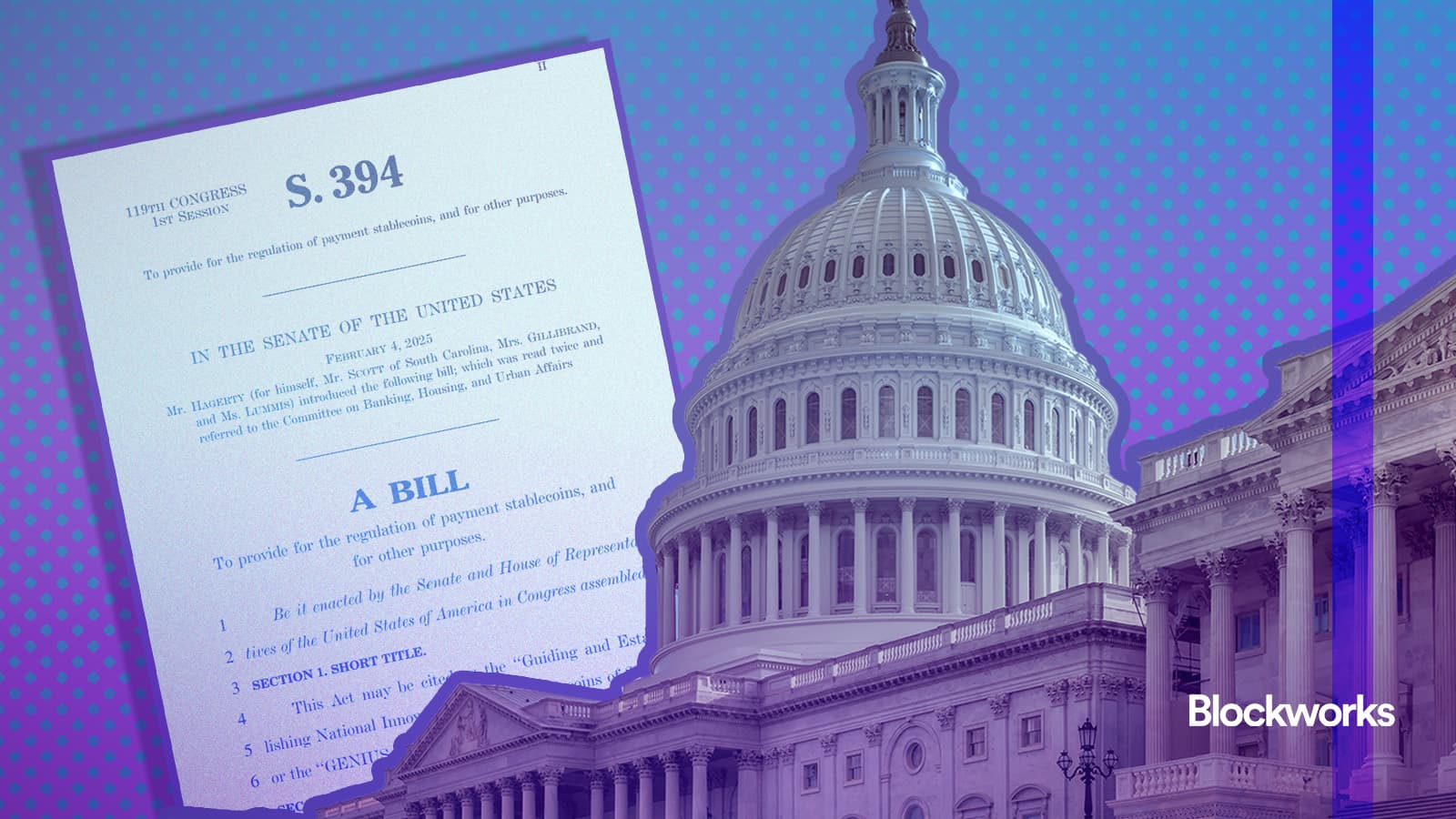
The US House on Thursday passed the GENIUS Act in a 307-122 vote. The landmark stablecoin legislation will now advance to President Trump, who is expected to sign the bill into law on Friday, according to a person familiar with the matter.
The Senate passed the GENIUS Act last month with a 68-30 vote. 18 Democrats voted in favor.
The bill requires stablecoin issuers to maintain fully-backed reserves of US dollars or “similarly liquid” government-issued assets, such as bonds. Issuers with more than $50 billion in issued tokens must complete annual audits.
The law also affords more authority to state regulators, which will be required to maintain regulatory frameworks that are “substantially similar” to those at the federal level. Issuers who exceed $10 billion in issuance must be overseen by federal regulators or apply for an exemption.
Rep. Bryan Steil, who chairs the Subcommittee on Digital Assets, Financial Technology, and Artificial Intelligence, hailed the GENIUS Act as an important milestone for US crypto policy.
“It encourages the innovation and development of Web3 businesses here in the United States,” Steil said during the debate on Thursday morning. “It establishes clear rules to ensure that consumers are protected and businesses have clear regulations to responsibly participate in the digital asset ecosystem.”
Other Representatives insisted that the GENIUS Act does little to protect consumers and prevent runs on stablecoins.
“Central bankers last week issued a warning that stablecoins threaten global financial stability and need a much more restrictive regime than traditional finance,” Democrat Sean Casten said during Thursday morning’s debate.
“The GENIUS act ignores all those experts and instead ties stablecoins into our financial system, but without the safeguards that are required by banks and investment companies,” he added.
The passage comes after a dramatic few days for crypto policy.
After initially failing to pass a procedural vote on Tuesday, Trump met with GOP holdouts to come to an agreement to get the GENIUS Act over the finish line.
In a follow-up vote on Wednesday morning, the measure once again failed before eventually passing late in the evening after hours of vote-flipping and behind-closed-doors debate, according to people familiar with the matter.
Much of the holdup was due to two other crypto bills Representatives are currently considering: the CLARITY Act, which focuses on crypto market structure, and the Anti-CBDC Surveillance Act. Some Republicans wanted to combine the GENIUS and Anti-CBDC Acts, but the faction of the party that insisted on keeping the legislation separate ultimately prevailed.
This is a developing story.
Get the news in your inbox. Explore Blockworks newsletters:
- The Breakdown: Decoding crypto and the markets. Daily.
- 0xResearch: Alpha in your inbox. Think like an analyst.
