DeFi Sector Warms Under Crypto Winter Sun
The DeFi sector is flashing signs of life despite the recent turmoil that has gripped digital assets’ spot market
DALL-E modified by Blockworks
The “crypto dominoes” are falling, sending shockwaves rippling across the landscape, including in decentralized finance, a ranking European Central Bank official opined Wednesday during a keynote speech.
The statement from executive board member — and crypto skeptic — Fabio Panetta, particularly within the decentralized finance (DeFi) sphere, only speaks to half the story.
While it’s apparent that crypto has experienced a number of “painful bankruptcies” that have underscored just how interconnected major firms had become, activity across competing protocols supporting DeFi applications has yet to drive entirely off a cliff.
DeFi has emerged as a silent hero as users lose faith in the endless fraud and failures among centralized crypto institutions, Jehan Chu, founder of Hong Kong-based trading and investment firm Kenetic, told Blockworks.
“Though regulation looms…increasing mindshare is giving DeFi its chance to shine and prove it has long-term advantages over centralized systems,” Chu said.
Peering across the sector, one may be forgiven for thinking most projects or protocols in the budding sector appeared lifeless.
Monthly trading volume across decentralized exchanges has fallen each period beginning from the middle of the year. That’s before volume spiked in November on the back of an industry-wide panic — courtesy of FTX.
In June, total decentralized exchange volume clocked around $95 million, data from Dune Analytics shows. That figure fell to a low of around $44 million in October before November’s spike.
December’s data stands at roughly $8 million, hinting at a weaker-than-average showing of user trading activity for the month so far.
Still, data from DeFiLlama shows the total value locked (TVL) in DeFi protocols hovers at February 2021 highs — a period in which DeFi had just begun to pick up in earnest.
At that particular peak, DeFi’s protocols contained roughly $54 billion in value before skyrocketing to an all-time high of around $244 billion just 10 months later. It’s still down by about 77% from its peak to stand at roughly $55 billion TVL at the time of writing.
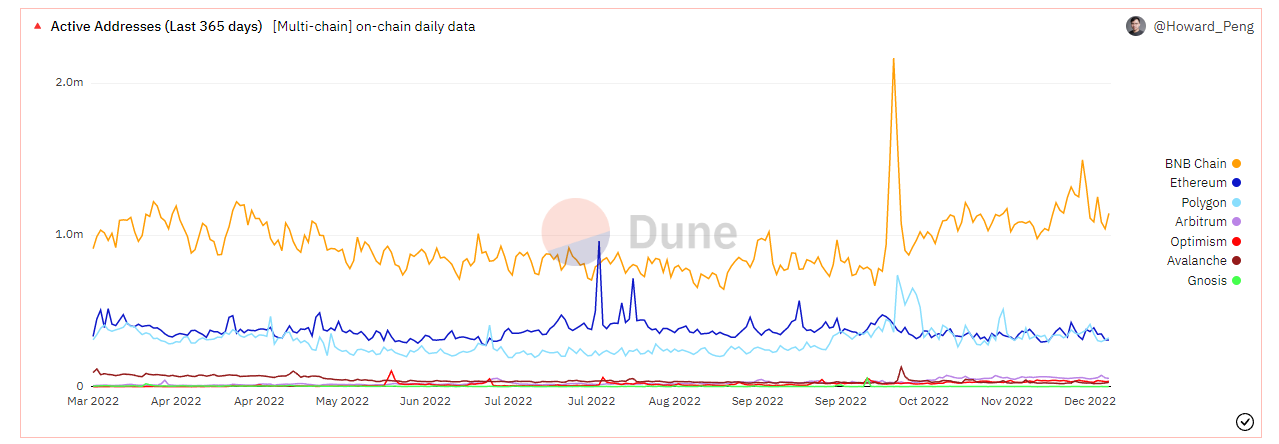 Dune Analytics dashboard by nascent data analyst Howard Peng
Meanwhile, activity on Ethereum layer-2s Optimism and Arbitrum — considered the two largest by adoption to date — show both total transactions per day and active addresses have trended upward since the end of August, albeit in a see-saw fashion.
On Aug. 28, Arbitrum and Optimism’s active addresses stood at roughly 27,000 and 10,000, respectively. Today, those figures have more than doubled to 56,000 and 36,000, data show.
Daily transactions on Arbitrum have jumped more than 480% from July 10 lows of around 58,800 to 338,400. Optimism’s has spiked more than 546% from 55,600 to 349,800 over the same period.
Contracts deployed — which show how many users are engaging and executing tasks on both networks — reveal Optimism’s data has exceeded most other weekly periods in the last 90 days, while Arbitrum continues to chug along nicely.
Individuals appear to be more interested in “free money” included in airdrops during crypto winter, so there’s a focus on Arbitrum, which has not yet launched a token, a spokesperson for on-chain data analytics firm CryptoQuant told Blockworks.
“As alternatives to layer-1s, and having success in protocols such as GMX and Magic naturally increase the interest in layer-2s,” they said.
As the year comes to a close, interest in DeFi remains strong, a counterpoint to the contraction trends seen in metrics like capital flows out of crypto-focused funds from traditional institutions.
Get the news in your inbox. Explore Blockworks newsletters:
- The Breakdown: Decoding crypto and the markets. Daily.
- 0xResearch: Alpha in your inbox. Think like an analyst.
