The MicroStrategy effect: Rate of corporate bitcoin buys accelerates
First it was MicroStrategy, then Block. Now over a dozen companies have bought bitcoin, treating it the same as cash.
MicroStrategy and Adobe Stock modified by Blockworks
If you bought the bitcoin dip, you’re definitely not alone.
At least six companies — five of which are publicly traded — have snapped up bitcoin following its all-time high in March.
MicroStrategy, Block, Metaplanet, Semler Scientific, OneMedNet and soccer team Real Bedford FC — owned by Bitcoin podcaster Peter McCormack — altogether bought an estimated 48,836 BTC in that period.
They probably paid about $3.09 billion for that stash, which would now be worth closer to $3.1 billion.
And OK, MicroStrategy is relentless. The data intelligence firm was responsible for 97% of the bitcoin bought by those corporations since bitcoin’s recent top, leaving the others to spend roughly $92.7 million on stacking sats.
Read more: MicroStrategy stock is beating bitcoin — because it buys a lot of bitcoin
Bitcoin retraced as much as 27% as markets consolidated — from almost $73,740 to $53,900.
It’s not totally possible to determine the exact purchase price in many instances. Still, the data suggests they probably spent somewhere around $63,250 per coin.
But publicly-listed companies have been buying bitcoin for over four years now.
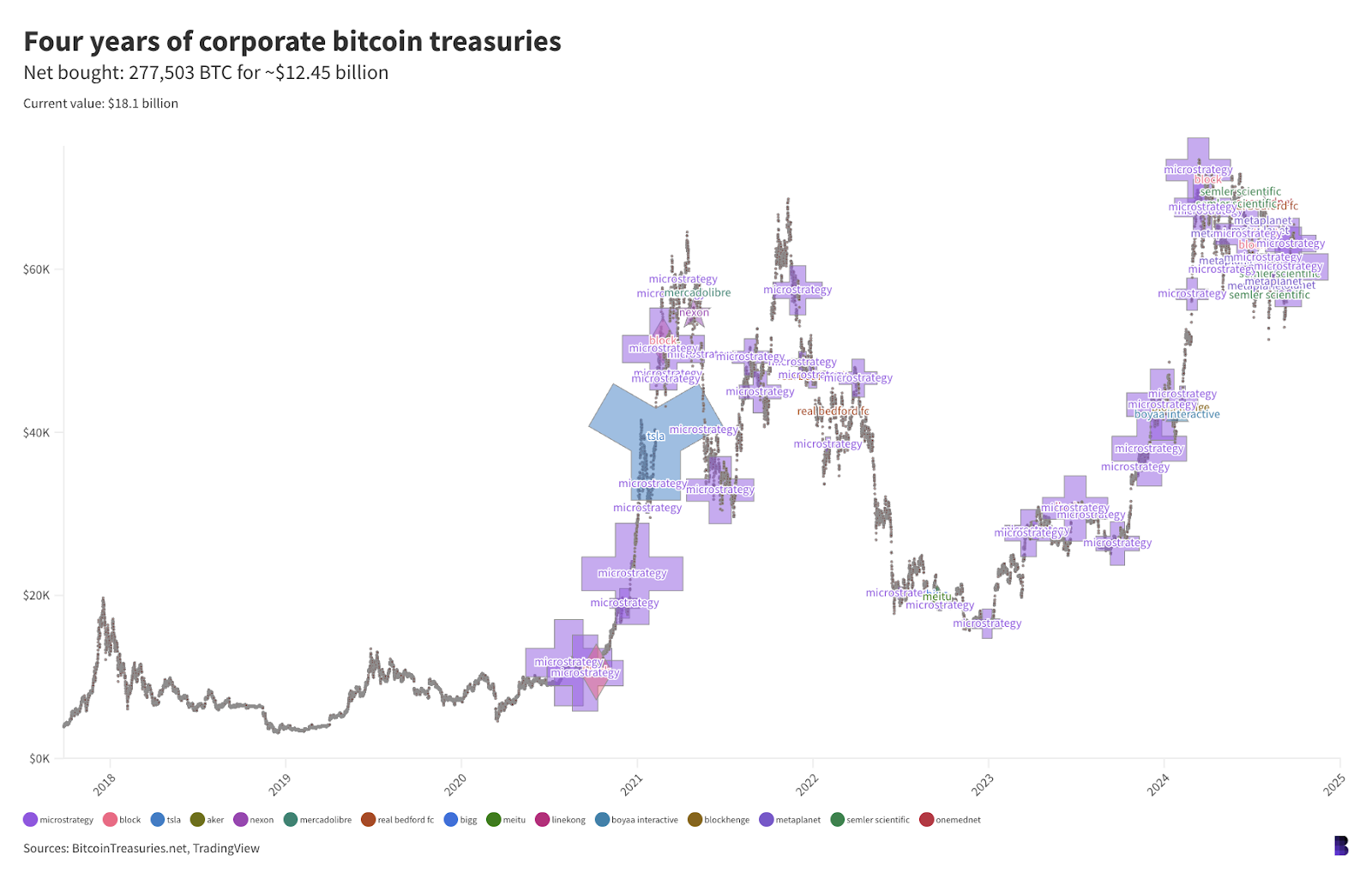
Since MicroStrategy bought its first BTC in August 2020 (after then-CEO Michael Saylor sold the Voice.com domain to EOS issuer Block.one for $30 million), at least fifteen different companies have added bitcoin to their balance sheets.
(The real figure is actually somewhat higher. Fifteen is the number of bitcoin-buying companies that aren’t specifically related to bitcoin mining or digital asset management, that have also disclosed the dates of their purchases to date — which allows us to see a cost basis on BitcoinTreasuries.net.)
The chart above plots every bitcoin purchase disclosed by companies against the price of bitcoin, from Latin America ecommerce giant MercadoLibre to South Korean video game publisher Nexon. It covers 277,503 BTC worth of purchases, the equivalent of 1.4% of the circulating supply, and some are positioned at estimated times due to unspecified disclosures.
It doesn’t, however, show the 33,480 BTC ($2.2 billion) sold by Tesla between April 2021 and July 2022, around 75% of its stash.
It does include estimated buys for Block’s new dollar-cost averaging strategy, which sees the Jack Dorsey-founded fintech firm directing 10% of its gross bitcoin-related profits from Cash App into buying more BTC every month.
Block reported $67 million bitcoin-related gross profit in Q2 2024, which averages out to $22.3 million per month. If its gross profits remain steady, Block is buying something like $2.2 million in bitcoin each month — about 33.2 BTC at current prices.
All told, the rate of individual bitcoin disclosures from corporations is increasing: At least 32 so far this year compared to nine in all of 2023, eight in 2022, 20 in 2021 and five in 2020.
And, of course, many more from El Salvador and various crypto funds and ETFs, and even ones that haven’t been publicly reported. Bitcoin bulls have company.
A modified version of this article first appeared in the daily Empire newsletter. Subscribe here so you don’t miss tomorrow’s edition.
Get the news in your inbox. Explore Blockworks newsletters:
- The Breakdown: Decoding crypto and the markets. Daily.
- 0xResearch: Alpha in your inbox. Think like an analyst.
