Months After De-Pegging Event, USDC Continues to Lag Behind Tether
Tether’s recent market share gains seem to be directly at the expense of Circle’s USDC
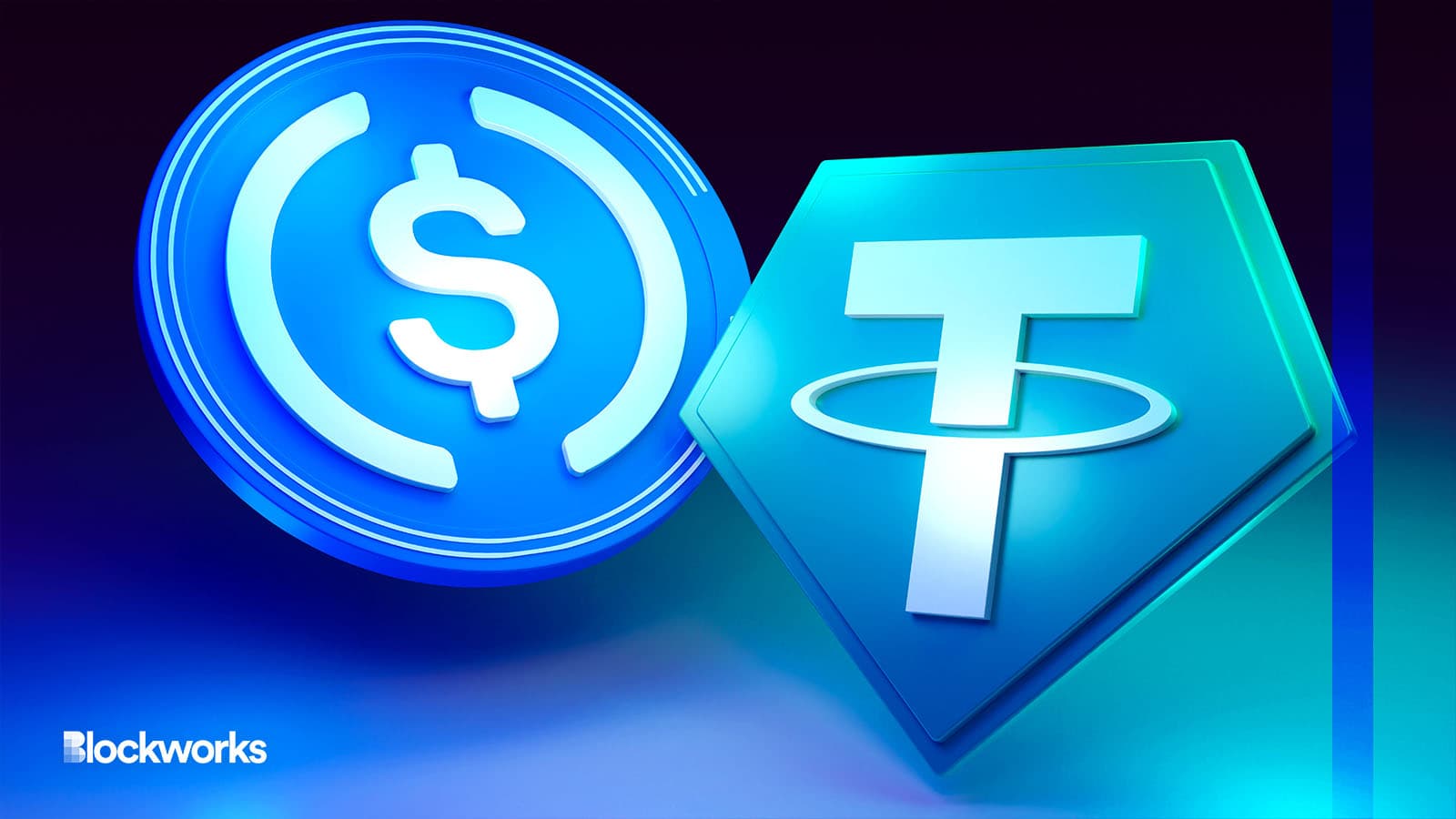
Source: Shutterstock / CryptoFX, modified by Blockworks
Reflecting on events like the Terra collapse in the spring of 2022 and the de-pegging of USDC less than a year later might cause one to question the accuracy of the term “stablecoin.”
Despite the tumult, the most popular stablecoin token, Tether’s USDT (USDT), continued growing in market share while competitors faltered. It began the year with a market cap of $66 billion, and now exceeds $82 billion. Much of these gains seem to be directly at the expense of Circle’s stablecoin offering, USDC (USDC), which began the year with a market cap of $44 billion but has since fallen to just under $30 billion.
Bitwise CIO Matt Hougan and crypto research analyst Ryan Rasmussen discussed USDC’s momentary depegging from the dollar and its potential long-term implications in an interview with Blockworks on the 0xResearch podcast.
“We at no time had real fundamental worries about how it would shake out in the end,” says Hougan. “My only concern was that it would damage their reputation.”
Liquidity issues related to regional bank failures were reportedly the primary cause of USDC’s brief period of instability. Hougan says he feared onlookers would assume the USDC depegging event was a crypto-native failure, like the aforementioned Terra algorithmic stablecoin meltdown, rather than a traditional finance failure.
“That turned out not to be the case. I think everyone has confidence in USDC, more confidence even today than they did back then because they’ve improved their collateral.”
“But yeah, I wish USDT wasn’t gaining market share.”
Markets are rewarding opacity
Hougan says it’s bad for the market “when you reward opacity.” People perceived Tether as a safer place for their money, he says, “because they couldn’t see that they couldn’t access their money. That’s terrible reasoning.”
“I wish it would go the other way. I think it will over time. I still believe in that.”
Hougan believes institutions will become a larger part of the market. “People want more regulated entities.”
Rasmussen says regional bank failures and USDC’s subsequent liquidity problems did, in fact, harm its reputation. It was “a ripple effect,” he says, of Silicon Valley Bank’s “not so great risk management.”
According to Rasmussen, an important lesson was derived by Circle from the fiasco: “Spreading your capital across multiple banks as a stablecoin issuer probably makes a lot more sense” than concentrating funds in one place, “especially a regional bank.”
He states that USDC now holds a “huge portion” of its capital in treasuries. “You’re really getting a very similar risk profile from exposure to the traditional financial system with either stablecoin,” he says.
Rasmussen presents factors for choosing between USDT and USDC, “Which one has less opacity? Which one has less regulatory risk?”
“USDC wins that battle every single time.”
Hougan laments the current regulatory climate in America and how it’s holding back companies that are attempting to comply. “USDC is doing the best job of trying to be a regulated, audited, clearly accessible entity.”
“That doesn’t actually necessarily mean in today’s climate that it has lower regulatory risk.”
“You’re not necessarily rewarded for trying to do the right thing in today’s crypto environment. I wish that weren’t the case, but this is an imperfect market that we all operate in.”
Podcast host Dan Smith adds, “I did think it was very interesting that during the USDC de-peg, USDT was the safe haven. And that would imply that at the time Tether had no exposure to the US banking system.”
“Whether that’s a good thing or a bad thing is definitely up in the air.”
Get the news in your inbox. Explore Blockworks newsletters:
- The Breakdown: Decoding crypto and the markets. Daily.
- 0xResearch: Alpha in your inbox. Think like an analyst.