Can We Solve the Crypto Exchange Liquidity Problem?
In the crypto market, liquidity is fragmented between different platforms, making global price discovery almost impossible

Source: Shutterstock
Cryptocurrency exchanges have evolved significantly from the days of Mt. Gox – once the world’s largest bitcoin exchange. Crypto exchanges in this age are highly sophisticated, with advanced security, trading functionalities, and even self-custodial access with decentralized exchanges.
However, these improvements across centralized and decentralized exchanges need to address significant liquidity bottlenecks. The closed nature of the various centralized trading venues leads to fragmented liquidity, while decentralized exchanges introduce unique constraints that adversely impact traders.
The challenges facing global crypto liquidity has inspired exchanges like Bullish to innovative trading technology that can offer tighter spreads and more reliable depth.
The liquidity problem in crypto exchanges
Liquidity refers to the ease at which an investor can buy or sell an asset without moving the asset’s market price. This degree of ease is a direct result of the amount of buyer and seller activity on a trading venue.
In the cryptocurrency market, liquidity is fragmented between different platforms making global price discovery almost impossible. For example, the bitcoin spot price usually differs across exchanges at a given time. Thus, because these exchanges are not connected, the price discovery process takes place on individual platforms.
In traditional markets, true price discovery is possible because global liquidity is aggregated on a single trading venue, such as Nasdaq. In the crypto market, exchanges meet investors’ liquidity demands through different mechanisms.
Centralized exchanges
Centralized exchanges utilize a model that relies on hiring market makers. Market makers quote bids and ask prices on an asset’s order book throughout the day. The objective is to encourage active trading and ensure tight spreads for traders. Yet, this heavy reliance on market makers poses a unique problem.
Only a handful of institutional-grade market makers are willing to undertake the technical and volatility risks associated with crypto markets. Centralized exchanges must typically compete for limited liquidity from available market makers. This results in fractured liquidity and increased volatility, especially during peak trading demands.
Institutions dipping their toes into the crypto market must utilize several tools to search through multiple exchanges for the best prices. The rigorous process of accessing deep crypto liquidity is a major impediment to greater institutional adoption. Under the current approach, centralized crypto exchanges cannot reach the liquidity standards required to serve institutional trading desks trading hundreds of billions of dollars daily.
Decentralized exchanges
Decentralized exchanges take a unique approach to solving the liquidity problem. The automated market-making (AMM) model pioneered by DEXes replaces traditional market makers with liquidity providers (LPs). Liquidity providers receive a fraction of transaction fees on each trade and additional incentives from the protocol’s governance tokens.
However, the decentralized and permissionless model utilized by DEXes creates a unique set of problems. First, their on-chain architecture decreases throughput and is unsuitable for high-frequency trading. Next, there is a general lack of market depth compared to market-making on centralized platforms. Liquidity providers recognize the volatility and security issues associated with DeFi and deploy limited capital based on their respective risk profiles. Additionally, DEXes face a constant struggle to retain liquidity as most providers deploy mercenary capital and will immediately withdraw funds to competitors that offer the highest short-term returns.
The general lack of market depth fundamentally encourages liquidity fragmentation, increased price slippage for traders, and wild fluctuations in available liquidity during periods of peak market volatility. These bottlenecks make it difficult for market participants to calculate the involvement risks, discouraging institutional investors.
A second challenge facing AMMs is the increased risk of front-running attacks, commonly known as miner extractable value (MEV). In this rare disadvantage for traders, blockchain transparency enables sophisticated developers to front-run a trader’s transaction by creating a similar one that increases the exchange value and generates profit for the developer.
The MEV loophole executed through bots results in increased slippage or traders paying higher fees to access on-chain liquidity. According to data from Flashbots Explorer, the total extracted MEV value currently sits at over $670 million in the past three years.
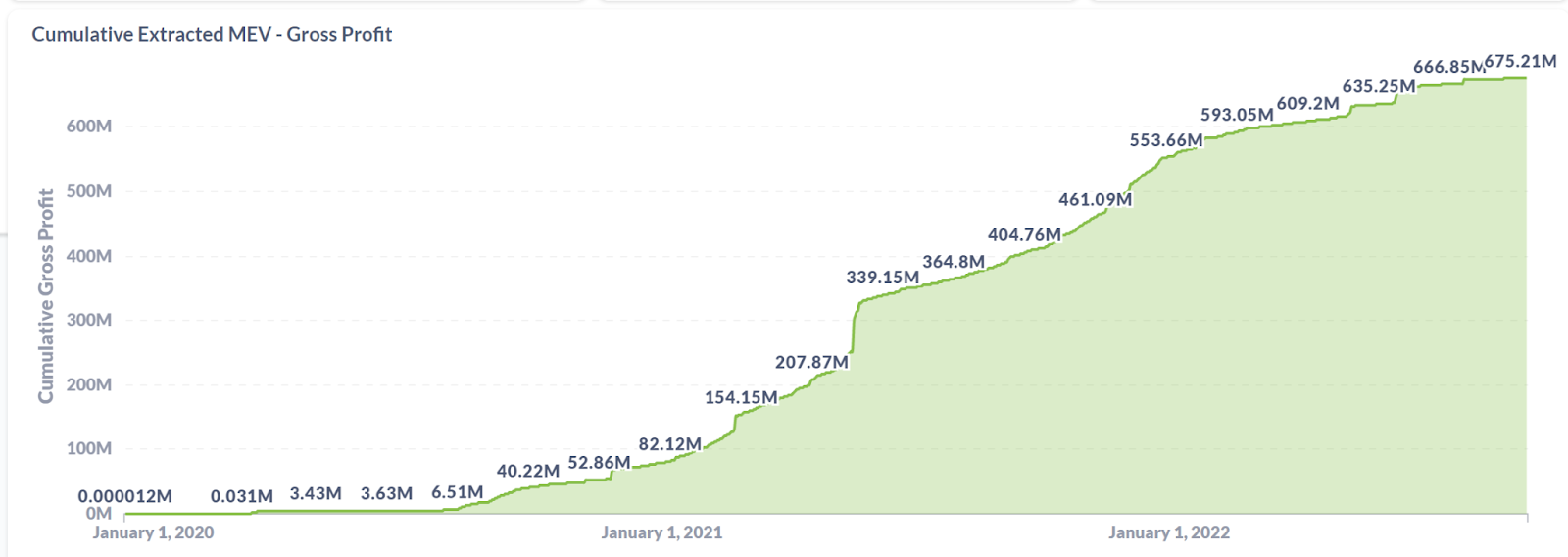 Cumulative extracted MEV | Source: FlashBots Explorer
AMMs tackle the lack of sufficient liquidity by innovating ways to attract more liquidity providers. One innovation by Curve Finance involves tying a protocol’s liquidity profile to its governance token and requiring other protocols to acquire as many tokens as possible to influence liquidity distribution and rewards. This model introduced the so-called “Curve Wars,” which brought more liquidity and mercenary capital.
Meanwhile, traders bear the brunt of these ‘wars’ as they pay higher fees enforced by governance token holders and controlling protocols keen on getting the best possible yield. The reliance on perverse incentives to attract and sustain on-chain liquidity makes the approach unfavorable to traders and the institutional investor class, which the crypto market requires to reach mainstream adoption.
An new approach to tackling the crypto exchange liquidity problem
A fresh perspective is required to solve the current liquidity issues facing the cryptocurrency market. The ideal solution will enable exchanges to provide greater market depth and increased certainty while delivering the best exchange value to traders.
Bullish is amongst the first exchanges to implement AMM technology in a centralized order book, unlocking unparalleled liquidity without sacrificing performance. Bullish utilizes a novel solution called AMM instructions that provide greater order book depth and tighter spreads, making it one of the most efficient platforms to execute through .
The Bullish approach combines the performance and compliance of centralized exchanges with the liquidity profile of decentralized exchanges. The result is a radical improvement to global crypto liquidity and an institutional-grade platform set to accelerate the adoption of digital assets.
This content is sponsored by Bullish.
Get the news in your inbox. Explore Blockworks newsletters:
- The Breakdown: Decoding crypto and the markets. Daily.
- 0xResearch: Alpha in your inbox. Think like an analyst.