Safe is designing a new standard for modular smart accounts
The Safe team is seeking community feedback on how to improve modular smart accounts

DwaFotografy/Shutterstock modified by Blockworks
Safe, previously known as Gnosis Safe, is developing a standard with the goal of transitioning the Web3 space to modular smart accounts.
As Ethereum co-founder contended in a June blog post, smart accounts are critical to bringing on more users into the blockchain Web3 space. A smart account, in essence, enhances how a user manages their digital assets via the use of smart contracts.
Richard Meissner, co-founder of Safe, told Blockworks that when the team began its work, it sought ways to extend smart account functionality.
“The challenge was that these modules bring an inherent risk because the more powerful it is, the more you expose your underlying logic and your account could be abused,” Meissner said.
With growing interest from the Web3 community in account abstraction and smart contract wallets over recent months, Meissner said it was a good opportunity to begin delving into these problems.
Along with co-founder Lukas Schor, Safe released a whitepaper for a “Safe Core Protocol” that explores different ways to streamline smart account solutions. Beyond general security concerns, the whitepaper addresses potential solutions to ecosystem fragmentation.
Today, there are multiple ecosystem initiatives around smart accounts and smart contract wallets, all of which have slight differences between them. Instadapp and MetaMask, for example, are all looking at ways to incorporate the technology into their respective infrastructure stacks.
Meissner told Blockworks that “over the next couple of months, it will be an important task to look at where we can further line up to prevent fragmentation.
Seeking a solution
The whitepaper introduces the concept of a “Manager” which is responsible for managing “Accounts”, “Registries” and “Modules.”
An abstraction layer — a separation layer between different components of a system — is used to navigate the complexities between fragmentation, interoperability and security.
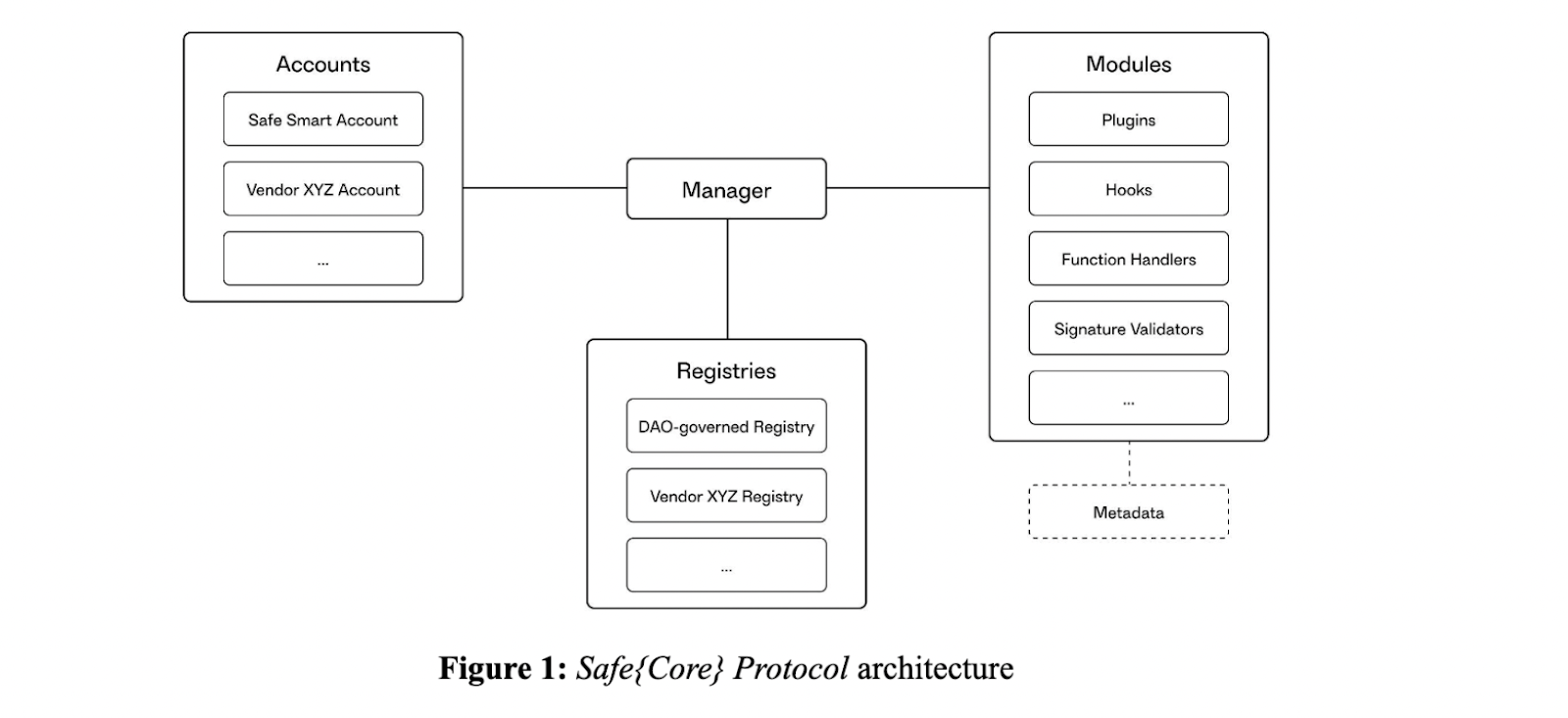
Per the paper, smart account users can choose to opt into a protocol by enabling the Manager, which will then give it access to functionalities enabled through Modules. To ensure the security of these Modules, Registries exist to enforce standards.
Schor told Blockworks that the Safe Core Protocol aims to address issues around interoperability and security.
“In the long run, we want you to be able to plug your different smart accounts into the same protocol, it’s all interoperable, and it all leverages the same security properties,” said Schor.
Over the next few months, the team will seek community feedback on the proposed protocol.
“We wanted to get the white paper out early even though we’re still working on the actual implementation to get early community feedback,” Schor said. “It gets harder to change things as we go along, so we want to get feedback as early as possible when things are still very flexible.”
Get the news in your inbox. Explore Blockworks newsletters:
- The Breakdown: Decoding crypto and the markets. Daily.
- 0xResearch: Alpha in your inbox. Think like an analyst.
