Permissionless day 3: What’s next?
Industry luminaries turned their attention to what’s next for crypto in the final day of the Permissionless conference
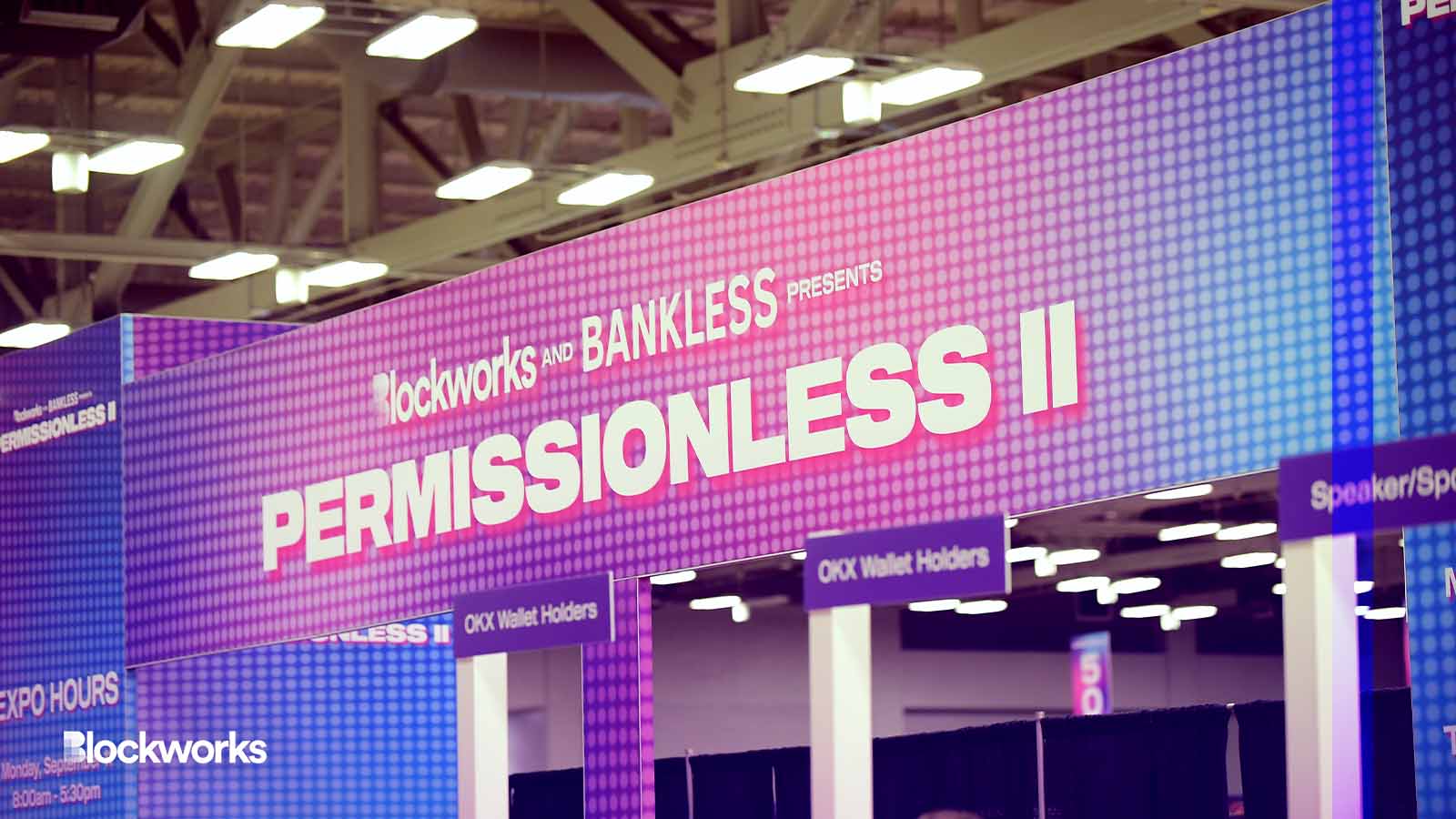
Permissionless II by Blockworks
As the luggage piled up in a checking area as attendees streamed in for the third and final day of the Permissionless conference in Austin, it seemed as if the question on everyone’s mind was, “What’s next?”
Calling in virtually from his travels in East Asia, Ethereum co-founder Vitalik Buterin served as the day’s opening main stage attraction. He fielded questions on some of the most promising and underappreciated avenues for further crypto development.
On his mind were various forms of public goods funding — DeSci and more privacy-preserving zero knowledge proofs, among others — as well as more robust, high-security oracle and DeFi models. Buterin also speculated on the continued growth of decentralized social media, naming Farcaster and Lens in particular.
Aside from use cases that need to develop further, multiple conversations focused on whether or not crypto can be expected to follow the classic “four year cycle” bull/bear pattern that has consistently played out essentially since Bitcoin’s inception.
At the “Who Is Still Investing In Crypto” panel, Framework’s Vance Spencer and Alliance DAO’s Qiao Wang took up the topic, with Wang arguing that crypto’s size means that crypto is now tethered to global markets more broadly.
To explore the question further, I caught up with Framework’s Michael Anderson among the conference booths. Anderson’s view is that by late spring of next year — the end of May and beginning of June — we’ll know for sure that we’ve started a new cycle as prices rally.
But what if the broader economy tanks on higher-for-longer interest rates, taking crypto down with it and undercutting the start of a new cycle?
Read more: Permissionless day 1: Prepping for institutional adoption
“We win either way,” says Anderson, pointing to the uptake of tokenized treasury yields — even if we don’t get another cycle, degens can sit back and reap high rates.
Also working in the industry’s favor are a number of high-upside use cases that could stealthily bring on large numbers of users. Anderson pointed to social and gaming — both sectors that have been around and discussed for the better part of a decade, but due to structural challenges (say, the amount of time and talent it takes to make a good game) haven’t quite seen the light of day just yet. Keep an eye out for AI Arena and Illuvium, he recommended.
Personally, I’m a fan of Superstate founder Robert Leshner’s call: Come June 2024, exactly four years after the launch of Compound’s COMP governance token that kicked off DeFi summer, we’ll have our answer as to if crypto will see a new spring or another few years of a devastating winter.
Get the news in your inbox. Explore Blockworks newsletters:
- The Breakdown: Decoding crypto and the markets. Daily.
- 0xResearch: Alpha in your inbox. Think like an analyst.
