Kevin McCarthy ousted! And it means nothing for crypto
The idea that McCarthy’s political downfall will somehow shift the crypto policy landscape in the US is a bad take
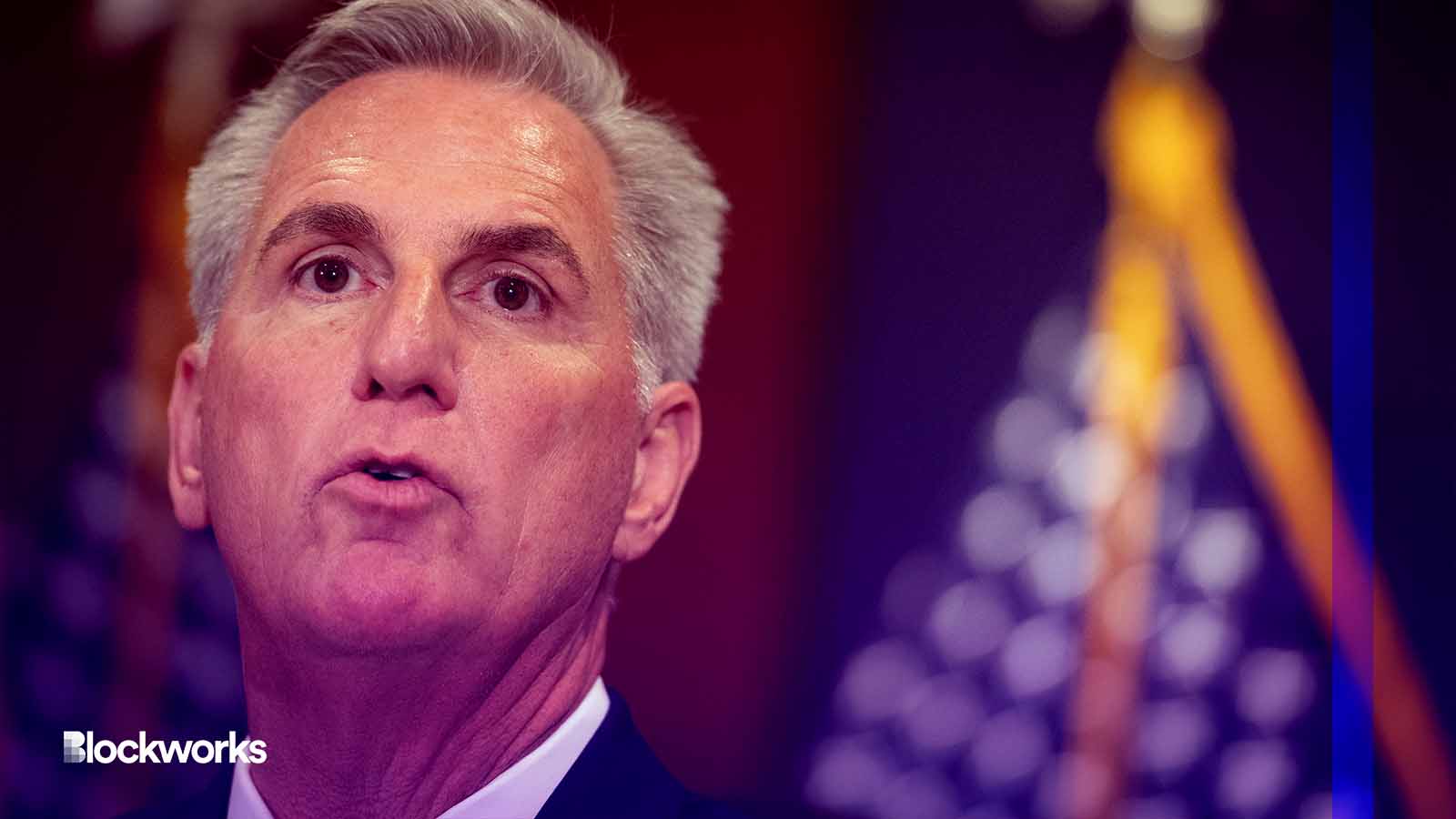
Rep Kevin McCarthy | Consolidated News Photos/Shutterstock modified by Blockworks
I’ve seen some garbage opinions out there recently about Kevin McCarthy’s expulsion from office as speaker of the US House of Representatives and how this might be a good thing for crypto.
Much, I think, is being made of nothing.
First, there’s the erroneous notion that the ascent of Patrick McHenry (R-NC) as speaker pro tempore is somehow a boon because of McHenry’s “crypto-friendly” posture.
To be clear: McHenry’s sole function is to conduct the election for the next speaker of the house. That’s it. He’s basically there to hold out the hat as people drop their votes in — nothing to do with crypto.
Here’s the truth as I see it. No political game of musical chairs is going to fundamentally revise the prevailing regulatory narrative around crypto. Certainly not the exit of a politician known better for his fundraising acumen rather than his ability to wield real power.
As far as I can tell, McHenry isn’t joining the race for the full promotion. That’s likely because two other House heavyweights — Steve Scalise (R-La.) and Jim Jordan (R-OH) — have absorbed just about all the available competitive oxygen.
Maybe something crazy happens, Scalise and Jordan go down in flames, and McHenry steps up to fill the void. But I just don’t see it happening.
Tom Emmer (R-MN) was the other House Republican raised as a preferred replacement in the wake of McCarthy’s exile. Indeed, Emmer was floated via a far-right whisper campaign picked up by the Washington Post in a Sept. 28 report.
But this never made much sense to begin with. Emmer supported McCarthy, voted to keep him in office, and, oh, he’s already backing Scalise. So much for that.
Barring any unforeseen madness — and yeah, there’s no shortage of that in Congress these days — either Scalise or Jordan will be the next speaker of the House. I think the race will go to Jordan, thanks in part to a Friday endorsement by former US president and current courtroom resident Donald Trump. Jordan’s deep connection to the agenda-setting right wing of the GOP and grenade-throwing tendencies, however accurate or inaccurate, makes him an ideal candidate in today’s political moment.
Jordan, it bears mentioning, hasn’t taken any kind of crypto position.
So, where does McCarthy’s expulsion leave crypto more broadly? Some crypto commentators will continue to grasp for straws in an attempt to frame events around some kind of positive or negative narrative for the industry. More importantly, things will carry on as they have: shaped by the failure of FTX and the ever-growing legal and regulatory pressures surrounding Binance.
The McCarthy-exit-will-help-us mentality has less to do with tangible reality and more to do with the tendency among some in the crypto “space” to project their desires, biases and theses on the aforementioned reality. Crypto advocates want Congress to help them out of their economic and perceptual dilemmas, so any major change — and yes, McCarthy’s defeat is a big deal — will be perceived as some kind of opportunity or moment of deliverance.
Read more from our op-ed section: Need an edge in the 2024 presidential election? Look to crypto.
Despite how the business community and lobby apparatus might otherwise feel, crypto is…really small. Congress faces a feast of problems, like paying for the government to run, so addressing things like the tax status of cryptocurrency is, well, probably not super-high on the agenda.
But I digress. Looking ahead, I predict that the basic calculus will stay the same.
Cannibalism and Trump-worship will remain the preferred Republican political strategies. Democrats will keep fundraising. The Senate will creak along, as will President Joe Biden. There’s a decent chance the government shuts down this fall, though a proposed bill to effectively end the risk of government funding cliffs might curtail that possibility.
Okay, sure, those are some pretty low-risk predictions. But what about crypto policy?
I think policy changes will inch along, as they have, as part of the broader appropriations process. This is a strategy advanced by lawmakers like Darren Soto (D-FL), given that the essential bipartisan fashion of these processes (well, normally) is conducive for finding common ground on thorny issues.
Policymaking efforts — like those focused on stablecoins, exchange rules, etc. — will succeed not through media-savvy political wars but the slow, collaborative processes that reflect the way Congress should operate. Maybe the industry will like the outcomes. Maybe they won’t. They’re certainly out there trying.
But Kevin McCarthy’s tortuous downfall changes absolutely nothing.
Get the news in your inbox. Explore Blockworks newsletters:
- The Breakdown: Decoding crypto and the markets. Daily.
- 0xResearch: Alpha in your inbox. Think like an analyst.
