Ethereum rivals are ‘dead on arrival,’ says Cumberland’s Van Bourg
“What computational ability is possible on Solana that isn’t possible on Arbitrum or Optimism at this point?” Jonah Van Bourg asks

Maurice NORBERT/Shutterstock modified by Blockworks
Despite the crypto market’s turn toward a cautiously positive sentiment, things aren’t looking good for Ethereum’s competitors, according to Jonah Van Bourg.
On the 1000X podcast (Spotify/Apple), Cumberland’s global head of trading says user counts and wallet addresses have plateaued on alternative layer-1 blockchains.
“Your Solanas, NEARs and Polkadots — and all these other coins — these ecosystems are dead on arrival at this point.”
In the meantime, Ethereum layer-2 solutions like Arbitrum and Optimism are flourishing, Van Bourg says. According to Blockworks Research, the TVL, or total value locked — a measure of the monetary value that resides in a blockchain’s ecosystem — is comparatively low on competing chains.
The current total value locked in Solana stands at approximately $320 million, a little more than one percent of Ethereum’s TVL, which is currently around $26 billion.
Ethereum-based layer-2 chains Arbitrum and Optimism are trending positively and already overshadow Solana’s TVL with values of approximately $2 billion and $900 million, respectively.
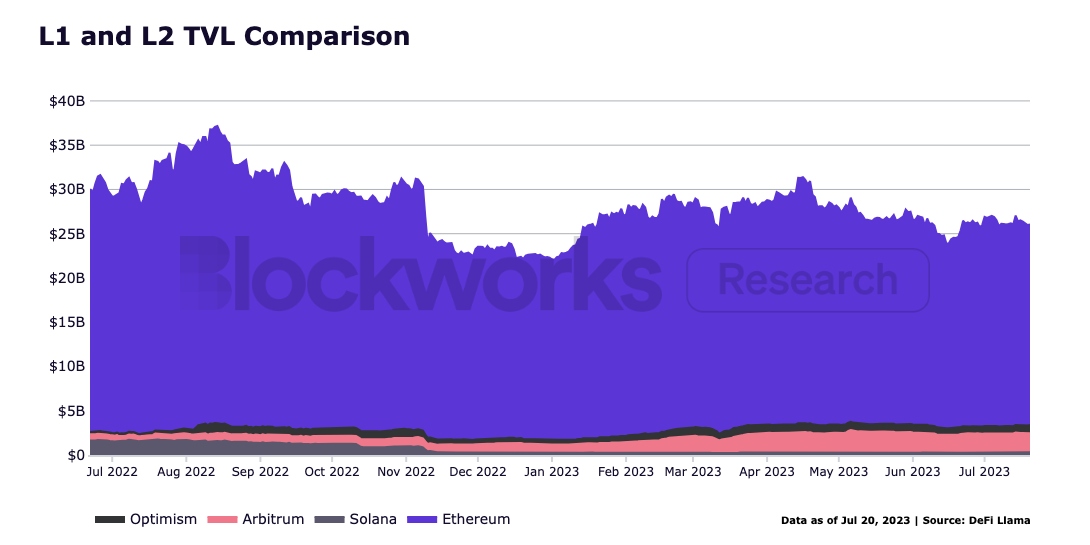 Chart by Blockworks Research analyst Spencer Hughes
“So is the multichain thesis still alive for the next cycle?” Van Bourg asks. “I vote no. I think it’s time to write it off.”
The greed factor
Avi Feldman, GoldenTree’s head of digital asset trading, is quick to disagree.
“Greed is too large to write it off,” he says. “You get projects that are willing to build on things like Solana and Avalanche and NEAR and all of these other protocols because if they’re a competent, good team, they can win that space.”
Incentive programs will draw value to competing protocols, Felman argues, “when the bull market comes back.”
But incentive programs have been the “only draw” for the competing chains, Van Bourg retorts. “That doesn’t last forever.”
Felman expects competing chains to experience a “renaissance” due to their novelty and the “greed factor,” arguing that by onboarding people with incentives, they may potentially reach “escape velocity” to become “real projects.”
Referring to a previous interview with Galaxy Digital’s Mike Novogratz (Spotify/Apple), Van Bourg says the next bull cycle will be the “show me” stage of crypto, whereby projects need to prove their worth at a practical level.
“What computational ability is possible on Solana that isn’t possible on Arbitrum or Optimism at this point?” he asks.
Felman says it’s not so much about the tech itself, but instead a matter of “use-case fit.”
“The constraint is not always the tech. The constraint is figuring out what to do with the tech,” he says.
Van Bourg agrees, but suggests that the argument only further proves his point. “If it isn’t about the tech, what’s the advantage of one shiny alt-L1 versus another versus ETH?” Ethereum, he says, “gives you everything you need right now for today’s limited slate of use-cases.”
“If ETH was bowling over because of too many people trying to use it or too much throughput,” Van Bourg says, “then you have an alt-L1 thesis right there.”
Get the news in your inbox. Explore Blockworks newsletters:
- The Breakdown: Decoding crypto and the markets. Daily.
- 0xResearch: Alpha in your inbox. Think like an analyst.
