Cross-chain transactions in just 2 seconds? Squid says it’s possible
Squid said its new Boost feature will enable all its swaps under $20,000 to occur in less than a minute.

nekomamire/Shutterstock modified by Blockworks
Cross-chain swap and liquidity routing protocol Squid today launched Boost — a tool that is intended to reduce transaction speeds across different blockchains to as little as two seconds.
The protocol itself is built on top of cross-chain communication network Axelar. It uses Axelar’s General Messaging Passing (GMP) to enable one-click swaps across chains.
Squid said it supports over 43 different blockchains, including Ethereum virtual machine (EVM) chains such as Ethereum, Arbitrum, Polygon and Avalanche, and many Cosmos chains such as Cosmos Hub, Crescent and Injective.
Squid launched in February and has since seen $93 million in transaction volumes, co-founder Christina Rud told Blockworks.
How does Squid swap tokens?
Squid co-founder Fig told Blockworks that instead of needing to transfer funds to an application, then convert it to a different token to use it, Squid’s router enables users to directly transfer across blockchains and into the token they wish to receive in just one click.
This means that users can swap any-to-any token across all blockchain networks that Squid supports.
Squid said it achieves this functionality by utilizing existing liquidity on different automated market makers (AMMs) — such as Uniswap or Curve.
All its transactions are routed through Axelar Wrapped USDC (axIUSDC)/USDC stable swap pools and USDC/native token pools on AMMs.
“If you have USDC on Avalanche and you want to stake Ethereum on a liquid staking contract, what Squid would do is we would swap USDC on Avalanche into Axelar Wrapped USDC, we would do that on Stellaswap, and transfer that across to Ethereum where the USDC gets unlocked by the Axelar bridge, and then stake it in the Lido contract, for example,” Fig said. “All of that happens in one click.”
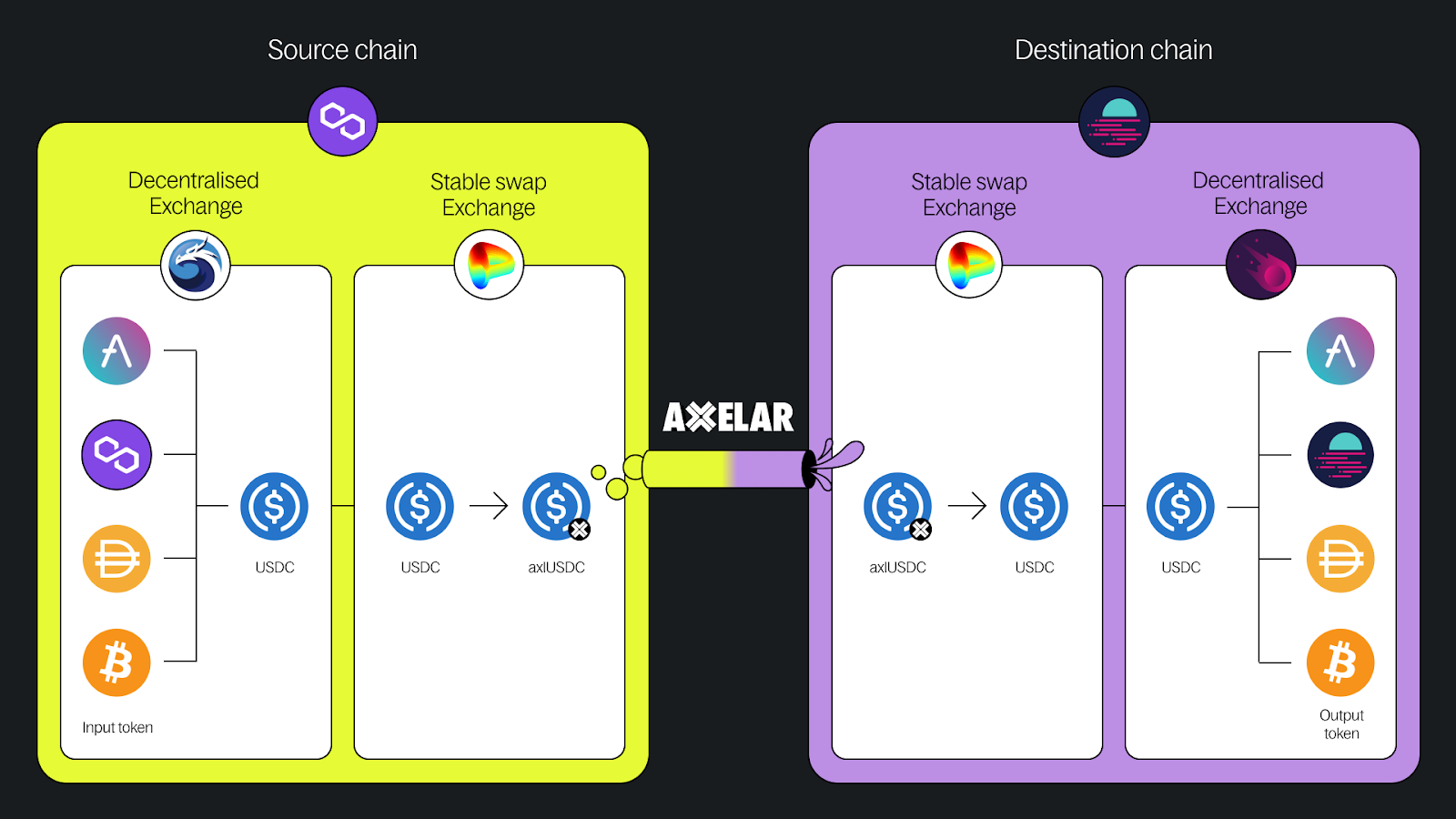 Source: Squid
The latest Boost feature
Squid’s new Boost feature will now improve the cross-chain swap process, the protocol said.
Although the Squid router has simplified the cross-chain swapping experience down to one click, the time to execute these transactions is still slow — ranging anywhere from 20 to 60 minutes.
Boost’s goal is to enable all swaps to occur in under one minute — and as little as two seconds — with the caveat that it is only available for transactions under $20,000.
“Boost is a layer which allows service providers to provide that bridge out of their own inventory almost as a loan, execute the swap immediately, and then when the bridge comes through 20 minutes later, it pays back the service provider instead of now sending to the user again,” Fig said.
Boost itself has received over five audits, and the Axelar bridge has more than 50 audits, Fig noted.
“The important thing is in the design, the risk is only for the service provider providing funds to the user. At no point is the user exposed to losing money compared to what we have in our standard credit protocol,” Fig said.
“The worst thing that can happen is if the service provider tries to censor the transaction, in that case, it falls back elegantly to the previous system…so you will still get your transaction in 20 minutes.”
Get the news in your inbox. Explore Blockworks newsletters:
- The Breakdown: Decoding crypto and the markets. Daily.
- 0xResearch: Alpha in your inbox. Think like an analyst.
