Correlation or Fake Alert? Bitcoin Price Swings on Bank News
Nic Carter says “each bank failure drives the Fed closer to a liquidity bazooka”
Tada Images/Shutterstock, modified by Blockworks
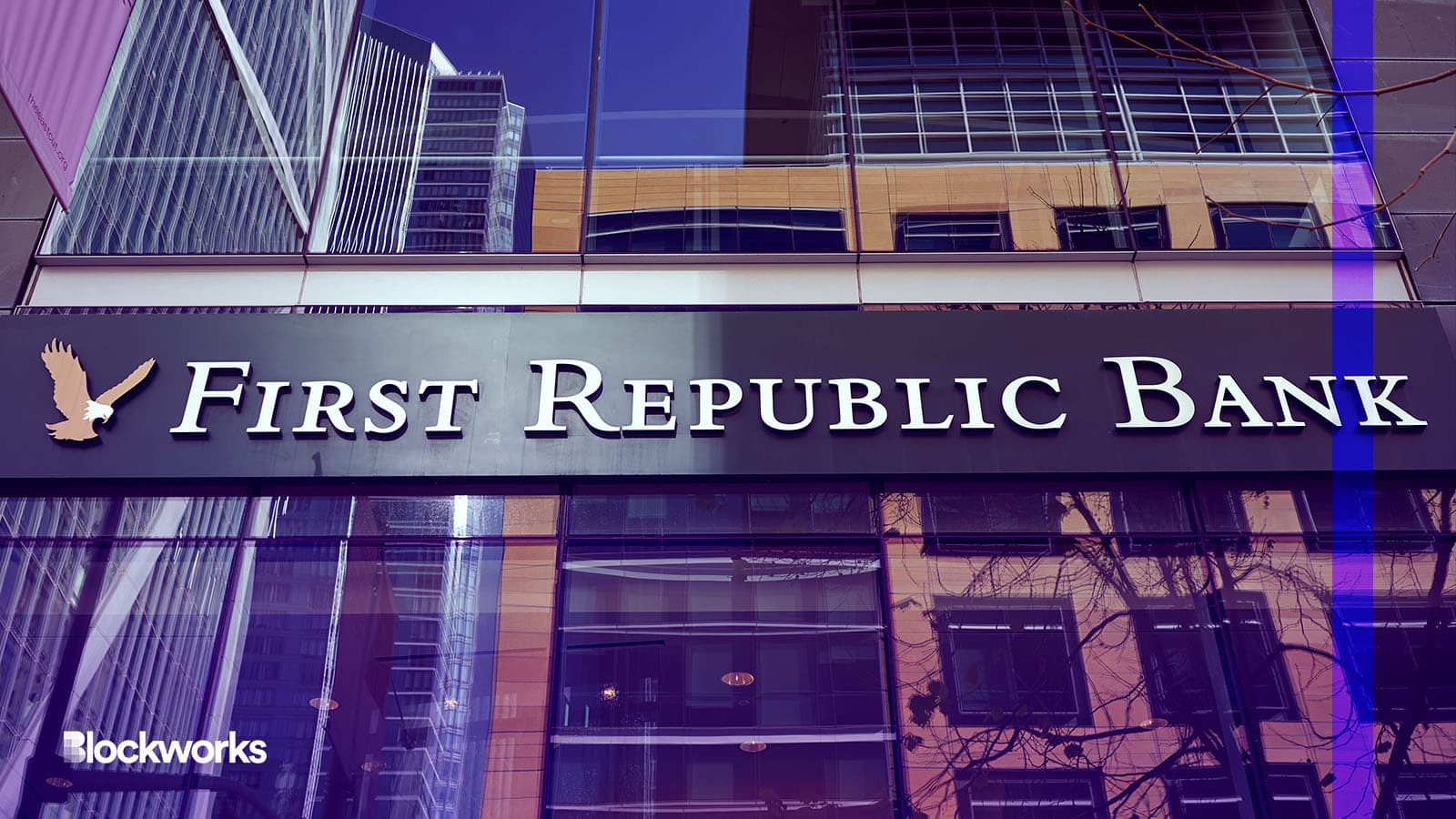
First Republic Bank’s shares recently fell to a new low following their latest quarterly earnings report. It certainly didn’t appear to help share prices when the US government stated they would not step in to help out the ailing bank. But it may have helped the price of bitcoin.
What was once the country’s 14th largest bank now faces the threat of collapse, another in a series of recent failures.
Coincidentally or not, bitcoin (BTC) experienced a brief upswing of nearly 10% immediately following the news before crashing back to previous levels.
The apparent correlation led Nic Carter, general partner at Castle Island Ventures and board chair at Coin Metrics, to tweet, “The fact that bitcoin almost mechanically rallies on news of bank failures is one of the most validating phenomena I’ve experienced in a decade of doing this.”
“I don’t want banks to fail and I’m dismayed at how Fed policy has zombified the sector which will surely retard growth. But having bitcoin act in this manner is remarkable nevertheless.”
On a recent Empire podcast, co-hosts Jason Yanowitz and Santiago Roel Santos discussed the relationship between bank failures and bitcoin’s volatility.
It was “pretty crazy price action,” Yanowitz observes, “Can’t remember a day like that in a while.”
Many market observers were correlating the First Republic fall with a rise in bitcoin buying activity, Yanowitz explains, but a rapid reversal points to what he calls a “fake alert.”
Liquidity has dried up
“This is more a side effect of a low liquidity market.”
Santos comments that with the current low-liquidity conditions of the crypto market, it takes relatively little trading action to cause significant price swings. “That’s just a testament [that] liquidity has really dried up over the last six months.”
This carries over to traditional markets, Santos says, with the growth of retail trading activity and the ease of trading with the click of a button. “Our generation is just more trigger-happy to trade a lot and crypto, obviously, it’s just on steroids.”
“A lot of folks are still sitting on stablecoins,” Santos continues, but they “haven’t really fully deployed.”
“I think they’re using these dips as opportunities to cost their way in.”
How much more can it deteriorate?
Santos found an “interesting piece of language” in the US government’s statements about refraining from helping First Republic Bank. Two words stood out to him: “not currently.”
Santos suggests this may mean the government “will wait for the situation to really, really deteriorate. Although,” he says, “how much more can it deteriorate?”
“The question, of course, then is,” Santos asks, “how bad will it get?”
“If the Fed really will ‘let it die,’ and [they] don’t step in like they did with Lehman and others in the global financial crisis, then what happens?”
Santos says other banks or private equity firms are likely aiming to optimize for the best possible deal when picking up the pieces. “You’re basically trying to take First Republic to the brink of receivership, but not let it go into receivership.”
Yanowitz refers to Carter’s tweets, quoting, “I suspect the reason bitcoin behaves this way is not because of some ‘long bitcoin short the banks’ narrative, but because each bank failure drives the Fed closer to a liquidity bazooka — driving down the denominator in BTCUSD.”
“It all really comes down to liquidity,” Santos says, “As soon as the Fed really dried up liquidity, then you saw a huge correction in markets, including crypto.”
“I think if crypto rallies initially, it’ll be just purely because there’s way more liquidity in the market.”
Yanowitz replies, “Everything pumps and bitcoin is further out on the risk spectrum, so it comes along.”
Get the news in your inbox. Explore Blockworks newsletters:
- The Breakdown: Decoding crypto and the markets. Daily.
- 0xResearch: Alpha in your inbox. Think like an analyst.
