BlackRock CEO Touts Tokenization, Warns US ‘Lagging’ in Innovation
Underlying technologies in the digital assets space could have exciting applications for the asset management industry, according to BlackRock’s Larry Fink
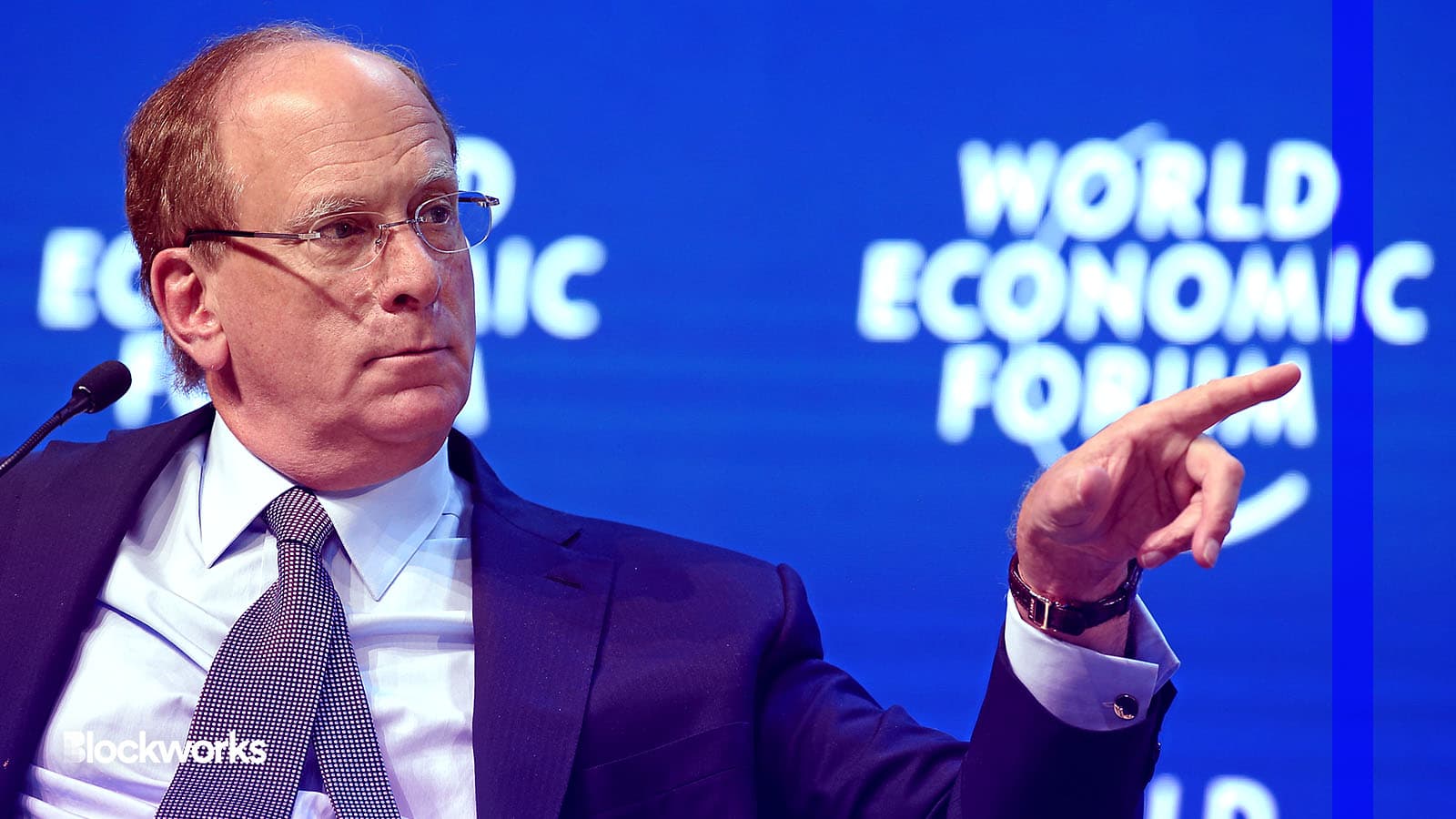
WORLD ECONOMIC FORUM/swiss-image.ch/Photo Moritz Hager, modified by Blockworks (CC BY-NC-SA 2.0)
BlackRock chief Larry Fink highlighted the financial headway taking place in some countries other than the US, which appears to be falling behind in comparison.
In an annual letter to investors published Wednesday, Fink wrote about rising interest in the digital assets space over the past year, even though bankrupt crypto exchange FTX really captured the spotlight.
He called attention to faster and more efficient payments in India, Brazil and parts of Africa. India’s United Payments Interface (UPI), a type of instant-real time payment system, has become a roaring success as it is now one of the most widely-used forms of payment in the country. A similar system in Brazil called Pix has evolved the way locals pay.
“By contrast, many developed markets, including the US, are lagging behind in innovation, leaving the cost of payments much higher,” he said.
Fink oversees the world’s largest asset manager, which has nearly $8 trillion in assets under management. And he believes the asset management industry is yet to utilize some of the most promising technologies in the digital asset space.
Specifically, the tokenization of assets is an attractive use case for the BlackRock CEO because it points to chances of “driving efficiencies in capital markets, shortening value chains, and improving cost and access for investors.”
He said BlackRock continues to explore the digital assets ecosystem, with a special focus on aspects that would drive the most value to clients, like permissioned blockchains and tokenization of stocks and bonds.
Other prominent financial institutions like Goldman Sachs, Hamilton Lane and Siemens have already piqued investor interest by undertaking their own distinct asset tokenization projects. In fact, Hong Kong’s government tapped Goldman Sachs’ tokenization protocol to issue its first tokenized green bond.
This isn’t the first time Fink vocalized his thoughts about the potential of asset tokenization. He addressed the FTX blow-up at the New York Times DealBook Summit in December, saying there were “some misbehavior of major consequences.” And despite the pitfalls associated with the collapse, he said the tech around cryptocurrencies will be “very important” going forward.
“I believe the next generation for markets and next generation for securities will be tokenization of securities,” he said then.
Fink acknowledged that participating in the digital assets industry doesn’t come without risks, and said there is a clear need for regulation in the market as it is yet to fully mature.
Get the news in your inbox. Explore Blockworks newsletters:
- The Breakdown: Decoding crypto and the markets. Daily.
- 0xResearch: Alpha in your inbox. Think like an analyst.
