Less than 10% of all bitcoin trading volume happens in the US: CCdata
US crypto exchanges are trending downwards in terms of bitcoin trading volume since January 2022, with March being an outlier

愚木混株 cdd20/Shutterstock modified by Blockworks
A small fraction of bitcoin trading volume, just 9.49%, exist on registered US crypto exchanges, leaving tons of transactional revenue off the table for platforms like Coinbase and Kraken.
And a newly released report from CCData suggests that American exchanges have been giving up more and more of their share of bitcoin (BTC) trades since at least January 2023, with March being an uncharacteristically good month.
So where is all this bitcoin volume?
The data suggests that bitcoin trading volume, as well as the volume for most other tokens, remains on Binance. In June, users traded $239 billion worth of crypto on Binance’s spot markets, representing a 12.6% jump from May.
Coinbase, which CCData noted represents 61% of bitcoin trading volume among US exchanges, has a much smaller share of the total pie with just $30 billion compared to Binance’s nearly quarter of a trillion.
And Kraken’s total spot trading volume was half that of Coinbase at $16.2 billion.
CCData researchers added the caveat that despite firms like Binance experiencing incremental increases in spot trading recently, “spot trading volumes on centralized exchanges remain at historically low levels, recording the lowest quarterly volumes since Q4 of 2019.”
The data also points to the fact that offshore crypto exchanges are starting to get rewarded in terms of market share. The lawsuits against Binance, Binance.US and Coinbase, however, coincide with a decrease in their market share in June.
Bybit, which is headquartered in Dubai, experienced about a 0.5% and 1.3% increase in market share during June and May, respectively. Bullish and Upbit, both of which reside outside of the US, also saw jumps in their business over the last two months, according to CCData.
However, it’s also important to note that crypto derivatives trading volume is far greater than spot volume, a trend that began in 2021, according to CCData.
In fact, the derivatives made up nearly 79% of the entire crypto market in June. Binance once again captured the majority of it at 56.8%. Kraken is the next closest American competitor to Binance, but doesn’t even come close. Similarly, Coinbase doesn’t even crack the top eight firms in terms of derivatives.
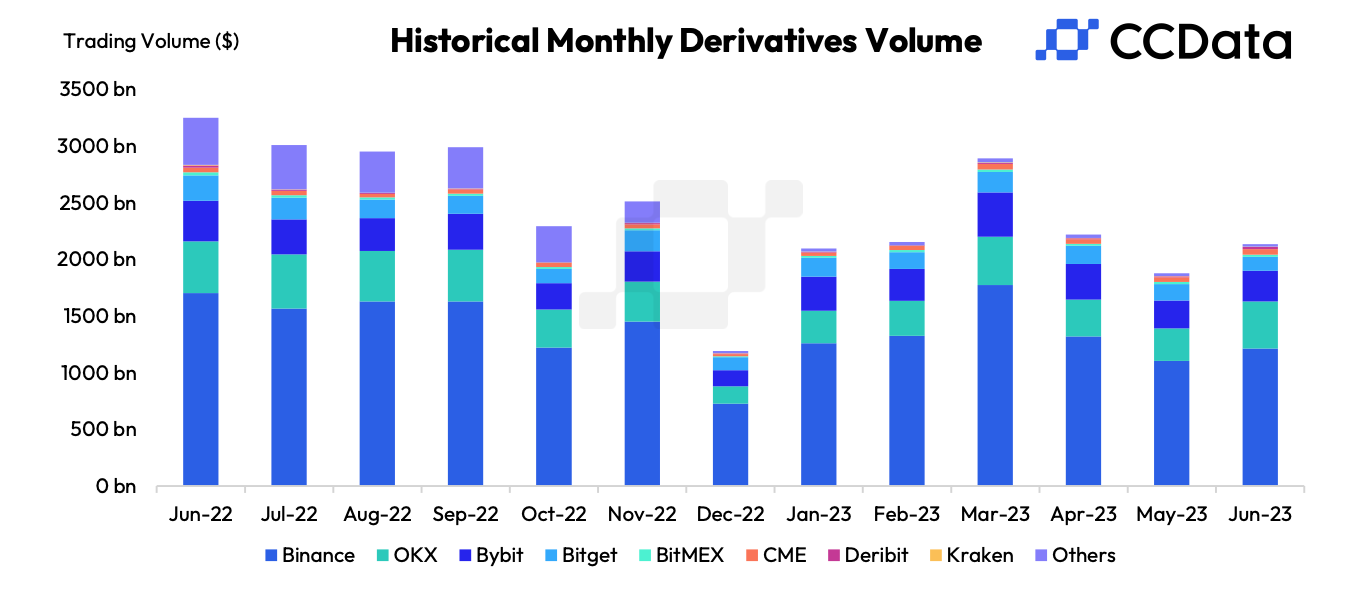 Source: CCData June Exchange Review
After Binance, which notably claims it does not have a static headquarters, the rest of the biggest firms who deal in derivatives are all based outside the US. Seychelles-based OKX had 19.5% of the derivatives market share in June, and in third place was Bybit with 12.6% of the market. Bitget, also registered in Seychelles came in fourth.
Get the news in your inbox. Explore Blockworks newsletters:
- The Breakdown: Decoding crypto and the markets. Daily.
- 0xResearch: Alpha in your inbox. Think like an analyst.
